Saved copy · 6 pages
Matt Sesow (YouTube video interview), shared as "Sesow on YouTube" by Daily Campello Art News
YouTube (Bradley Glanzrock), via Daily Campello Art News blog (video by Bradley Glanzrock; blog post · Video uploaded August 1, 2007; blog post Thursday, August 2, 2007 · original address
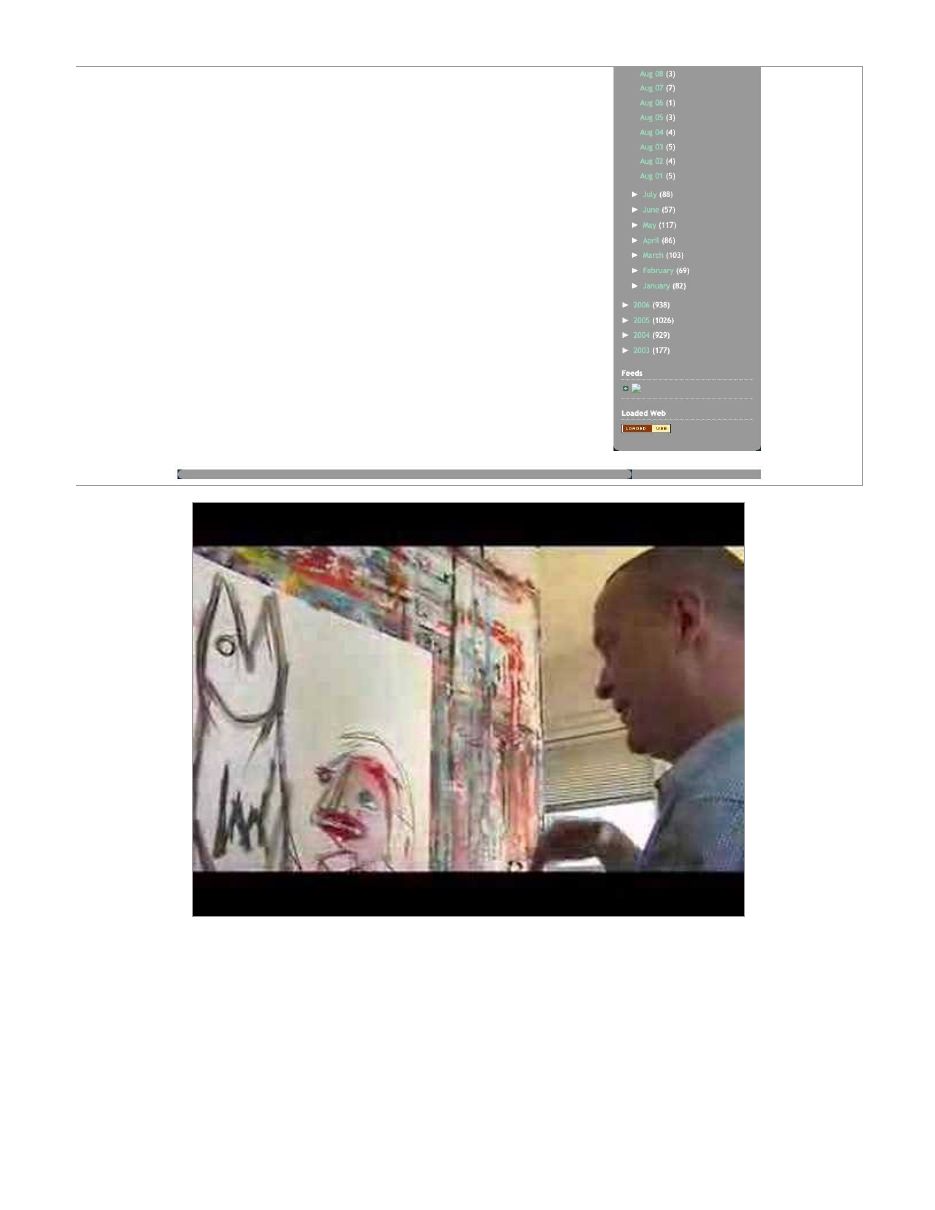
An 8-minute (8:04) video profile filmed in Adams Morgan. Sesow talks about how he started painting

Click a page to open it — scroll or pinch to zoom, drag to move, arrow keys for the next page.
Full text
Full text as published. Copyright remains with the original publisher; reproduced here for the historical record (machine-read pages may contain small errors — check the page images).
Dee ed
ee eer ed
Pe sae ar oa ear
—
[page 2 machine-read (OCR) from the image]
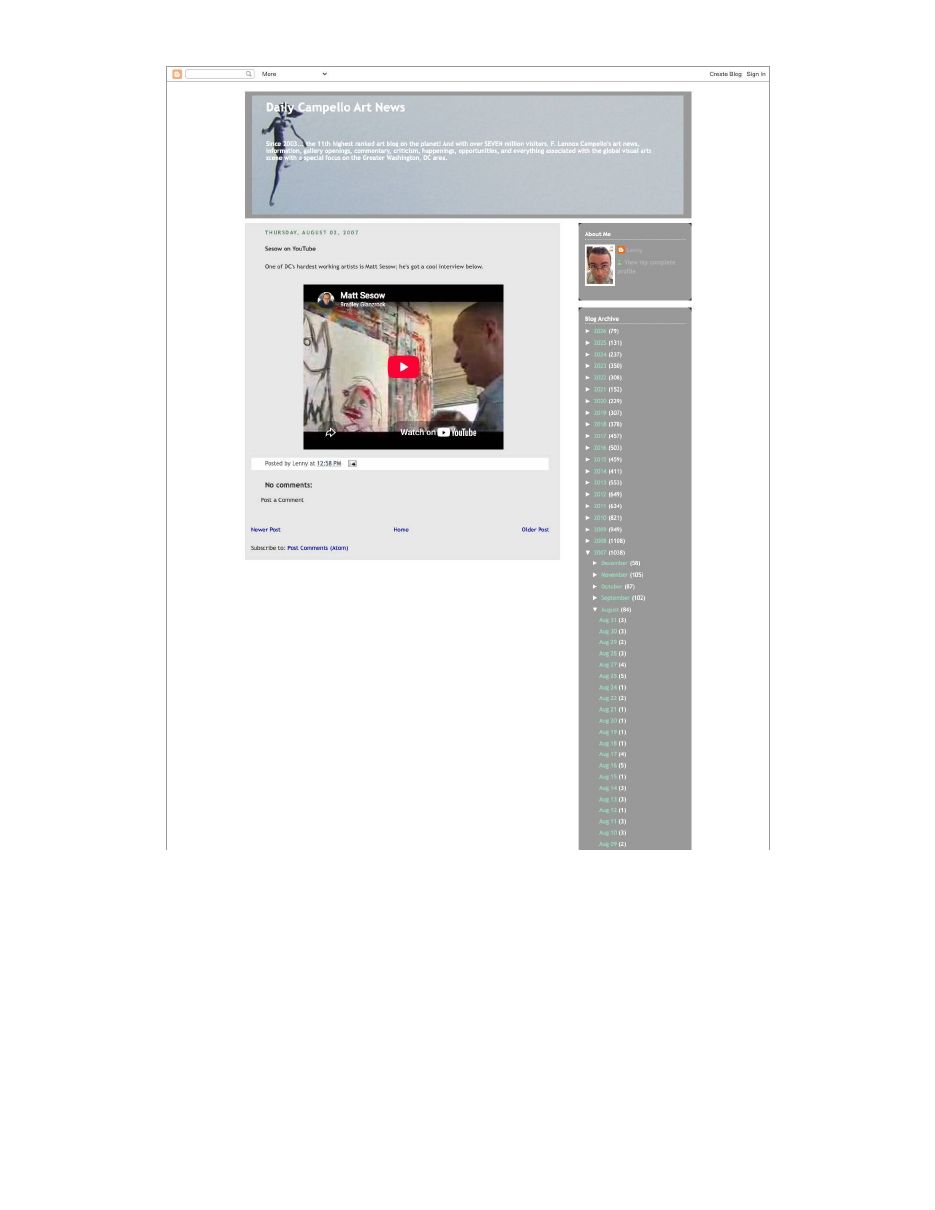
Matt Sesow (YouTube video interview), shared as "Sesow on YouTube" by Daily Campello Art News Blog post (Daily Campello Art News, Thursday, August 02, 2007), as published: Sesow on YouTube One of DC's hardest working artists is Matt Sesow; he's got a cool interview below. YouTube video: "Matt Sesow", uploaded by Bradley Glanzrock, 2007-08-01. Description: Matt Sesow is an established artist in Washington DC, dedicating his life to his art. Watch the story and then check out his site at www.sesow.com TRANSCRIPT (machine-generated from the audio, timestamps mm:ss)
[00:27] I never sat down and said, oh I want to be an artist. I wasn't in high school thinking, oh I want to be cool and set up coffee shops and get tattoos and do a lot of stuff and be cool. But I think that there wasn't really, there was never a desire. I would have rather been in a band than be a painter. But I can't sing and I can't play an instrument. I mean I probably could, but I don't think I would be as satisfied as I am now. Growing up in Nebraska, Matt Sesow studied for and became a computer programmer. With art barely a thought in his mind, it eventually became a main motivation in his life. As it always happens, I met a girl, and trying to impress her, I went, she lived in Mount Pleasant, and I was in Adams Morgan where I'm right now, and I walked over there one night for a date, and she had some of her housemates in the group House, they were art students and they were sitting around a table and they all, you know, fooling around with paint stuff and they asked me, oh, do you paint? And I go, sure, of course. And so that's my first time ever. I started, I mean, I ended up having like, you know, a hundred paintings or more after, you know, like a couple months because I started to deal with some issues of my physical disability that I hadn't really about or thought too much through, and I used the painting as kind of like a vehicle for communication, I guess. [02:02] As a young man, Matt lost most of his left arm after being struck by a plane while playing with his friends on an airport near his home. Because he was so young, Matt was able to adapt and never really held back. But it was his art that shed light on thoughts and emotions he hadn't confronted before. I mean, I didn't take myself seriously at the very beginning. I mean, when I first started painting, it was all about me and all my head and all, you know, just about things that I had been through or whatever. And then kind of what happened is the art, and they write about this, the art can heal. Like the art used as a therapy or art used as a way to deal with trauma and things like that. So I think I painted out a lot of the initial emotions, like they're just out of me now. [02:49] They're really something very comfortable. I don't have nightmares anymore. I mean, it's really amazing how that has gone away. And what I do now more is try to be a little more thoughtful about the painting, like using my lines or my emotion into something that maybe is about the war or wars or about other people's suffering sometimes, maybe not so much mine. And they're not all negative. I mean, I used to get that all the time, all the paintings are sad or angry or mad and it's
really not true. I mean some of them are quite, like they're about survival, they're about rising up, resistance is the one I really like a lot. So I did a lot of political and disability related stuff. So I just kind of took to it and it really provided me with a lot of, I guess a voice or language that I hadn't used before.
[03:45] Matt took to this outlet, eventually trying to share it with others. Yet, with no real background in art education, it has been a learn-as-you-go process, from the beginning and continuing today. Nobody liked it. People were saying, oh, monsters, you know, scary, or whatever, you know, saying how horrible it was. And I agreed with them, you know. I thought my paintings were pretty bad, and all of a sudden this lady just comes out of the blue and about has a heart attack, I guess, and says how I'm this outsider artist or, you know, raw, or I don't know what it was called, folk art, or whatever. And she ended up buying like a bunch of them and then sent me a contract a few weeks later so that she wanted to be my agent. And then what happened like five to six years into it, I started to realize that I was kind of happier painting than I was going to sit in a cube all day. [04:34] So I kind of started to think about how I could maybe make a living out of this. So what I did is I, after I guess the last dot com that I worked for let me go, You know, financial reasons. I decided just to try it, just to work full-time as a painter. People were already there. There was already a market. And then what I was able to do was kind of lower my prices and increase my output. And that seemed to work pretty well. So now it's, what, 2007, and I've been doing it full-time now for, I guess, six years. Since he has been painting full-time, Matt Sesow has been able to invest a lot of effort, experimenting in his style of painting and even distribution.
[05:21] Colors and all that, I mean, since I don't have any art training, I mean, I'm just like, you know, like a self-taught is what they say. I call it self-teaching, because I'm always learning. A lot of my paint just comes right out of the tube or out of the bucket or whatever you want to call it. I don't do a lot of mixing. I don't do a lot of blending or, you know, like rules. I break a lot of rules, I'm sure, with how I use the materials. I'll paint, like let's say I paint all day and into the night and then I'll post my paintings online right away. So I'd put a lot of stuff up on my webpage the day I create it or finish it. And I'll go take a shower and then I'll get out of the shower and it's already sold. That's the difference between what I'm doing with this internet stuff versus the classic painters like a Picasso or something like that, who the gallery had to come by or the agent had to come by and say, oh, what's new, Pablo?
[06:22] He goes, oh, I did this one three weeks ago. And that would probably be considered a new painting. But for me, I did it three minutes ago or 30 minutes ago. And those are the new paintings. The idea of starting to sell his paintings on his own goes into the idea of painting them for himself. Matt feels that you can't just decide to be a painter. It has to be based on thoughts, ideals, and emotions. I just like impact. I like stuff that's really powerful. You know, I don't necessarily like everything I do. I think a lot of my work's crap. But I know that there's a level of effort. If I put the effort into the paintings, then that's not just the painting itself. It's the thinking about the painting or the emotion that goes into the painting, people see that.
[07:11] I mean, it is like a, it's a, I guess a intangible thing that people pick up on when something's rushed or, you know, fake versus something that I've actually like put my heart into. That's what
painting is so much of is, you are alone a lot and, you know, you can try to go out and be a social artist. Like you can, you know, go and go to all the shows and go to do all the coffee shop hanging out, stuff like that. But I think what happens, if you put yourself out there too much, I think it's becomes more