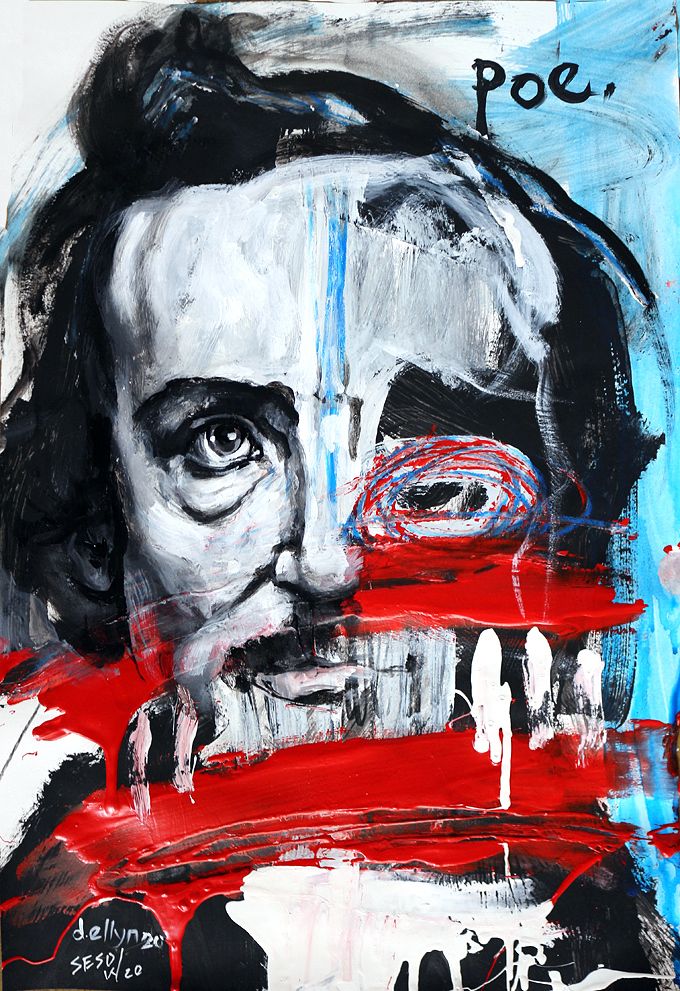
Saved copy · 11 pages
Matt Sesow and Dana Ellyn oral history with Jerry Russo, October 12, 2020
Jerry Russo Oral History Collection of Artists During COVID-19, Robert S. Cox Special Collections and · 2020-10-12 · original address
Video oral history on how COVID-19 affected Matt's and Dana Ellyn's lives and art; released by
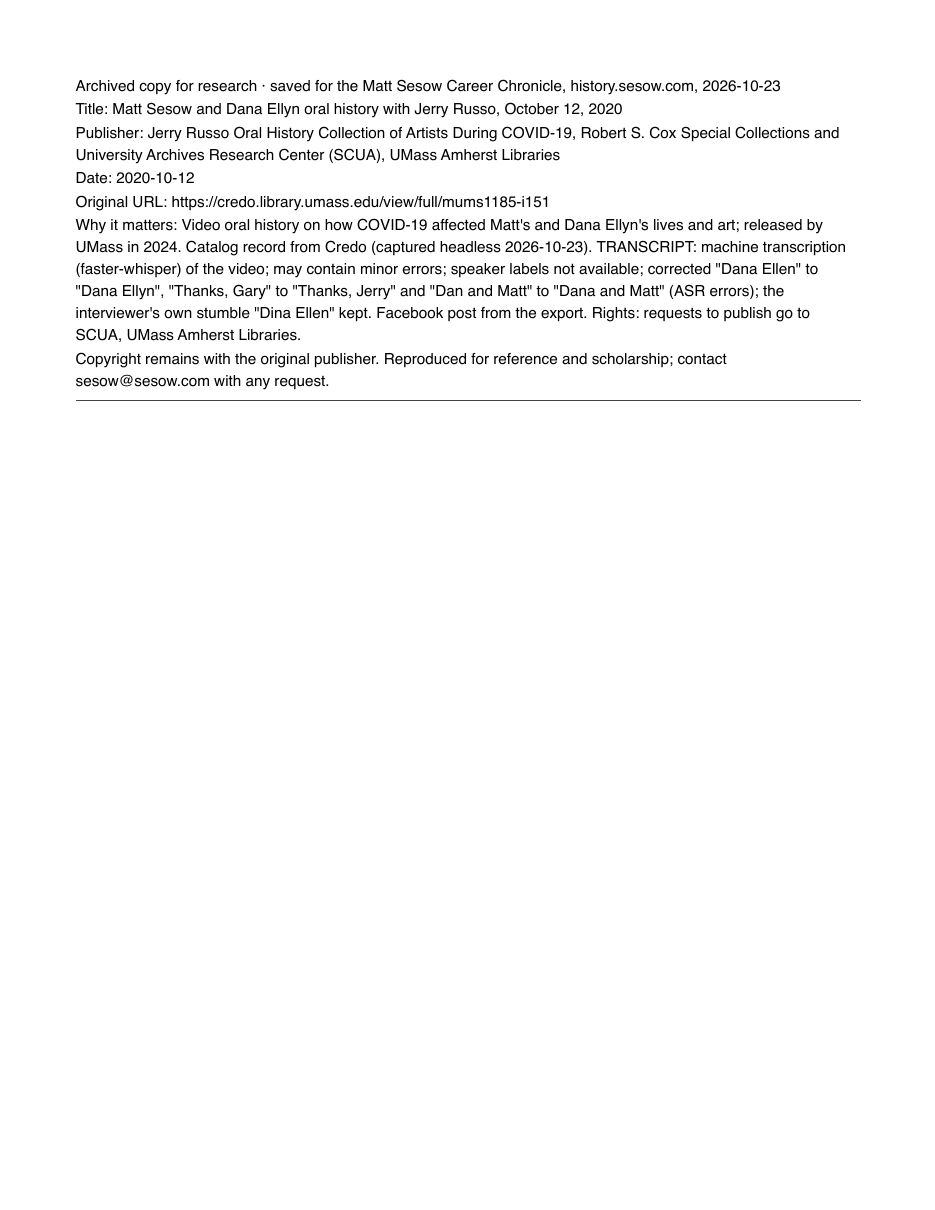
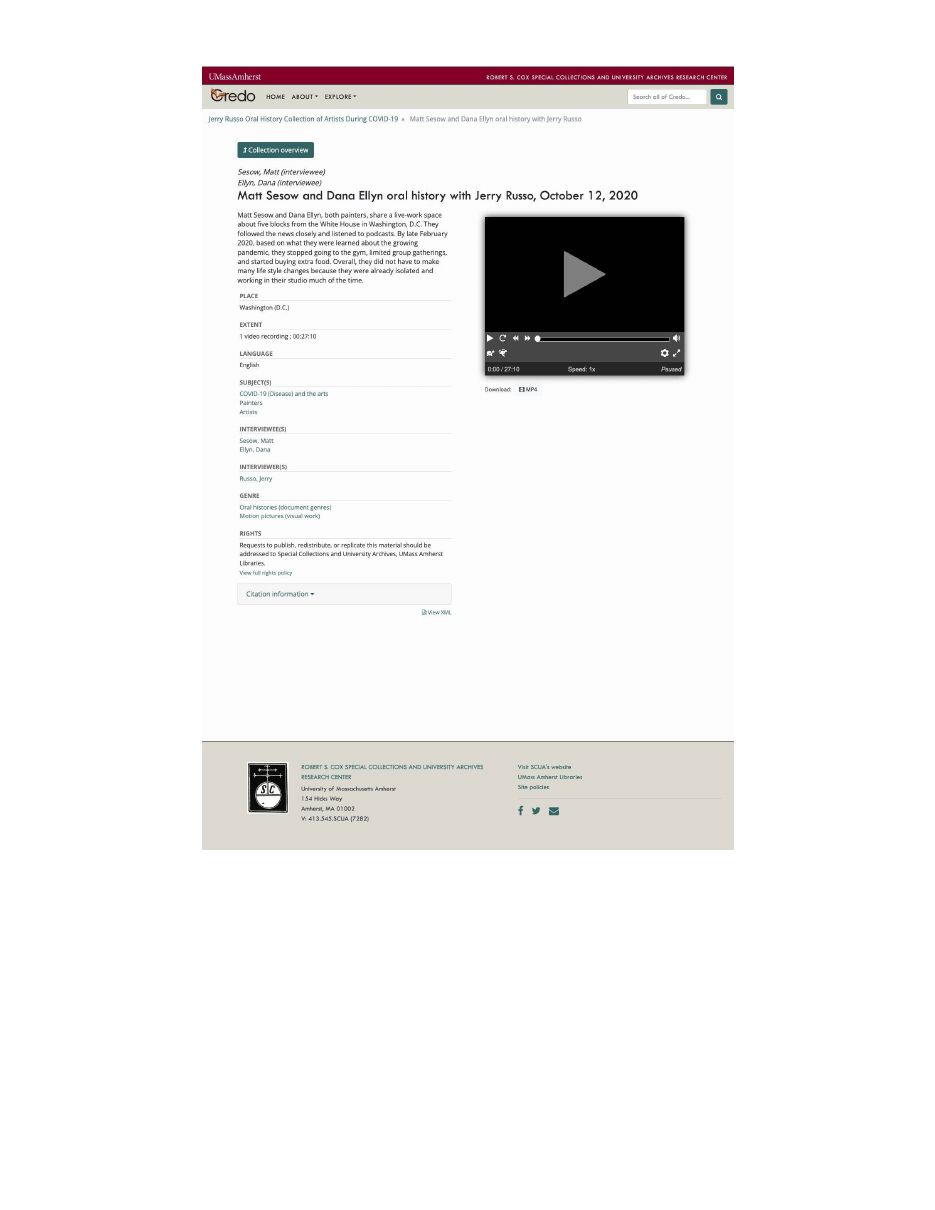
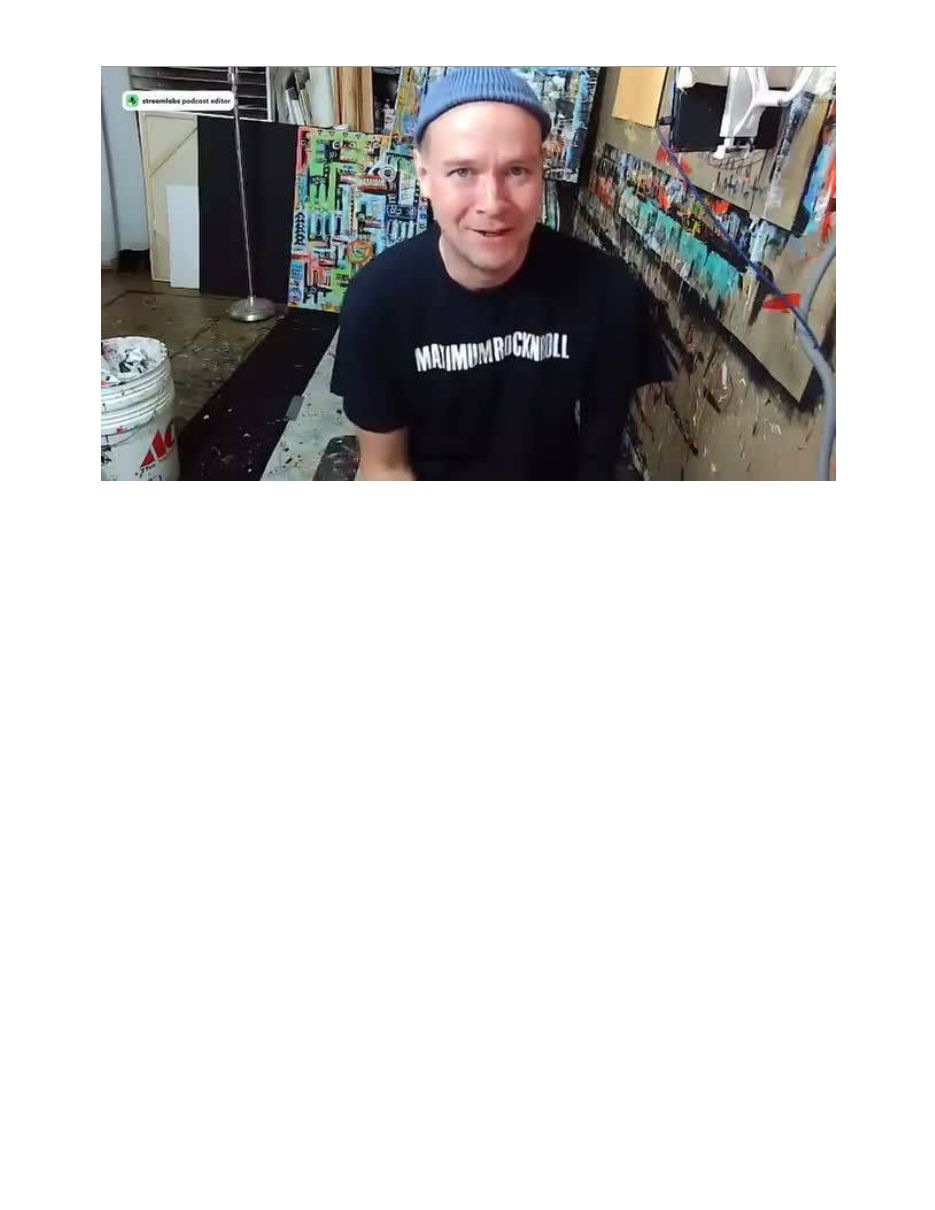
Click a page to open it — scroll or pinch to zoom, drag to move, arrow keys for the next page.
Full text
Full text as published. Copyright remains with the original publisher; reproduced here for the historical record (machine-read pages may contain small errors — check the page images).
Bredo ome saute prow:
‘Matt Sesow and Dana Ellyn oral history with Jerry Russo, October 12, 2020
[page 2 machine-read (OCR) from the image]
Matt Sesow and Dana Ellyn oral history with Jerry Russo, October 12, 2020 CATALOG RECORD:
Matt Sesow and Dana Ellyn oral history with Jerry Russo, October 12, 2020 Matt Sesow and Dana Ellyn, both painters, share a live-work space about five blocks from the White House in Washington, D.C. They followed the news closely and listened to podcasts. By late February 2020, based on what they were learned about the growing pandemic, they stopped going to the gym, limited group gatherings, and started buying extra food. Overall, they did not have to make many life style changes because they were already isolated and working in their studio much of the time. PLACE Washington (D.C.)
EXTENT 1 video recording ; 00:27:10 LANGUAGE English SUBJECT(S)
COVID-19 (Disease) and the arts Painters Artists INTERVIEWEE(S)
Sesow, Matt Ellyn, Dana INTERVIEWER(S)
Russo, Jerry GENRE Oral histories (document genres)
Motion pictures (visual work)
RIGHTS Requests to publish, redistribute, or replicate this material should be addressed to Special Collections and University Archives, UMass Amherst Libraries.
TRANSCRIPT (machine transcription of the 27:10 video recording):
[00:02] Good morning, this is Jerry Russo and I'm doing one-on-one interviews with artists around the world and today I have the honor of being here with friends and fellow artists Matt Sesow, and I'm gonna get this right Dina Ellen Help me here help me My brain is just How are you guys? Good. Thank you. Good. Where are you today? Where are we talking to you at? I'll go ahead. We're in Washington, D.C., downtown. We're, I guess, about five blocks from the White House. And Dana Ellyn is about, I'd say, 15 feet that away, separated by a book case and some curtains. [01:00] We live in the same studio, sleep in the same studio, eat in the same studio. OK, so you've got to kind of like what you call in Boston a live workspace. Yes. OK, so you're really close to the White House. That's pretty insane. I can't imagine what that weird glow coming at night from the dome feels like, you guys. Pretty radioactive stuff. So let's kind of like think about what it's been like for both of you since March, you know, like middle of March when we kind of all knew there was something going on and it was just kind of like, not freaking us out, but it's like, what is going on here? And maybe you can both discuss with us what this has been like for you since then, up till today.
[01:51] I'd say that what you're saying from early March, we started really taking it quite seriously late february um we were already reminiscing about remember the beginning um so it was late february and then this is an experience coming out we had already stopped going to the gym i'd already started with the extreme hand washing and washing the door handle every time we came in the in the house from the outside ordered in our first big block of the rosary kind of preparing for the worst uh that comes somewhat to the fact that the I got interrupted for a second you got you got some like weird echo going on I don't sound this kind of thing.
[02:52] I'm not sure what's going on here, but I just want to be able to hear everything you're saying. And there's some kind of audio thing going on. Try that again. Let's see what happens. Yeah. Yeah. I'm not sure what that is, Matt. Let me hear what it is on your end. Okay, so I'll say that we started really focusing on the coronavirus, I'd say as early as January, because we were big followers of all news sources, we watch BBC, we watch pretty much Amy Goodman just about every morning on Democracy Now, we watch Left leaning, right-leaning. So we tried to take in as many new sources as possible.
[03:42] So we found out, or we were following this pretty much in January and started preparing, I guess you could say, by staying away from groups and not going to the gym anymore in late February. And actually started kind of bulking up on some food and things like that. And just in case the grocery We started looking at the Coronavirus as a potential effect in our lives. [04:32] I, we took action in late February, but really started following it and painting about it in January. Why do you think that was? Because I know here in Boston, Dana, you know, we, we started taking it seriously like mid-March for some reason. I don't know why. And then things just, as you know, became, got on fire, like New York, you know. We up to date have like over 10,000, just about 10,000 people that are here in Massachusetts. But seems like Looks like you guys were a little ahead of the curve. I don't know that that was because of the amount of news that we watched, but as Matt
mentioned, we do immerse ourselves in all the news we can get our hands on and our eyes and ears on. But it's also partly my personal interest in all past pandemics and all things pandemic, all things current events.
[05:19] But I purchased the website bertfluepaintings.com way back when that was our top story and painted about the swine flu. So my personal interest, I read a lot about pandemics, sort of a sick fascination. So when this, even an inkling of this came out, I was like, well, once again, this could be the one. So we took it very seriously from the very beginning, just in case. I mean, it's better to be safe than sorry, cliches abound. But yeah, being the top news story, we paint about the news. So since that's what we heard about, we started painting about it. So I don't think that we heard anything different. DC wasn't having some greater outbreak than anywhere else. It's just under the same roof, divorcing ourselves and stuff all the time.
[06:08] We start talking about it and ideas get flowing maybe sooner than others. So do you guys take public transportation in Washington or do you drive or how does that work? That kind of goes to how much our life hasn't changed since the pandemic. So since we already work from home, we didn't stop taking public transportation. We don't take public transportation. and we walk everywhere, we run everywhere, we have bike share, we take bike share. So our day to day life actually didn't change. We're still in the studio 24 seven as always. We didn't have to make many lifestyle changes in that front. Okay, okay. So let's kind of shift gears a little bit and being that you have your studios at home, so you didn't have to leave your personal space to go out and make work. [06:54] I think what I'd like to do at this point in time, we can talk over this, You guys were both really nice enough to send over some work that you both made during the time we're talking about. So I'd like to share screen with this. And let's see. There we go. And give me a sec here. Anna, can you see this OK? Yes. OK, great. Maybe you can kind of give us an idea of what we're looking at, and we can talk about it a little bit. Sure. This painting is called City Dweller. It's about, yay big, 14 by 18-ish oil on canvas. I painted this. I could probably put a pretty precise date on it. [07:41] Probably May 31st, June 1st, I started it. It was a reaction to George Floyd, the protests that broke out around the country and around the world, Black Lives Matter protests. So DC was hit very hard with the protests. And something we saw firsthand that the news didn't cover very greatly was being that we live ground zero, blocks from the White House, blocks from the Capitol, right in the center of downtown DC, protests were right outside our door. We had to hire an armed guard in our lobby when the protests were happening. We got up every morning to go kind of assess what happened in the neighborhood. We went out in the morning of June 1st, I believe it was, and our entire neighborhood pretty much over 50 to 80% of the windows, Matt, you would say, were broken. [08:35] Stores were looted. There was merchandise all over the ground in front of our building from the store around the corner. Everything was just, it was hard to comprehend the amount of property destruction and spray paint and what had happened overnight. So this is in reaction to that. It's me being my downtown city dweller with my apartment, our physical apartment windows weren't boarded up, but our front door was, with the trying to stay safe, following the news on my laptop. We don't have a dog, we have kitties, but you know, little dog peeking out, but trying to stay safe and
happy inside with my little barbells. Yeah. But yeah, definitely a reaction to the protests that we witnessed here in DC and then witnessed on the news worldwide, but firsthand here. [09:24] Yeah, I mean, we were all seeing this and feeling it in some way or another. I mean, things are going on here in Boston, but nothing like what you're talking about, or like in Portland or other parts of the country. So, yeah, that's pretty radical. I mean, to walk out your front door and to see it firsthand, I mean, and feel it firsthand. I mean, I know I was speaking to somebody in Queens, New York a few weeks ago, and he was telling me that the first three or four weeks in the pandemic, he said, night and day, 24-7, all you heard was sirens, you know? And he said he would sit up on his roof with a six pack and a couple of doobies and just listen to this. And it was just, it would drive you crazy after a while.
[10:12] You know, there was no way to stop it. We were immersed in it, and most of it, oh, go ahead. We also had the National Guard right out, you know, right in our, right outside our building, too. So there were troops here too for a few days, which was rather unsettling. Yeah, it's so radical when you think about all this. It's like all of a sudden you're living in this dystopian dream of some sort. It's just like you're living in the time of not just COVID, but you're living in the time of this country being taken over. It almost felt like it. You know, just, I think this kind of speaks for itself. Yeah, it's called Run and Hide. I like to, I was an art history and fine arts major.
[11:00] So I like to use art history references a lot. And that also encapsulates like movie references, total movie buff, watch classic movies all the time. So this inspired by the birds, Hitchcock's thriller. I've used these kids like stills from the movie, the birds so many times in my paintings to be running from one or another terror that we're facing, right? So little girl running from COVID balls. I did six, seven similar to this piece specifically of COVID balls swooping in and people and children running from them. Yeah. How it sounds like everyone feels like, ah, run for the hills, it's going to get you. Yeah, I have a visceral reaction to this image. I agree with you on the Hitchcock analogy, but also this reminds me of that very famous photographic image from Vietnam when that little girl was running down the road, you know, being affected by napalm, you know?
[11:58] Yeah, you know, I should have used her too. I've used her in the past and other, you know, there's so many historic references, both cultural and, you know, cultural, artistic references and historic references to pull from. So I find that speaks to people much more clearly, like it's familiar first, and then they bring in current events into it. Yeah. You talk about capturing the gaze. I think it's amazing what you got here. This is beautiful. Considering what's going on right now as we speak in Washington at the hearings for the new Supreme Court Justice. Yeah, Supreme Court hearings start today on Amy Coney Barrett, just, what would you say, 10 blocks, 12 blocks in that direction. [12:44] If I lived in a taller floor of this building, I could see the Supreme Court from here. So I have painted, I've been painting Ruth for years and years, of course. It's not, yeah, she's not newly relevant. She's always been relevant. She always will be relevant. Just owed to Ruth, this one is the only one I've done since her passing. I call this one Notorious R.I.P. Yeah, her, gosh, what can I say? There's nothing I can say that could do this justice. It's just the obvious painting at times. Okay, this is, oh, how did I title this one? Well, of course it's Rosie the Riveter. So it's, oh my gosh, help me out here. Rosie the I didn't keep the captions, I'm sorry. I could probably look back on it.
[13:48] I feel like such a dodo right now. Anyway, it's the Rosie the Riveter about doing your part in this war against COVID. So war poster being the cultural references I'm I'm pulling from, where's your Twitter? Do your part, stay at home. All the commercials, there's a PSA that runs all the time on TV, our hashtags alone together, and everyone's saying just stay home, stay safe. So this painting is commenting on that, the idea of doing your part, staying home, staying safe. But have fun doing it, drinking Corona beers for the little funny aside to it. I love that it was titled, I'm sorry, Matt, go ahead. Sorry, I found it. It's called We Can Do It, Stay Home.
[14:34] We can do it. Duh. OK. We can do it. I love that expression alone together. It's an old jazz stand that I was actually listening to it one night a few years ago, and I've done this series for years and years on the public transportation, photographing people with my iPhone. I never named projects, but that seemed so fitting to what that was. I think what we're all going through right now, you know, we're alone in this, but yep, you know, we're together in it. Yeah, in fact, the first painting I did of all of the, I don't know, 50 paintings, some of the paintings I've done about coronavirus and COVID and all of this since the start in February, the first painting I did on the subject, I called it Alone Together.
[15:21] And it might've even been before it became the marketing thing. I just remember working, oh, and there it is, Alone Together. Two roommates, in DC is just full of 20 and 30 something women and men, predominantly women, there's a lot of women here. So just thinking these all these young women in DC who are sharing apartments and they're alone together in their apartment with the Brady Bunch tape line on the floor trying to keep their social distance at home. And the view out the window, if I were to spin my computer right now, that is actually the view out my window from my studio, the one I painted into this painting. And I remember starting at, Matt said when we first started, how we had stopped going to the gym already in I'm pretty serious, because then our gym closed.
[16:25] I haven't seen her since. Yeah, the crow in the mirror or painting, I'm not sure. That was a good call, too. All right. Anything you do is a tattoo. Thanks. Yeah, there's actually a few people have tattoos of my paintings out there on their bodies. I do not have any tattoos or anything in my paintings. But this one's called Socially Undistanced. And I basically did this one recently. I think it was done, when am I looking on my computer here, September. So that was just last month. But it was kind of going into the whole idea where a lot of people were, rightly or wrongly, being criticized for not wearing masks.
[17:17] There's a lot of that going on. I've made this a political issue, a lot of them. One side is wearing masks. Other sides isn't wearing masks. So this is just supposed to be two people who are not socially distancing. And I'm kind of showing that yellow glow around them, how they're kind of in the same zone. So whether or not they're going to be sharing coronavirus or not or any other things is up to debate, I suppose. But it's actually from an original photo of Jerry Lewis, and I have it right here. Is it Dean Martin? Dean Martin, yeah. I've actually done that painting several times, and I've done it probably most every year since 1994 when I started painting.
[18:09] So I just kind of like the expressions. I really love both of those, what those men have done in their careers and stuff. There's really very expressive. So anyways, I use a lot of photos with my
references. OK, so this one is called asymptomatic, I believe. Yes. And the canvas painting, it's kind of a homage to Basquiat. I've done this style several times over the years. It's kind of an idea if you have a left side or right side, and they're imposed over something, where they're, you know, kind of, the idea is always having the figures looking on each other to the center of it. And then this one, there's kind of that, at the bottom you can see like there's a little rabbit or bunny and he has like a red or pink border around him.
[18:59] And he's, I guess, the person in here or the animal, they're animals basically, but it's a person who's asymptomatic and is carrying the virus and everybody's kind of, you know, the idea of the chaos and the freaking out. around that, knowing that there is an asymptomatic carrier in the group. So anyways, I had a lot of my little icons in it too. There's like the upward Phoenix is the kind of the bird on the right. It's like a little skeleton looking thing, and on the left side there's one going down. So the upside is positive, down is negative, you know, whether people are positive or negative, and has the American flag in it. it, little casket there at the bottom in the middle, symbolizing the death. And so it's supposed to be chaotic.
[19:47] Yeah, but yet at the same time, you've created this wonderful syntax to your work. Thank you. I mean, there is definitely a language you've created, whether you want it or not, it's there. Yeah, the rabbit has always meant to me what people know about me or whatever, but I had an accident when I was a child, And that idea is as a child being affected by something and you're innocent. And that's the idea of the rabbit is kind of this little frolicking little creature that is just going about life and maybe something happens to it. But also it's about healing, it's about rising up and not letting whatever it is that happened to you be a crutch or anything, but rather be strong and maybe use it as a way to be stronger. So I'm all about the healing, I'm all about the fighting back and keep going. [20:36] And then that kind of brings us to this one. So this one is called The Protestor. And the idea there is I've done that a lot of times, this image over the years. So a lot of the things I found with the virus and the protests and everything is a lot of it is things that I'd focused on earlier, starting mainly back in the Bush era, one, about wars and being anti-war with my work. And I did The Protestor a lot. done whole shows basically about protesting violence and war. So this is that character reintroduced in the time of coronavirus and just kind of going along what was happening here in DC and continues to go on. Probably this week we'll have some more protesting about the Supreme Court justice. [21:27] Without being political with it too much, I just kind of wanted to mark the time with this icon of the protester. And the idea here is it's, it's the, those are pigtails coming off the top of her head. And that's kind of an iconic reference to Dana Ellyn, my wife who, when I met her, she was wearing pigtails a lot. I wasn't that young. You know what I mean? Usually when you say she was in pigtails, it means I was like 10 when we met. You know, I was 30. She was, yeah, she was 30. That's all right, my wife wears pigtails too, so. Yeah, it's very good. So that's kind of from, you know, references back to that. But anyways, that's that one. OK, then, oh, did we, we're still doing that. OK, so this one is called Social Distancing, I believe. And this is a painting that Dana and I did together. [22:15] So she did the guy in the front, and what's that historical, or what's the? Leonardo da Vinci. Which one? Leonardo da Vinci. Leonardo da Vinci. Leonardo da Vinci's whispering in my computer. And then, so she had done that originally, and then what I did is kind of what we called defile. I take
her work or she'll take my work and add our own spin to it. So I took that, circled the guy with a nice red, put the coronavirus in there with him. So he's kind of protected around that social distancing. And then my little characters are on the outside, like, ooh, don't go down, like my bees. I got a couple of UFOs up there because, you know, this is just a, you know, conspiracy. Is it real, is it not? But I have the phoenix, my little birds on the side are going up in the air, which means, you know, let's power through, let's work this out, let's go.
[23:06] And his little, one of his hands, I guess, or a couple of his hands are poking out of the circle, so maybe he's not social distancing correctly, who knows? So that's what that one means. Okay, now I have to correct myself, I believe it's actually Michelangelo, it's Vitruvius, it's the perfect man. Oh! Michelangelo's, I am terrible. Once I've got like a screen in front of me, my brain just empties. Yeah, I'm just saying, I'm kind of the same way, and I'm not supposed to be, I'm supposed to be. I heard his new professors just took away my A grades. It's not some kind of relationship. You guys seem to be making work that meets the moment. I mean, you continually have done this. It's not like you're doing it for the first time since the pandemic has hit and all the social unrest and the insane craziness coming out of the White House. You know, you have really followed the zeitgeist of what's going on in this country with your work.
[23:57] There's no question about it. At least I get that impression. Yeah, one thing to note is something we mentioned pretty much. It needs to be mentioned in every interview we do. We met back in 2002, right? Was it right after 9-11? 2001, right. And then after 9-11, we were newly dating, split that way, when the war in Iraq started. And I had just quit my job, my full-time job at a law firm. And I'm like, I'm gonna be an artist full-time. And Matt came up with a project for us to do together. He admits later, it was a challenge for me to see what kind of artist I was. And he came up with this project.
[24:42] He came up with the name 31 Days in July, what we did starting in 2003. Every day in July for 31 days in a row, open the newspaper in the morning, look at the news of the day, paint day, 31 days, bang, bang, bang. We did that for 10 years straight. So each of us have a set of paintings, of 310 paintings, one month every year as a time capsule of the news. And we did it for 10 years. We thought when we started it, we'll do it until the war ends. Since that was kind of a fuzzy date, we decided at a decade of the project that we would call it a decade of a time capsule. So yeah, and prior to that, Matt was always painting about the news on his own and before we met each other. But yeah, this is not something new for us to be commenting and painting and reacting to what's going on in the world via our art.
[25:30] Yeah, and that's so perfect. I mean, it's so cathartic for you guys to be able to do this every day. It's like what I'm doing with these interviews. I just needed something to kind of get me through the moment of what we're going through. Yeah, I mean, that's one of the things that I always say about my art is art is healing, And you can use it to get through things that maybe we're not able to communicate with words. Kind of like with music, too, that's said a lot that a lot of music is used as a communication tool. But for me, visual is creating a painting that maybe while I'm painting it, I'm really thinking about how I feel about something.
[26:15] And I leave those emotions on the canvas. That way I don't have to carry it into the rest of my life. That's kind of the idea. So I've always used exercise and painting as kind of a therapy for myself and I find it very useful. Dana and Matt, I want to thank you so much for being part of this oral history in the time of the pandemic. I can't thank you enough, both of you. It was really nice meeting you both. Yeah, you too. Thank you. You got a big fan here in Boston. I'm the president of your fan club here, for sure. Maybe I'll see you again when this is all over. I'll take a trip into Washington. Yeah, I think we're all anxious to go take a trip somewhere. Absolutely.
[27:00] Anywhere. That and that, thank you. Have a great day. Thanks, Jerry. Thanks so much. Byebye now. Bye. Facebook posts by Matt Sesow:
2024-05-02 11:26 ET: JUST RELEASED: Here's a video interview Dana Ellyn and myself gave to Jerry Russo of the University of Mass Amherst on how COVID -19 effected our lives and art on October 12, 2020:
https://credo.library.umass.edu/view/full/mums1185-i151