
Saved copy · 4 pages
zoomable page images

Click a page to open it — scroll or pinch to zoom, drag to move, arrow keys for the next page.
The full text of this page is printed above, under “Text of the original page”, with the machine-read text of its clippings.
Full text
Text taken from the saved copy (where a page was only an image, it was machine-read and may contain errors — check against the page image before quoting). Copyright remains with the original publisher; kept for the historical record.
116126,7:06 AM ‘Sesow's “Enron” painting in Nonprofit magazine, 2002
this page:
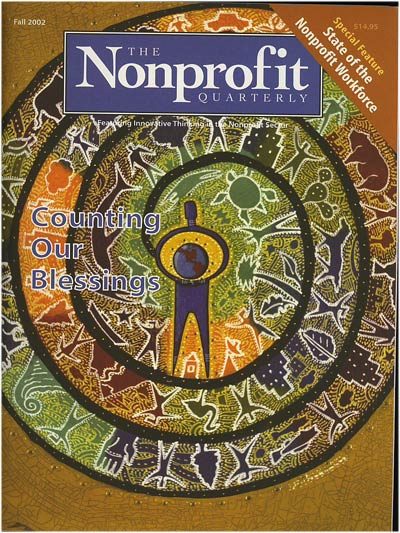
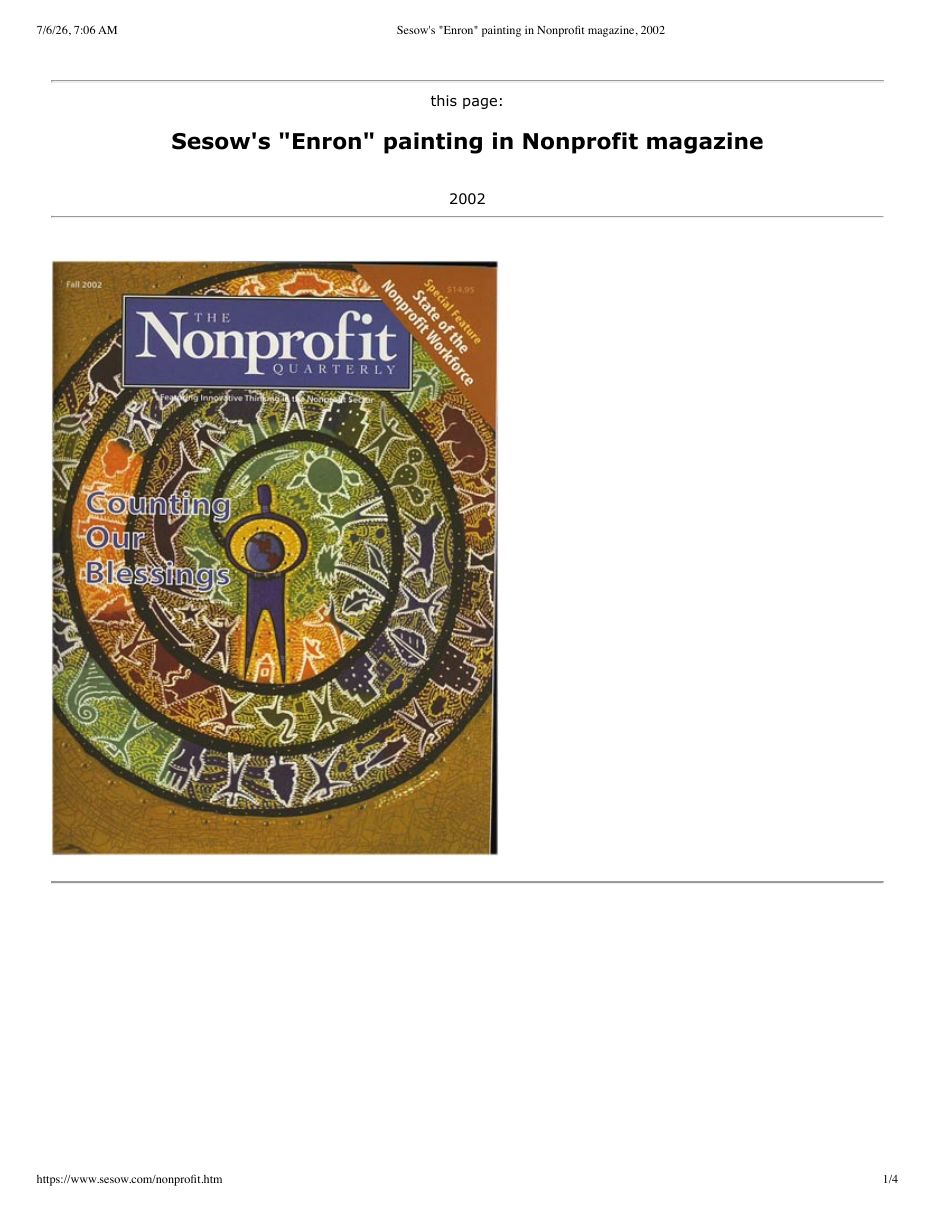
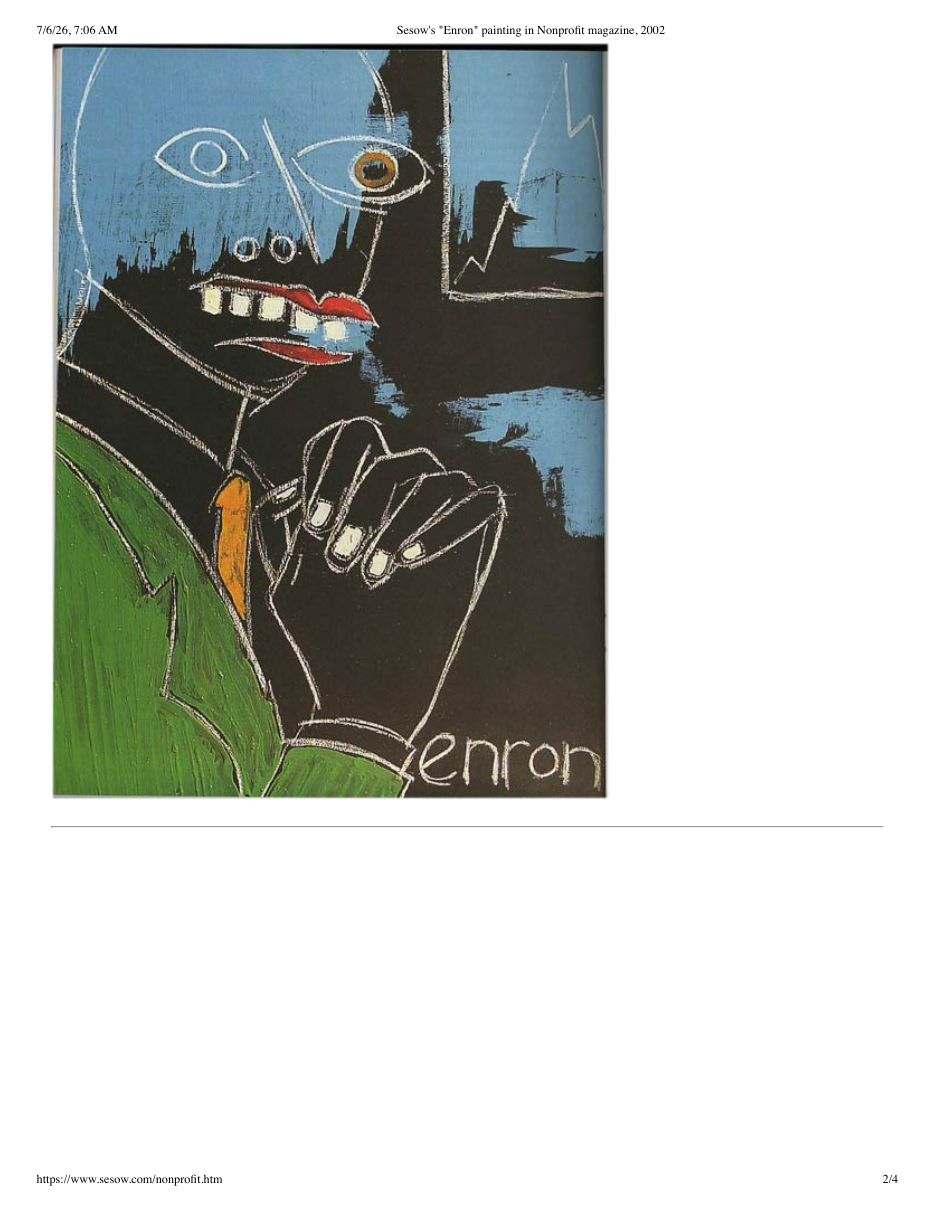
Sesow's "Enron" painting in Nonprofit magazine
2002
op
aa %
3%,
batps:/www.sesow.com/nonprofit htm a
[page 1 machine-read (OCR) from the image]
7/6/26, 7:06 AM
https://www.sesow.com/nonprofit.htm
Sesow's "Enron" painting in Nonprofit magazine, 2002
2/4
116126,7:06 AM
‘Sesow's “Enron” painting in Nonprofit magazine, 2002
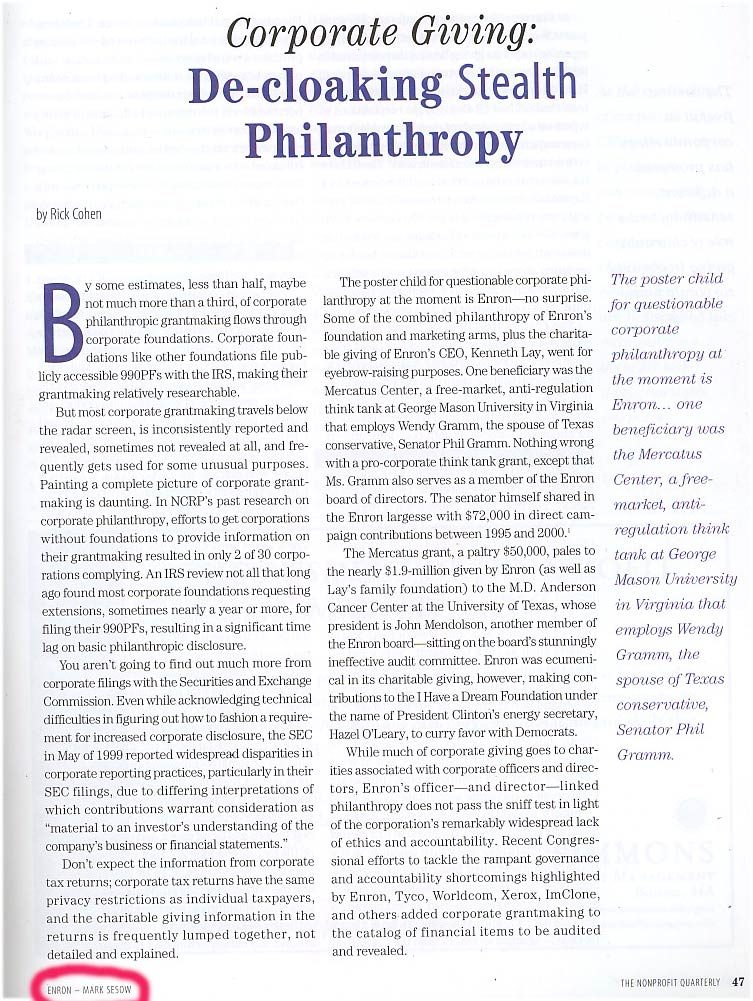
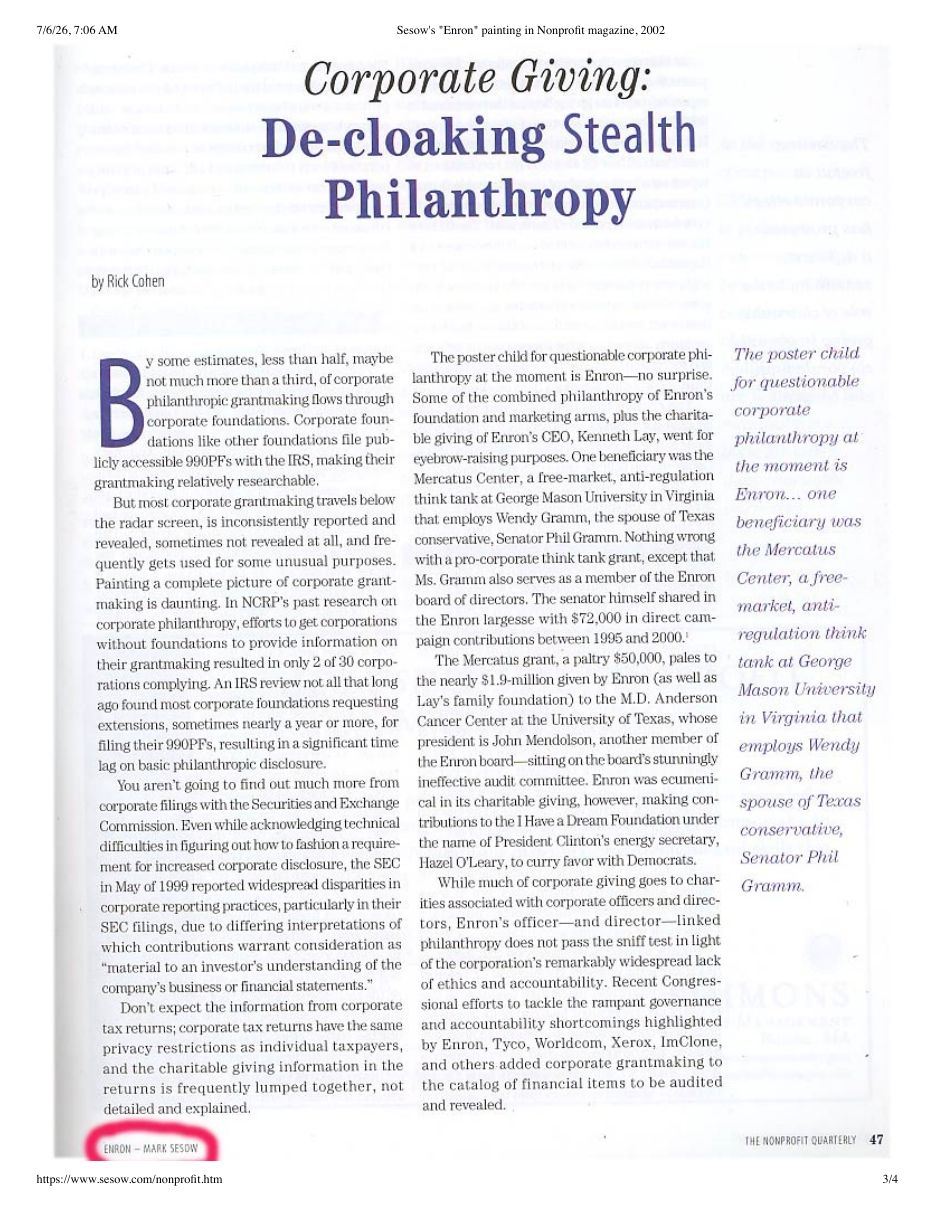
Corporate Giving:
De-cloaking Stealth
Philanthropy
by Rick Cohen
Y some estimates, less than half, maybe
not much more than a third, of corporate
philanthropic grantmaking flows through
corporate foundations. Corporate foun-
dations like other foundations file pub-
licly accessible 990PFs with the IRS, making their
grantmaking relatively researchable,
But most corporate grantmaking travels below
the radar screen, is inconsistently reported and
revealed, sometimes not revealed at all, and fre-
quently gets used for some unusual purposes.
Painting a complete picture of corporate grant-
making is daunting. In NCRP’s past research on
corporate philanthropy, efforts to get corporations
without foundations to provide information on
their grantmaking resulted in only 2 of 30 corpo-
rations complying. An IRS review not all that long
ago found most corporate foundations requesting
extensions, sometimes nearly a year or more, for
filing their 990PFs, resulting in a significant time
Jag on basic philanthropic disclosure.
You aren't going to find out much more from
corporate filings with the Securities and Exchange
Commission, Even while acknowledging technical
difficulties in figuring out how to fashion a require-
‘ment for increased corporate disclosure, the SEC
in May of 1999 reported widespread disparities in
corporate reporting practices, particularly in their
SEC filings, due to differing interpretations of
which contributions warrant consideration as
“material to an investor's understanding of the
company’s business or financial statements.”
Don’t expect the information from corporate
tax returns; corporate tax returns have the same
privacy restrictions as individual taxpayers,
and the charitable giving information in the
returns is frequently lumped together, not
Jed and explained.
I a. vane on
bntps:/ www sesow.com/nonprofit htm
‘The poster child for questionable corporate phi-
lanthropy at the moment is Enron—no surprise.
Some of the combined philanthropy of Enron's
foundation and marketing arms, plus the charita-
le giving of Enron's CEO, Kenneth Lay, went for
eyebrow-raising purposes. One beneficiary was the
Mercatus Center, a free-market, anti-regulation
think tank at George Mason University in Virginia
that employs Wendy Gramm, the spouse of Texas
conservative, Senator Phil Gramm. Nothing wrong
with a pro-corporate think tank grant, except that
Ms. Gran also serves as a member of the Enron
board of directors, The senator himself shared in
the Enron largesse with $72,000 in direct cam-
paign contributions between 1905 and 2000.
‘The Mercatus grant, a paltry $50,000, pales to
the nearly $1.9-million given by Enron (as well as
Lay's family foundation) to the M.D, Anderson
Cancer Center at the University of Texas, whose
president is John Mendolson, another member of
the Enron board—sitting on the board's stunningly
ineffective audit committee. Enron was ecumeni-
cal in its charitable giving, however, making con-
tributions to the I Havea Dream Foundation under
the name of President Clinton's energy secretary,
‘Hazel O'Leary, to curry favor with Democrats.
While much of corporate giving goes to char-
ities associated with corporate officers and direc-
tors, Enron’s officer—and director—linked
philanthropy does not pass the sniff test in light
of the corporation's remarkably widespread lack
of ethics and accountability. Recent Congres-
sional efforts to tackle the rampant governance
and accountability shortcomings highlighted
by Enron, Tyco, Worldcom, Xerox, ImClone,
and others. added corporate grantmaking to
the catalog of financial items to be audited
and revealed.
The pr
for questionable
rv child
corporate
philanthropy at
the moment is
Enron... one
beneficiary was
the Mercatus
Center, afi
market, anti-
regulation think
tank at George
Mason University
in Virginia that
employs Wendy
Gramm, the
spouse of Texas
conservative,
Senator Phil
Gramm.
HENOMPROFT quaRTERLY 47
34
[page 3 machine-read (OCR) from the image]
7/6/26, 7:06 AM
Sesow's "Enron" painting in Nonprofit magazine, 2002
CLICK HERE FOR MORE PAINTINGS...
https://www.sesow.com/nonprofit.htm
4/4