

Saved copy · 11 pages
zoomable page images


Click a page to open it — scroll or pinch to zoom, drag to move, arrow keys for the next page.
The full text of this page is printed above, under “Text of the original page”, with the machine-read text of its clippings.
Full text
Text taken from the saved copy (where a page was only an image, it was machine-read and may contain errors — check against the page image before quoting). Copyright remains with the original publisher; kept for the historical record.
7/6/26, 7:05 AM
Sesow's paintings in "Revelations and Reflections"
this page:
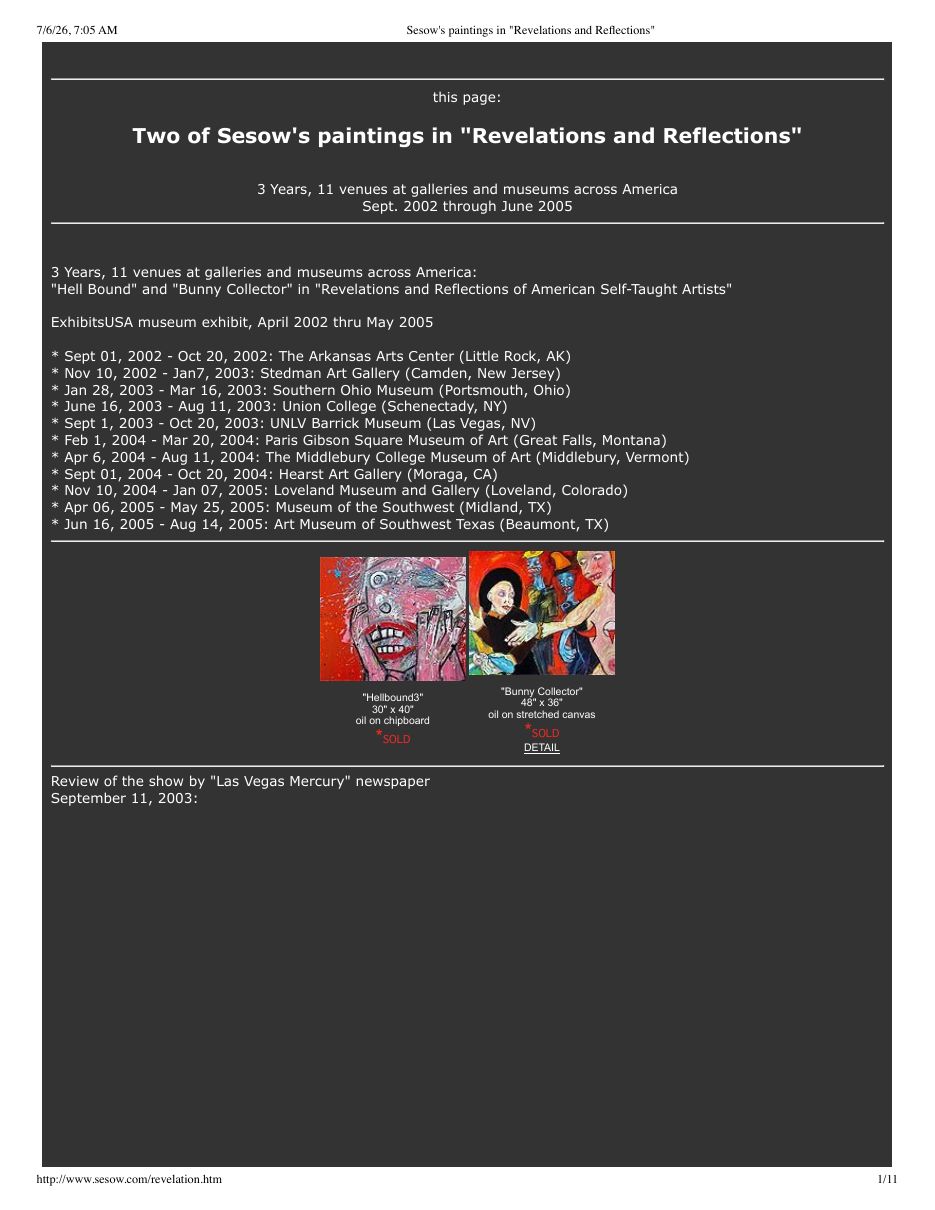
Two of Sesow's paintings in "Revelations and Reflections"
3 Years, 11 venues at galleries and museums across America
Sept. 2002 through June 2005
3 Years, 11 venues at galleries and museums across America:
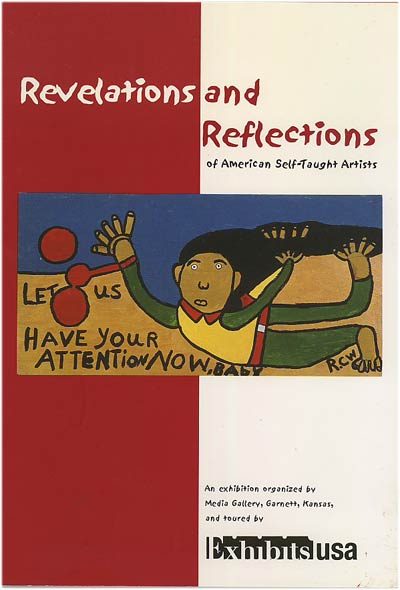
"Hell Bound" and "Bunny Collector" in "Revelations and Reflections of American Self-Taught Artists"
ExhibitsUSA museum exhibit, April 2002 thru May 2005
* Sept 01, 2002 - Oct 20, 2002: The Arkansas Arts Center (Little Rock, AK)
* Nov 10, 2002 - Jan7, 2003: Stedman Art Gallery (Camden, New Jersey)
* Jan 28, 2003 - Mar 16, 2003: Southern Ohio Museum (Portsmouth, Ohio)
* June 16, 2003 - Aug 11, 2003: Union College (Schenectady, NY)
* Sept 1, 2003 - Oct 20, 2003: UNLV Barrick Museum (Las Vegas, NV)
* Feb 1, 2004 - Mar 20, 2004: Paris Gibson Square Museum of Art (Great Falls, Montana)
* Apr 6, 2004 - Aug 11, 2004: The Middlebury College Museum of Art (Middlebury, Vermont)
* Sept 01, 2004 - Oct 20, 2004: Hearst Art Gallery (Moraga, CA)
* Nov 10, 2004 - Jan 07, 2005: Loveland Museum and Gallery (Loveland, Colorado)
* Apr 06, 2005 - May 25, 2005: Museum of the Southwest (Midland, TX)
* Jun 16, 2005 - Aug 14, 2005: Art Museum of Southwest Texas (Beaumont, TX)
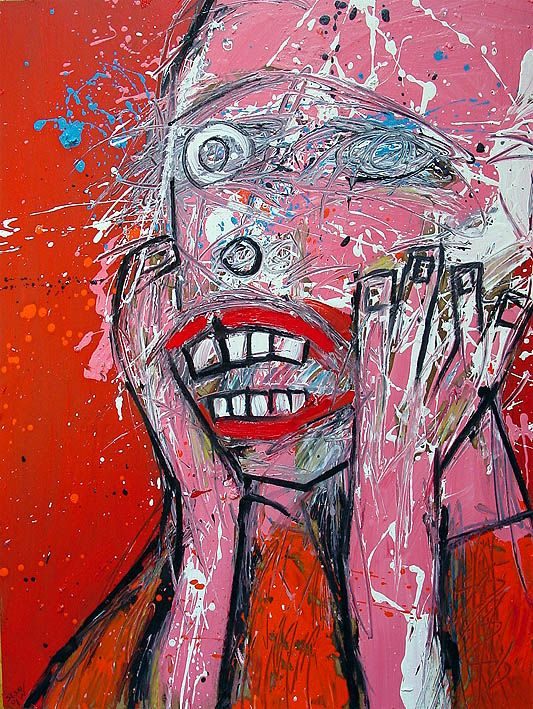
"Hellbound3"
30" x 40"
oil on chipboard
*SOLD
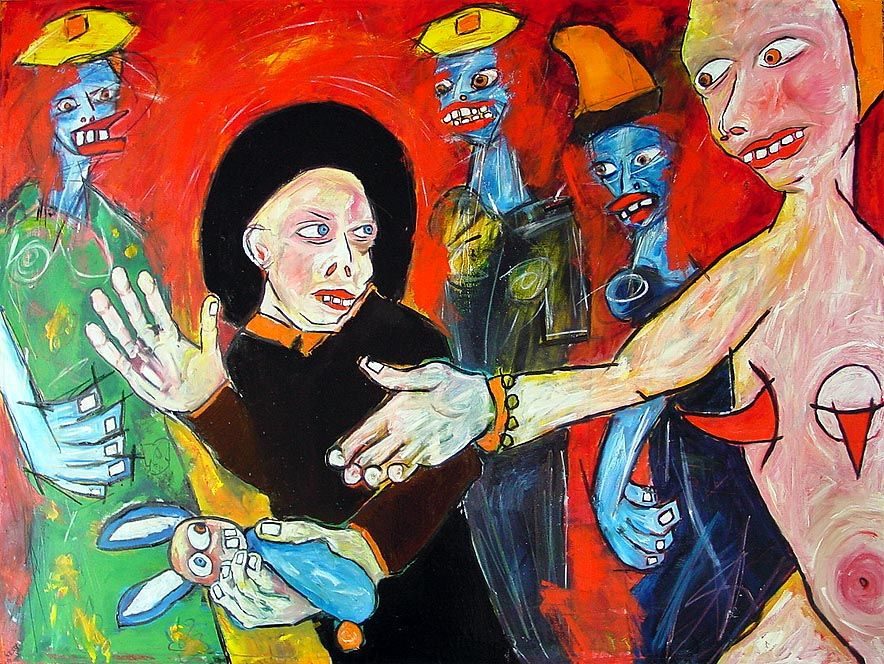
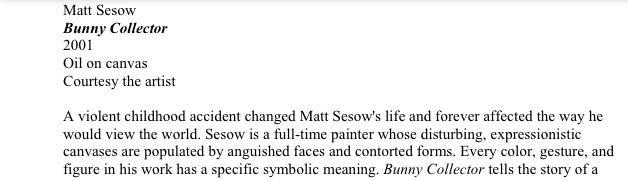
"Bunny Collector"
48" x 36"
oil on stretched canvas
*
SOLD
DETAIL
Review of the show by "Las Vegas Mercury" newspaper
September 11, 2003:
http://www.sesow.com/revelation.htm
1/11
7/6/26, 7:05 AM
http://www.sesow.com/revelation.htm
Sesow's paintings in "Revelations and Reflections"
2/11
btp:/www.sesow.com/tevel
‘Sesow's paintings in "Revelations and Reflections"
‘Thursday, September 11, 2003
Copyright © Las Vegas Mercury
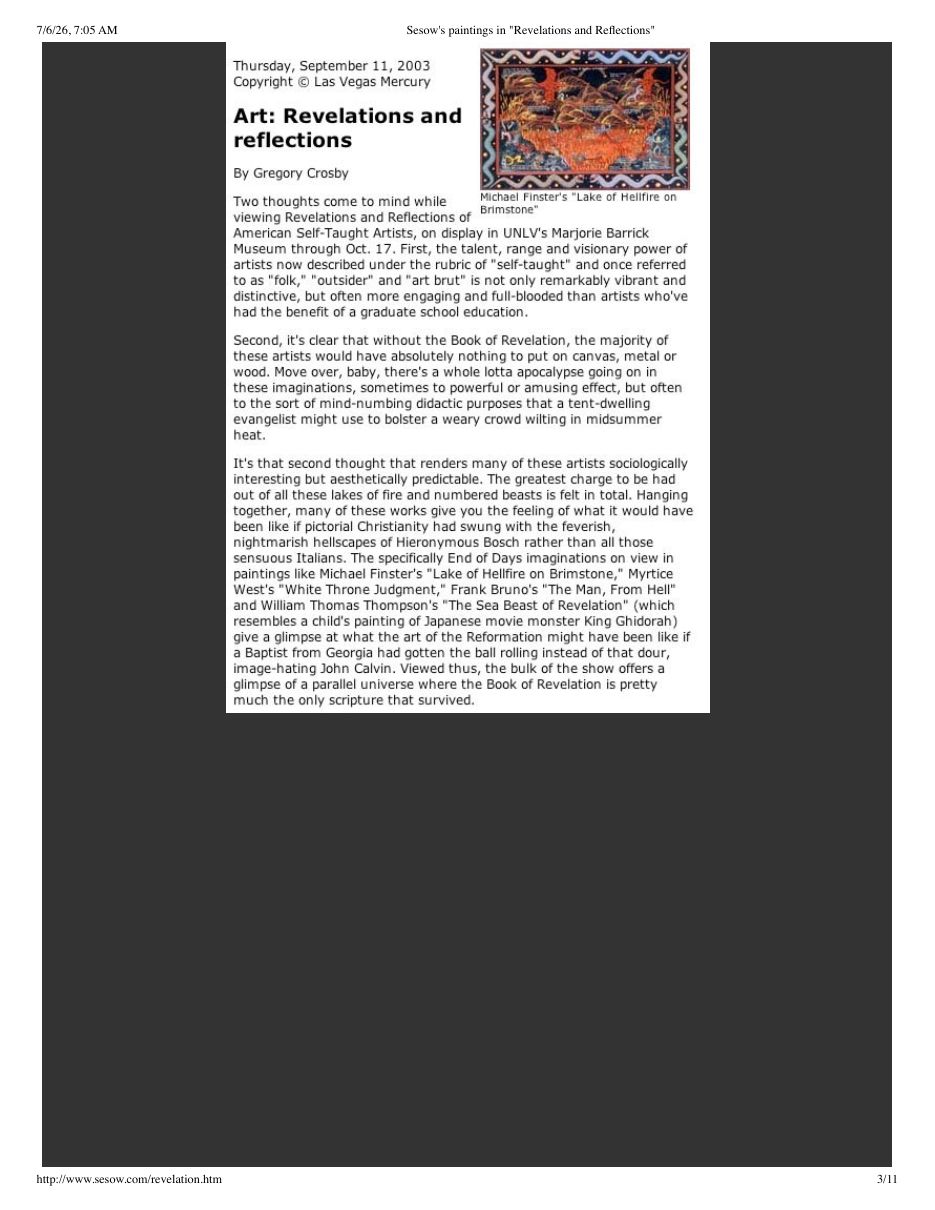
Art: Revelations and
reflections
By Gregory Crosby
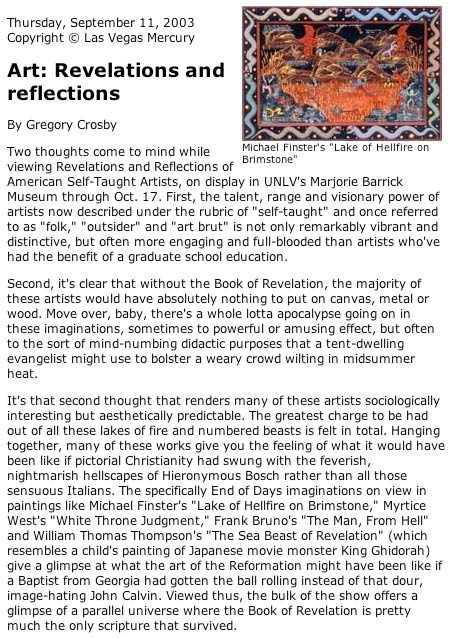
Michael Finster's "Lake of Hellfire on
Two thoughts come to mind while Michael Fi
viewing Revelations and Reflections of
American Self-Taught Artists, on display in UNLV's Marjorie Barrick
Museum through Oct. 17. First, the talent, range and visionary power of
artists now described under the rubric of "self-taught" and once referred
to as "folk,” “outsider” and "art brut” is not only remarkably vibrant and
distinctive, but often more engaging and full-blooded than artists w
had the benefit of a graduate school education.
Second, it’s clear that without the Book of Revelation, the majority of
these artists would have absolutely nothing to put on canvas, metal or
wood. Move over, baby, there's a whole lotta apocalypse going on in
these imaginations, sometimes to powerful or amusing effect, but often
to the sort of mind-numbing didactic purposes that a tent-dwelling
evangelist might use to bolster a weary crowd wilting in midsummer
heat.
It's that second thought that renders many of these artists sociologically
interesting but aesthetically predictable. The greatest charge to be had
out of all these lakes of fire and numbered beasts is felt in total. Hanging
together, many of these works give you the feeling of what it would have
been like if pictorial Christianity had swung with the feverish,
nightmarish hellscapes of Hieronymous Bosch rather than all those
sensuous Italians. The specifically End of Days imaginations on vie
paintings like Michael Finster's “Lake of Heliire on Brimston
West's "White Throne Judgment,” Frank Bruno's "The Man, From Hell"
and William Thomas Thompson's "The Sea Beast of Revelation"
resembles a child's painting of Japanese movie monster King Ghidorah)
give a glimpse at what the art of the Reformation might have been like if
a Baptist from Georgia had gotten the ball rolling instead of that dour,
image-hating John Calvin. Viewed thus, the bulk of the show offers a
glimpse of a parallel universe where the Book of Revelation is pretty
much the only scripture that survived.
[page 3 machine-read (OCR) from the image]
‘Sesow's paintings in "Revelations and Reflections"
‘The reasons for this are simple. As Stephen King once remarked about
Tolkien, "He's a lot better at evoking the dread of Mordor than the
goodness of Gandalf.” Hell, as usual, is a lot more fun to depict than
heaven, and devils are always more fascinating than Jesus (who only has
a few odd cameos in this show), though a few artists pitch the sweetness
of salvation rather than the terror of damnation: Wanda Tee's joyous
uplifting hands in “I'll Fly Away Some Day," Mary Proctor's shiny found
s recast as "Heavenly Choir in Gold” and Woodie Long's delicate
wave-like swirl of celestials, "The Angels Heard the Music.” But it's Old
Scratch who, just like in Paradise Lost, gets pride of place, along
his progeny: O.L. Samuels’ "Devil Dog,” a glittering pit bull with
greyhound legs, or Lorenzo Scott's "Devil Family at Art Gallery
thin family of rather nondemonic devils tours a museum filled
paintings of other nice, respectable-looking devils. Only Hope Atkinson’
"One Day at a Time” seems to strike the right balance: A set-upon
woman is harried by far more tiny devils than attended by angels that
hover, eyes closed, above her head.
A viewer might think this effusion of religious artwork denotes some
cultural divide, the regular folk clinging to a Deep South Protestant way
of being in the world that’s far removed from the secular art world that
dumped Christian-themed art around a century ago in favor of the brittle
branches of modernity. There's some truth to that, but the real answer
lies in the artist biographies that accompany each piece. Again and again,
according to the wall texts, it's a wound that has made an artist:
sickness, injury and sorrow, followed by a revelatory vision that leads the
person to paint or sculpt
The theme is so prevalent, so tidy, that one begins to distrust the:
as somehow eliding the truth in favor of making these “outsiders” even
more so. But the proof of this seeming cliché is in the art itself. No one
viewing the serpentine, text-laden self-portraits of Jane “in Vain"
Winkleman as she wrestles with Death and Evil is likely to doubt the
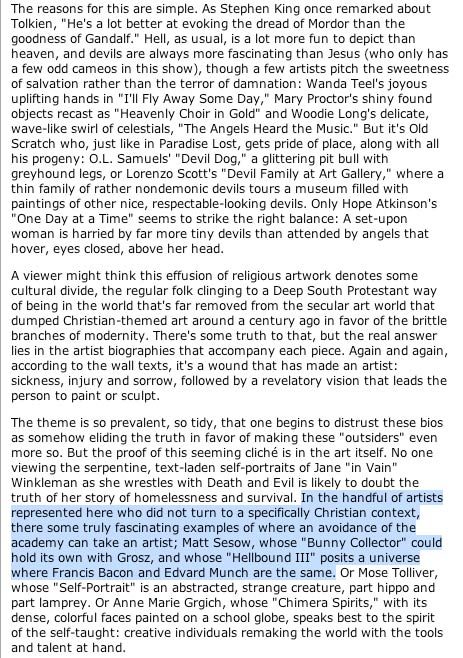
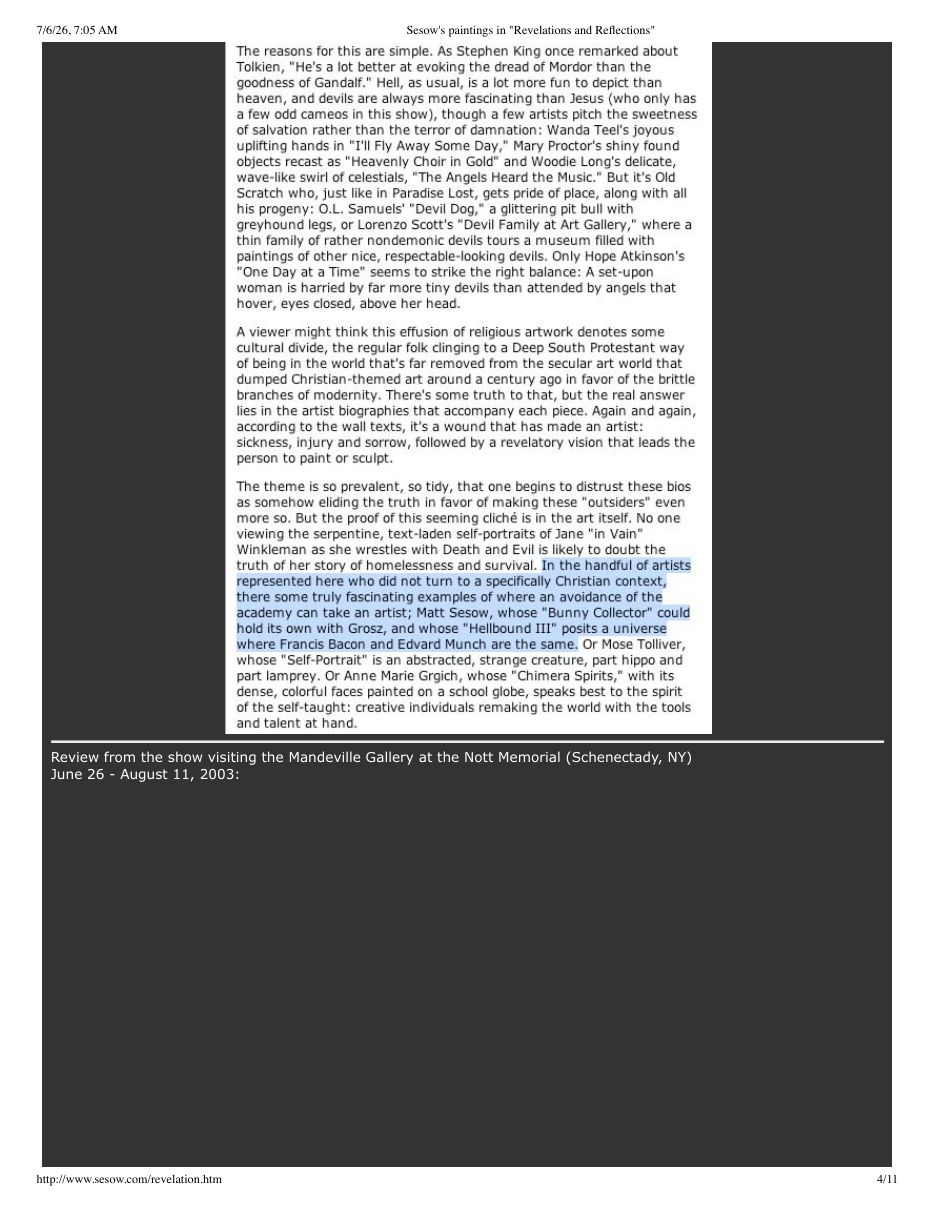
truth of her story of homelessness and survival. In the handful of artists
represented here who did not turn to a specifically Christian context,
there some truly fascinating examples of where an avoidance of the
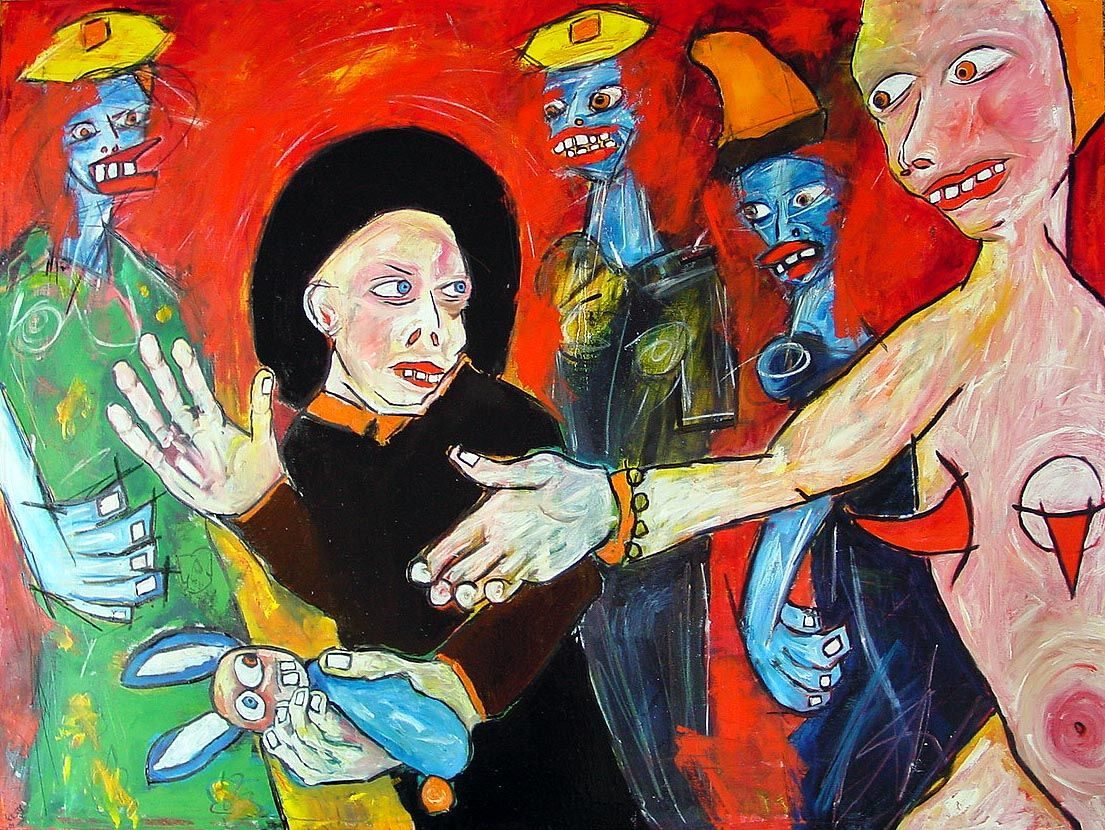
academy can take an artist; Matt Sesow, whose “Bunny Collector” could
hold its own with Grosz, and whose "Hellbound III” posits a universe
where Francis Bacon and Edvard Munch are the same. Or Mose Tolliver,
whose "Self-Portrait" is an abstracted, strange creature, part hippo and
part lamprey. Or Anne Marie Grgich, whose "Chimera Spirits,” with its
dense, colorful faces painted on a school globe, speaks best to the spirit
of the self-taught: creative individuals remaking the world with the tools
and talent at hand.
Review from the show visiting the Mandeville Gallery at the Nott Memorial (Schenectady, NY)
Bites ie ras B01)
btp:/www.sesow.com/tevel
[page 4 machine-read (OCR) from the image]
7/6/26, 7:05 AM
http://www.sesow.com/revelation.htm
Sesow's paintings in "Revelations and Reflections"
5/11
716126,7.05 AM ‘Sesow's paintings in "Revelations and Reflections"
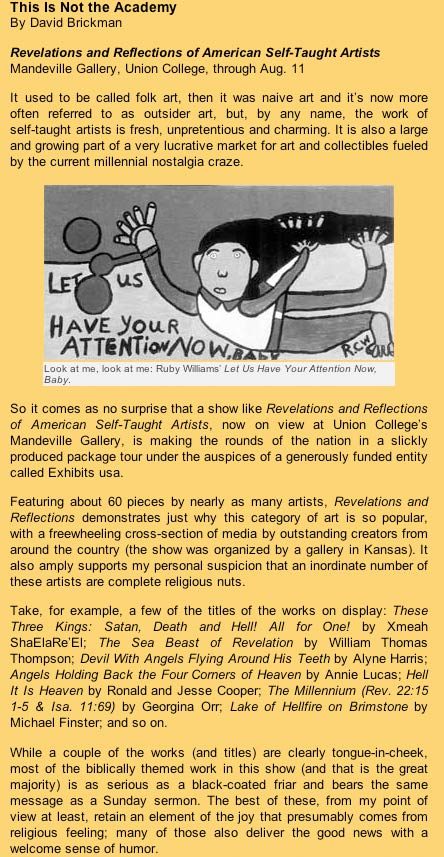
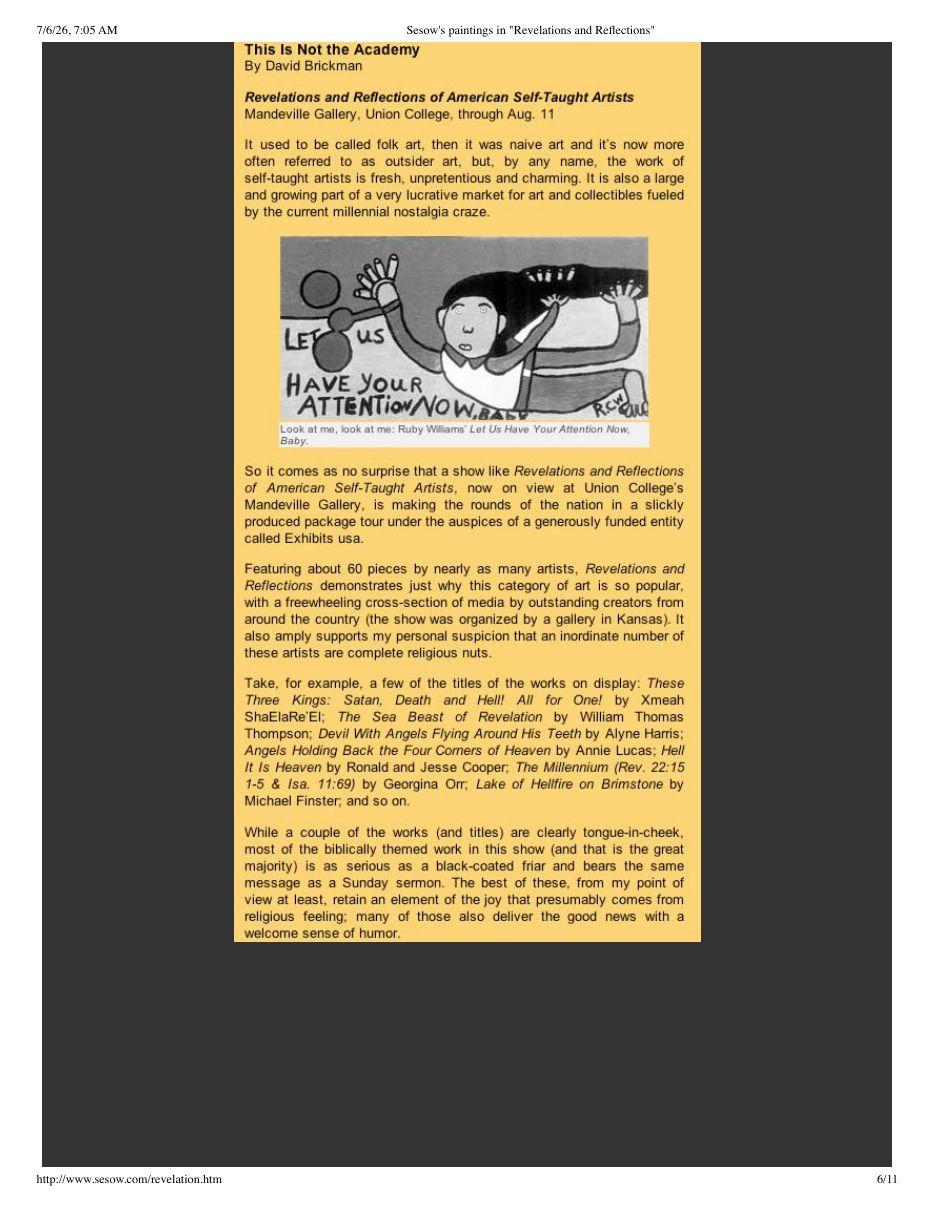
HAVE Your
ATIENTIWNO Wixe—
batp:/www.sesow.com/tevelation htm
[page 6 machine-read (OCR) from the image]
7:05 AM, ‘Sesow's paintings in "Revelations and Reflections
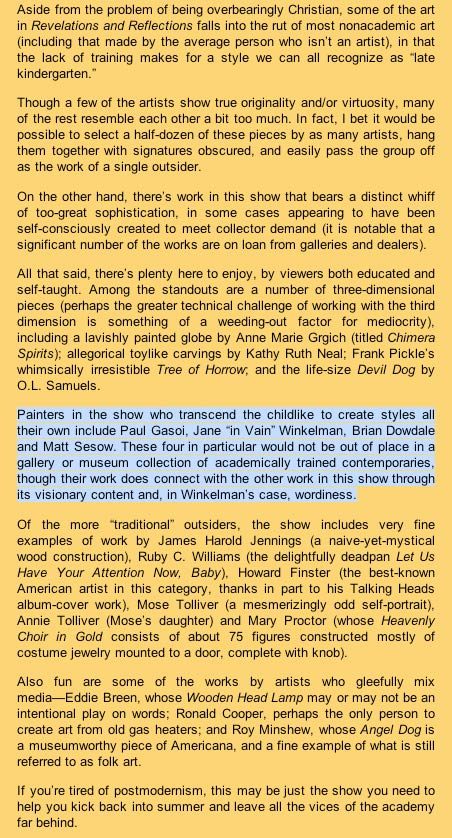
Painters in the show who transcend the childlike to create styles all
their own include Paul Gasoi, Jane “in Vain’ Winkelman, Brian Dowdale
and Matt Sesow. These four in particular would not be out of place in z
gallery or museum collection of academically trained contemporaries,
hough their work does connect with the other work in this show throug
ts visionary content and, in Winkelman’s case, wordiness.
CoM ir Rie
batp:/www.sesow.com/tevelation htm
[page 7 machine-read (OCR) from the image]
116126,7.05 AM Sesow's paintings in "Revelations and Reflections"
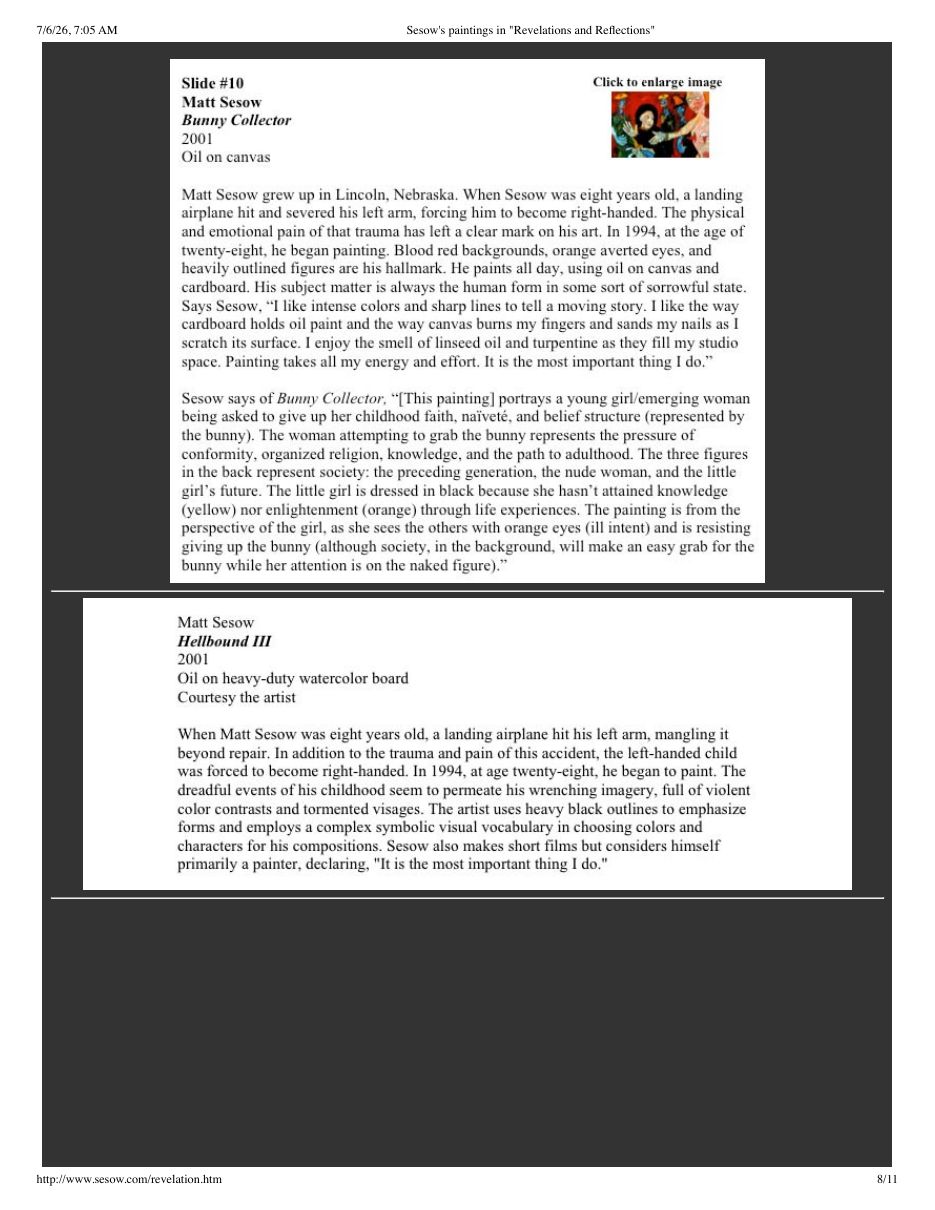
Slide #10 Click to enlarge image
of
Oil on canvas
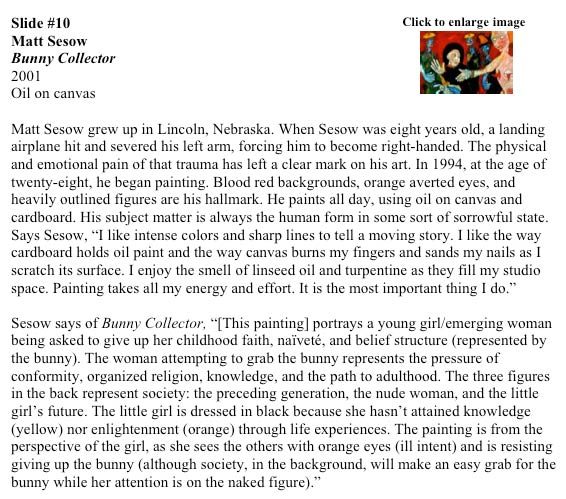
Matt Sesow grew up in Lincoln, Nebraska, When Sesow was eight years old, a landing
airplane hit and severed his left arm, forcing him to become right-handed. The physica
and emotional pain of that trauma has left a clear mark on his art, In 1994, at the age of
twenty-cight, he began painting. Blood red backgrounds, orange averted eyes, and
heavily outlined figures are his hallmark. He paints all day, using oil on canvas and
cardboard. His subject matter is always the human form in some sort of sorrowfill state.
Says Sesow, “I like intense colors and sharp lines to tell a moving story. I like the way
cardboard holds oil paint and the way canvas burns my fingers and sands my nails as I
scratch its surface. I enjoy the smell of linseed oil and turpentine as they fill my studio
space. Painting takes all my energy and effort, It is the most important thing 1 do.”
Sesow says of Bunny Collector, “{This painting] portrays a young girl/emerging woman
being asked to give up her childhood faith, naiveté, and belief structure (represented by
the bunny). The woman attempting to grab the bunny represents the pressure of
conformity, organized religion, knowledge, and the path to adulthood. The three f
in the back represent society: the preceding generation, the nude woman, and the little
irl’s future. The little girl is dressed in black because she hasn't attained knowledge
(yellow) nor enlightenment (orange) through life experiences. The painting is from the
perspective of the girl, as she sees the others with orange eyes (ill intent) and is resisting
giving up the bunny (although society, in the background, will make an easy grab for the
bunny while her attention is on the naked figure).”
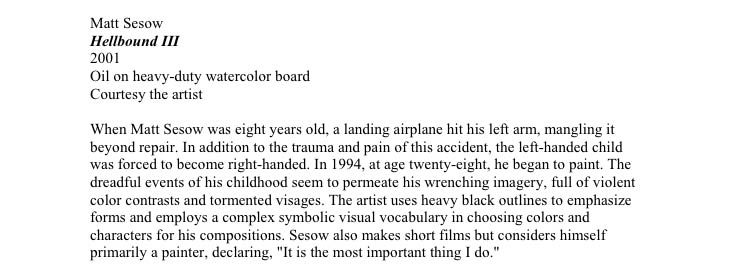
Matt Sesow
Hellbound It
2001
Oil on heavy-duty watercolor board
Courtesy the artist
When Matt Sesow was eight years old, a landing airplane hit his left arm, mangling it
beyond repair, In addition to the trauma and pain of this accident, the left-handed child
was forced to become right-handed. In 1994, at age twenty-eight, he began to paint. The
dreadful events of his childhood seem to permeate his wrenching imagery, full of violent
color contrasts and tormented visages. The artist uses heavy black outlines to emphasize
forms and employs a complex symbolic visual vocabulary in choosing colors and
characters for his compositions. Sesow also makes short films but considers himself
primarily a painter, declaring, "It is the most important thing I do.
btp:/www.sesow.com/tevelation htm
[page 8 machine-read (OCR) from the image]
‘Sesow's paintings in "Revelations and Reflections"
Matt Sesow
Bunny Collector
2001
Oil on canvas
Courtesy the artist
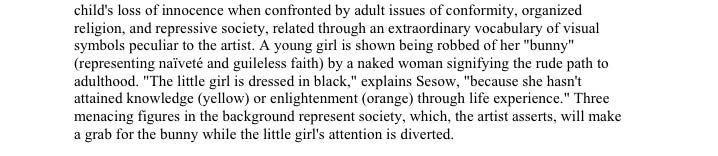
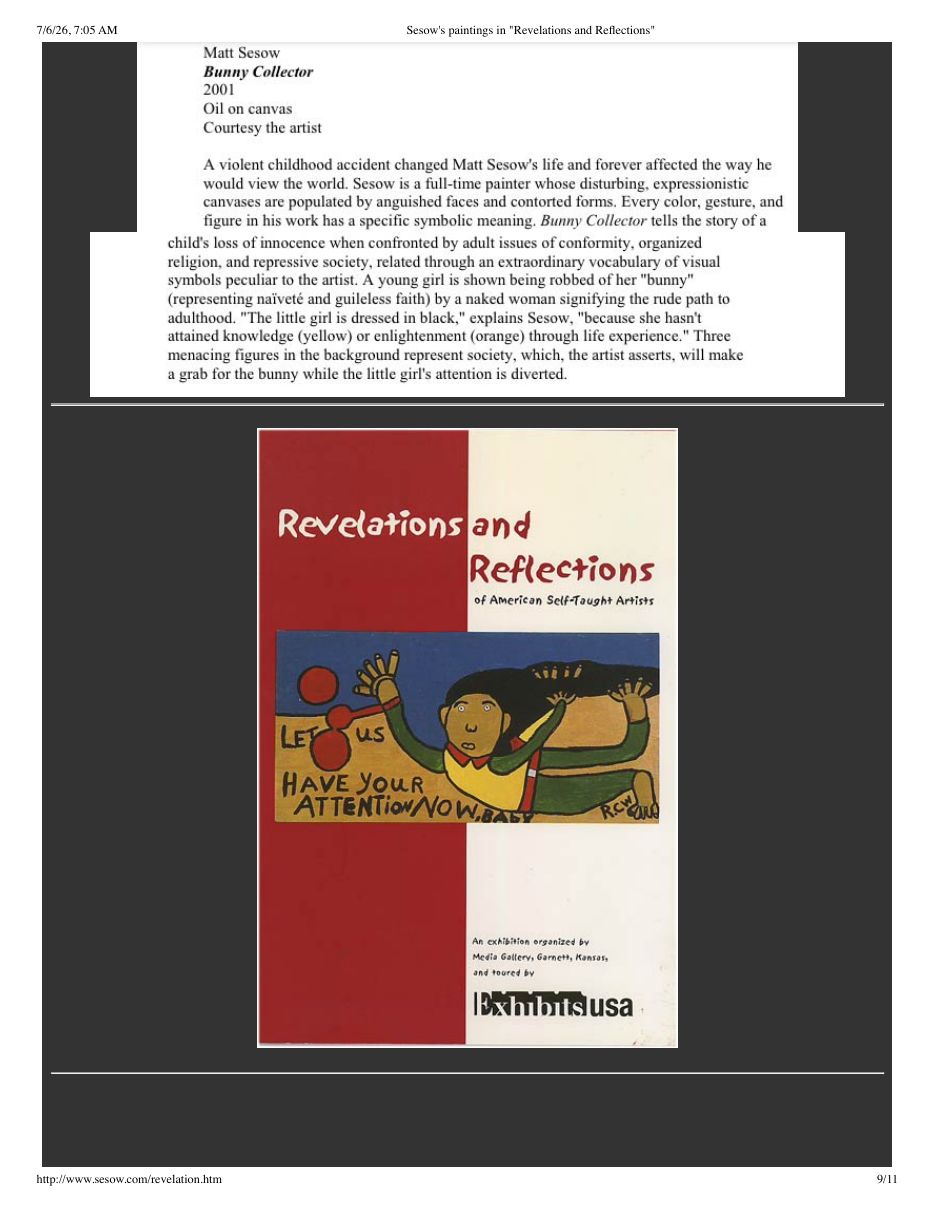
A violent childhood accident changed Matt Sesow’s life and forever affected the way he
would view the world. Sesow is a full-time painter whose disturbing, expressionistic
canvases are populated by anguished faces and contorted forms. Every color, gesture, and
figure in his work has a specific symbolic meaning. Bunny Collector tells the story of a
child's loss of innocence when confronted by adult issues of conformity, organized
religion, and repressive society, related through an extraordinary vocabulary of visual
symbols peculiar to the artist. A young girl is shown being robbed of her "bunm
(representing naiveté and guileless faith) by a naked woman signifying the rude path to
adulthood, "The little girl is dressed in black," explains Sesow, "because she hasn't
attained knowledge (yellow) or enlightenment (orange) through life experience." Three
menacing figures in the background represent society, which, the artist asserts, will make
a grab for the bunny while the little girl's attention is diverted.
Revetations EY]
Reflections
of American Self-Taught Artists
‘An exhibition orponized by
Media Galleys Garner
and toured by
DTteusa
btp:/www.sesow.com/tevel
[page 9 machine-read (OCR) from the image]
116126,7.05 AM
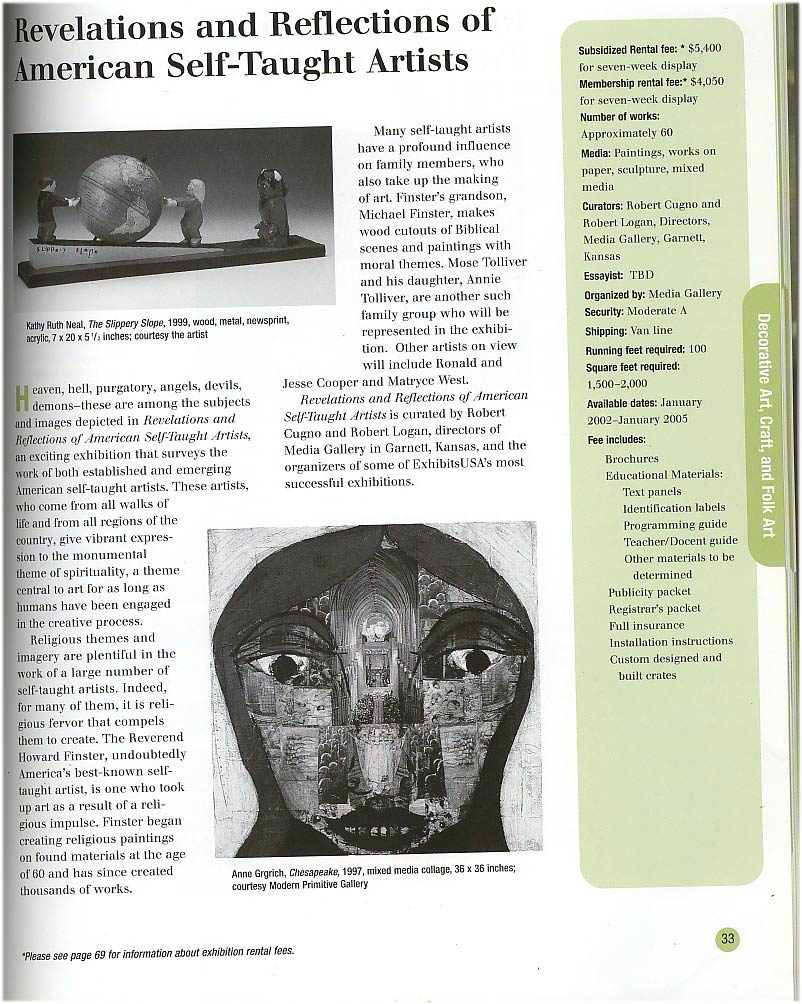
Faty uth Neal, The Stppery Slope, 1999, aod, meta, newsprint,
enlie 7 #20 x5" inches; courtesy the artist
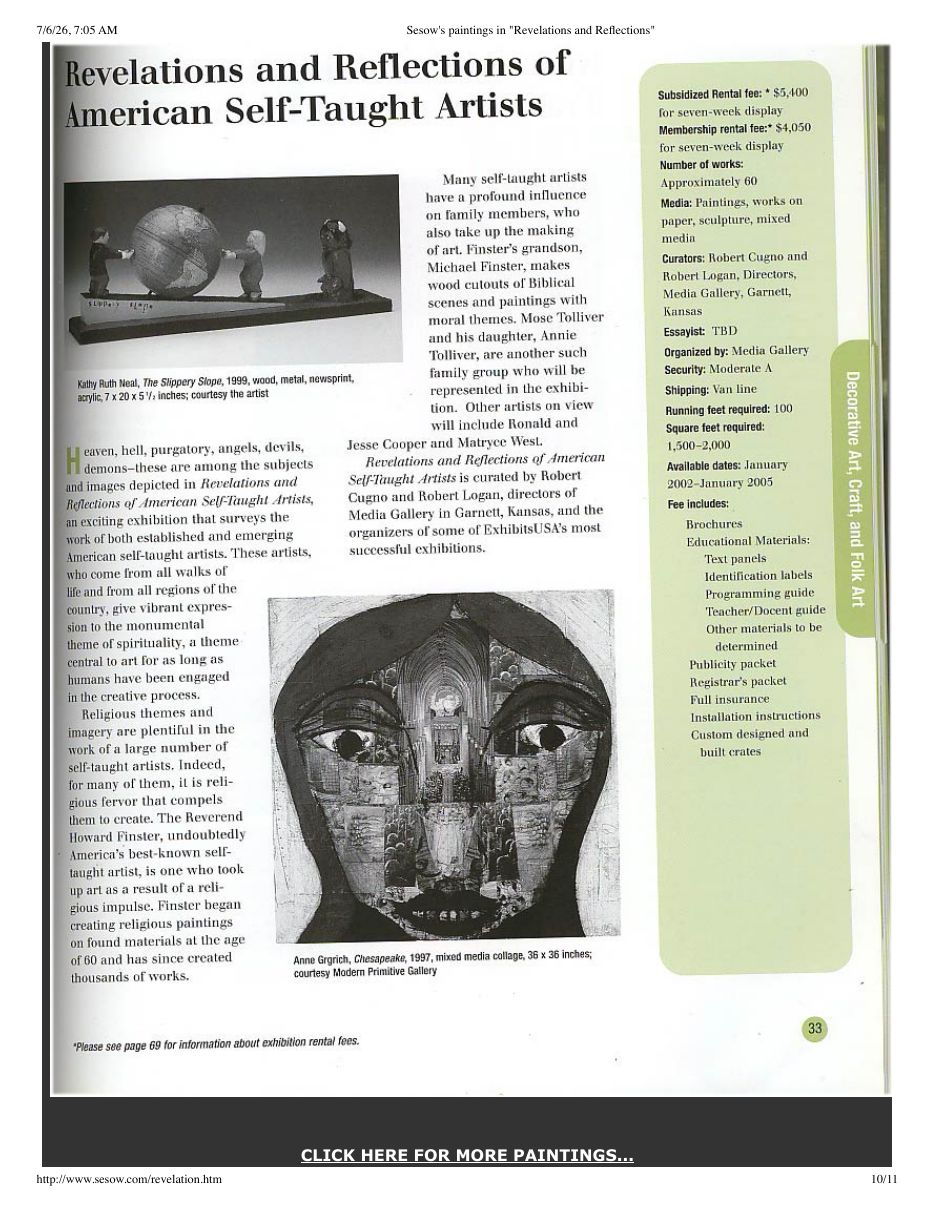
eayen, hell, purgatory, angels, devils,
demons-these are among the subjects
images depicted in Revelations and
Mections of American SelPTaught Artists,
‘Sesow's paintings in "Revelations and Reflections"
velations and Reflections of
American Self-Taught Artists
Many se
have a profound influence
‘on family members, who
Iso take up the makin
of art, Finster’s grandson,
Michael Finster, makes
wood cutouts of Biblical
scenes and paintings with
moral themes, Mose Tolliver
and his daughter, Annie
‘Tolliver, are another such
family group who will be
represented in the exhibi-
tion. Other artists on view
will include Ronald and
Jesse Cooper and Matryce West,
Revelations and Reflections of American
Self Taught Artists is curated by Robert
Cugno and Robert Logan, directors of
‘Subsidized Rental foe: * $5,400
isplay
for seven-week
‘Memborship ental fee:* $4,050
for seven-week display
‘Number of works:
Approximately 60
Paintings, works on
sculpture, mixed
media
Curators: Robert Cugno and
Robert Logan, Directors,
Media Gallery, Garnett,
Kansas
Essayist: TD
Organized by: Media Gallery
Security: Moderate A
‘Shipping: Van line
Running feet requlred: 100
‘Square feet require
1,500-2,000
‘Available dates: January
2002-Janunry 2005
exciting exhibition that surveys the Media Gallery in Garnett, Kansas, and the Foe inches
of both established and emerging anizers of some of ExhibitsUSA's most Brochures
mrerican self-taught artists. These artists, successful exhibitio Educational Materials: | =
“Text panels
ho come from all walks of
and from all regions of the
country, give vibrant expres
to the monum
Aheme of spirituality, a theme
tdniaon tbl
Procamming fide
Tather/Docent ue
uc cht
mlisirance
talon nor
Gusto designed and
pal ois
s long as
humans have been engaged
alive process.
Religious themes and
imagery are plentiful in the
Iyork of a large number of
self-taught artists. Indeed,
for many of them, it is re
ious fervor that compels
them to create. The Reverend
Howard Finster, undoubtedly
America’s best-known sell
taught artist, is one who took
part as a result of a rel
ious impulse, Finster bega
creating religious paintings
fon found materials at the age
0f 60 and has since created
thousands of works.
‘Anne Grvih, Chesapeake, 1997, mixed media collage, 96x 36 inches;
‘courtesy Mader Primitive Gallery
“Please see page 69 for information about exhioition rental foes.
CLICK HERE FOR MORE PAINTINGS.
btp:/www.sesow.com/tevelation htm
[page 10 machine-read (OCR) from the image]
7/6/26, 7:05 AM
http://www.sesow.com/revelation.htm
Sesow's paintings in "Revelations and Reflections"
11/11