Saved copy · 5 pages
zoomable page images
Click a page to open it — scroll or pinch to zoom, drag to move, arrow keys for the next page.
The full text of this page is printed above, under “Text of the original page”, with the machine-read text of its clippings.
Full text
Text taken from the saved copy (where a page was only an image, it was machine-read and may contain errors — check against the page image before quoting). Copyright remains with the original publisher; kept for the historical record.
116126,7.03 AM ‘Compass Magazine Article, 2003 ***
this page:
Matt Sesow in Compass Magazine Article, 2003
December 2003
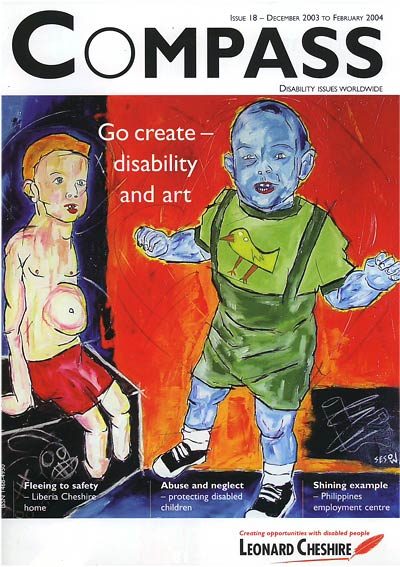
cover of Compass Magazine:
tee 18 Decoren 2003 ro Fenn 2004
COMPASS
sana? sins woRLowoe
Go create —
disability
Elicia
Ue 7
icamteani a”
batps:// www sesow.com/compass him
us
[page 1 machine-read (OCR) from the image]
116126,7.03 AM
‘Compass Magazine Anticle, 2003 #*
In focus...
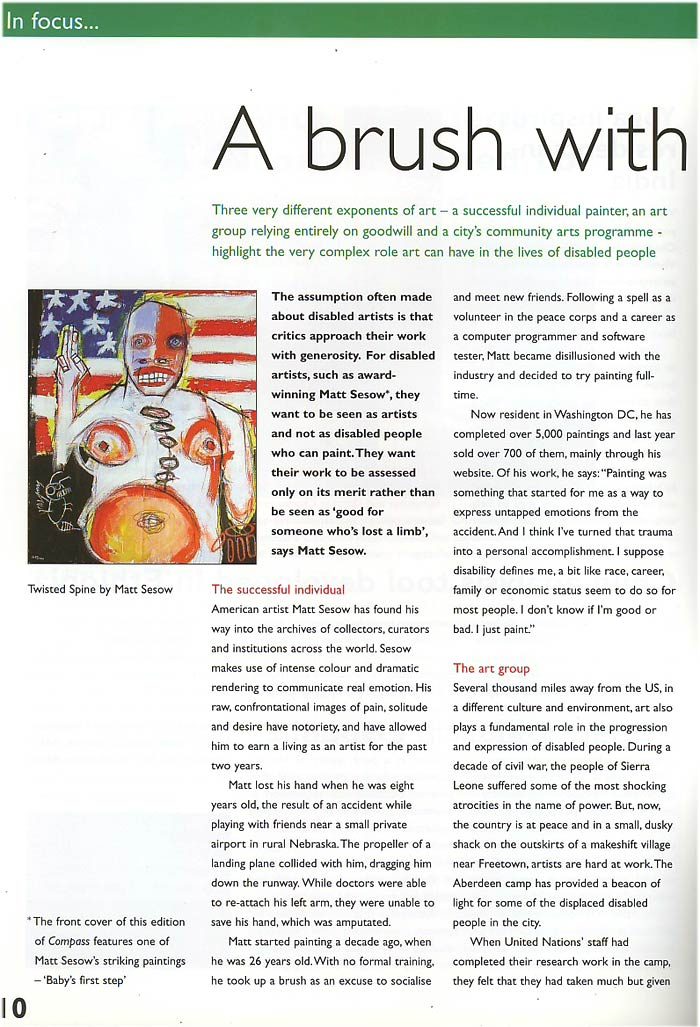
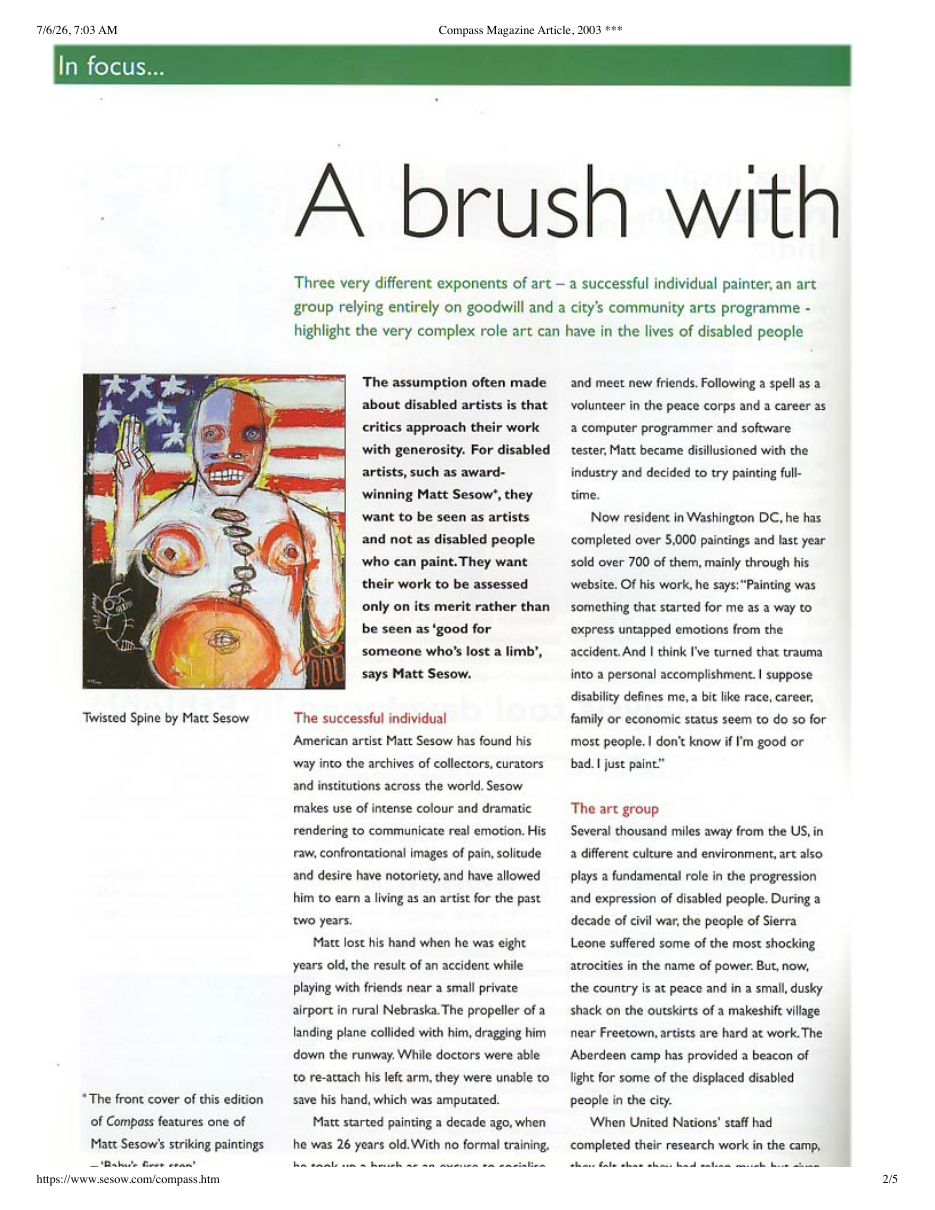
‘Twisted Spine by Matt Sesow
“The front cover of this edition
of Compass features one of
Matt Sesow's striking paintings
batps:!/ www sesow.com/compass him
A brush with
Three very different exponents of art — a successful individual painter, an art
group relying entirely on goodwill and a city’s community arts programme -
highlight the very complex role art can have in the lives of disabled people
The assumption often made
about disabled artists is that
critics approach their work
with generosity. For disabled
artists, such as award-
winning Matt Sesow’, they
want to be seen as artists
and not as disabled people
who can paint. They want
their work to be assessed
only on its merit rather than
be seen as ‘good for
someone who's lost a limb’,
says Matt Sesow.
The successful individual
‘American artist Matt Sesow has found his
way into the archives of collectors, curators
and institutions across the world. Sesow
makes use of intense colour and dramatic
rendering to communicate real emotion. His
Faw, confrontational images of pain, solitude
and desire have notoriety, and have allowed
him to earn a living as an artist for the past
two years.
Mate lost his hand when he was eight
years old, the result of an accident while
playing with friends near a small private
airport in rural Nebraska. The propeller of a
landing plane collided with him, dragging him
down the runway, While doctors were able
to re-attach his left arm, they were unable to
save his hand, which was amputated.
‘Mate started painting a decade ago, when
he was 26 years old. With no formal training,
and meet new friends. Following a spell as 2
volunteer in the peace corps and a career as
a computer programmer and software
tester, Matt became disillusioned with the
industry and decided to try painting full-
time.
Now resident in Washington DC, he has
completed over 5,000 paintings and last year
sold over 700 of them, mainly through his
website. Of his work, he says: “Painting was
something that started for me as a way to
‘express untapped emotions from the
accident.And | think I've turned that trauma
into a personal accomplishment. | suppose
disability defines me,a bit lke race, career,
family or economic status seem to do so for
most people. | don't know if 'm good or
bad. I just paint”
The art group
Several thousand miles away from the US, in
a different culture and environment, art also
plays a fundamental role in the progression
and expression of disabled people. During a
decade of civil war, the people of Sierra
Leone suffered some of the most shocking
atrocities in the name of power. But, now,
the country is at peace and in a small, dusky
shack on the outskirts of a makeshift village
near Freetown, artists are hard at work. The
‘Aberdeen camp has provided a beacon of
light for some of the displaced disabled
people in the city.
‘When United Nations’ staff had
completed their research work in the camp,
25
[page 2 machine-read (OCR) from the image]
116126,7.03 AM ‘Compass Magazine Anticle, 2003 #**
10
batps:// www sesow.com/compass him 35
[page 3 machine-read (OCR) from the image]
116126,7.03 AM
very little back to the community. It was at
this point that Hilary Ravenscroft arrived.
A teacher by profession and an artist in her
spare time, she took on the challenge for the
frustrated UN staff and an art project was
born. Its impact during the short time it has
been operational has been remarkable,
believes Hilary.
“Local businesses were approached to
provide bits of material for the artists, the
nearby print shop donates reams of paper
and a local manufacturer supplies the paint.”
says Hilary.“Although the wounds from lost
limbs visibly heal over, internal wounds can
take longer to heal. In this respect,
participation in the arts and creative media
can increase individual confidence and self-
‘esteem. But the painting is not just
therapeutic. It is also lucrative.”
Within the first three months, 50 people
had joined the group and more than 500
pieces of work were created all of which
were sold at an exhibition held at the UN
headquarters in Freetown. The income gained
has made a significant difference to the lives
of the disabled people and their families
The community art programme
Returning to the United States, in
Washington DC the WVSA Arts Connection
is a far more established programme, that
has been thriving for two decades. The
WVSA serves disabled young people and
combines both art and education, providing
tools for success in school, adulthood and
life in general
From modest beginnings, in the basement
batps:!/ www sesow.com/compass him
Compass Magazine Anticle, 2003 #**
today grown to be a state-wide
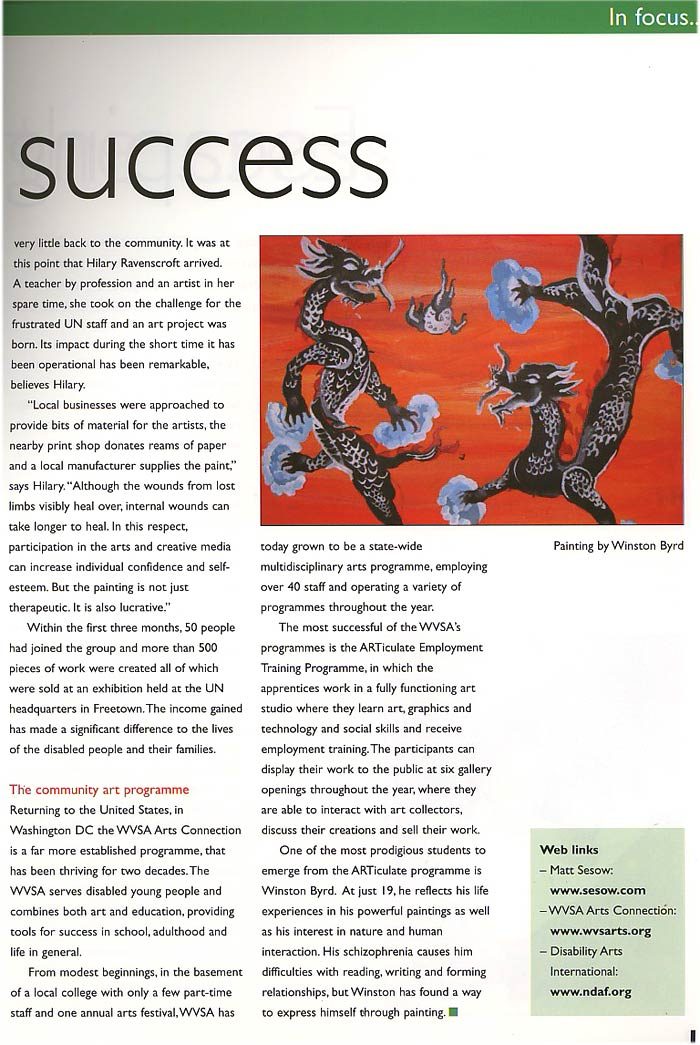
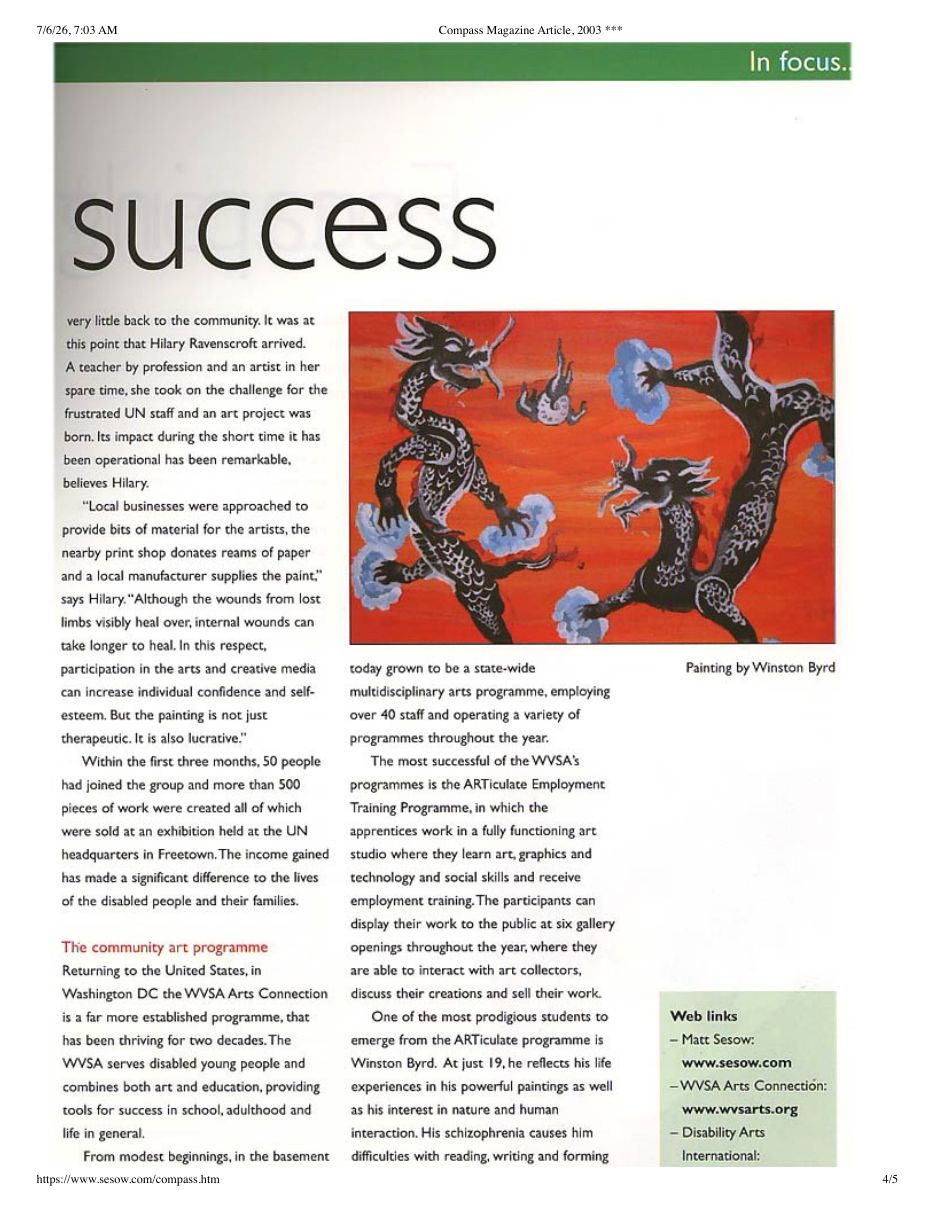
Painting by Winston Byrd
multidisciplinary arts programme, employing
over 40 staff and operating a variety of
programmes throughout the year.
The most successful of the WVSA's
programmes is the ARTiculate Employment
Training Programme, in which the
apprentices work in a fully functioning art
studio where they learn art, graphics and
technology and social skills and receive
employment training. The participants can
display their work to the public at six gallery
‘openings throughout the year, where they
are able to interact with art collectors,
discuss their creations and sell their work.
One of the most prodigious students to Web links
‘emerge from the ARTiculate programme is ~ Matt Sesow:
Winston Byrd. At just 19,he reflects his life www.sesow.com
‘experiences in his powerful paintings as well —WYSA Arts Connection:
as his interest in nature and human www.awysarts.org
interaction. His schizophrenia causes him = Disability Arts
difficulties with reading, writing and forming International:
45
[page 4 machine-read (OCR) from the image]
716126,7.03 AM Compass Magazine Anicle, 2003 *#*
‘of a local college with only a few part-time _relationships, but Winston has found a way www.ndafiorg
staff and one annual arts festival, WVSA has to express himself through painting. ll
CLICK HERE FOR MORE PAINTINGS...
batps:// www sesow.com/compass him 55
[page 5 machine-read (OCR) from the image]