
Saved copy · 12 pages
Click a page to open it — scroll or pinch to zoom, drag to move, arrow keys for the next page.
The full text of this page is printed above, under “Text of the original page”, with the machine-read text of its clippings.
Full text
Text taken from the saved copy (where a page was only an image, it was machine-read and may contain errors — check against the page image before quoting). Copyright remains with the original publisher; kept for the historical record.
7/6/26, 6:59 AM
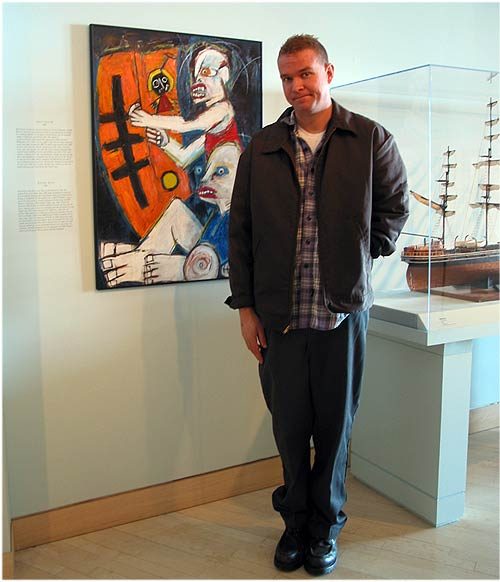
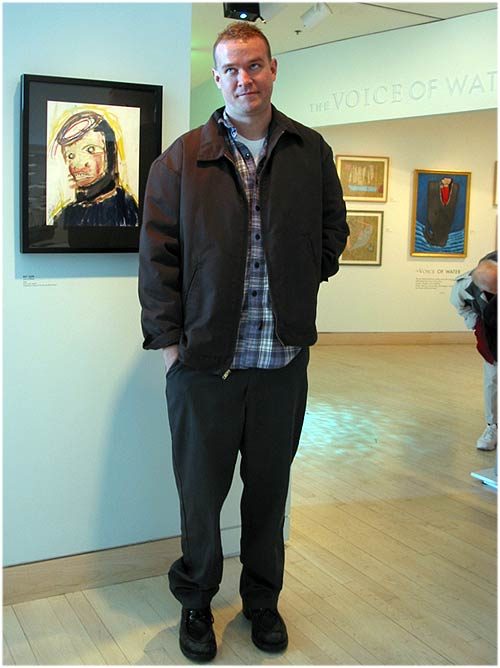
Matt Sesow in the Visionary Museum
this page:
Sesow in "Holy H2O": Fluid Universe
The American Visionary Art Museum
Baltimore, Maryland
October 2, 2004 - September 4, 2005.
https://www.sesow.com/avam2k5.htm
1/12
7/6/26, 6:59 AM
Matt Sesow in the Visionary Museum
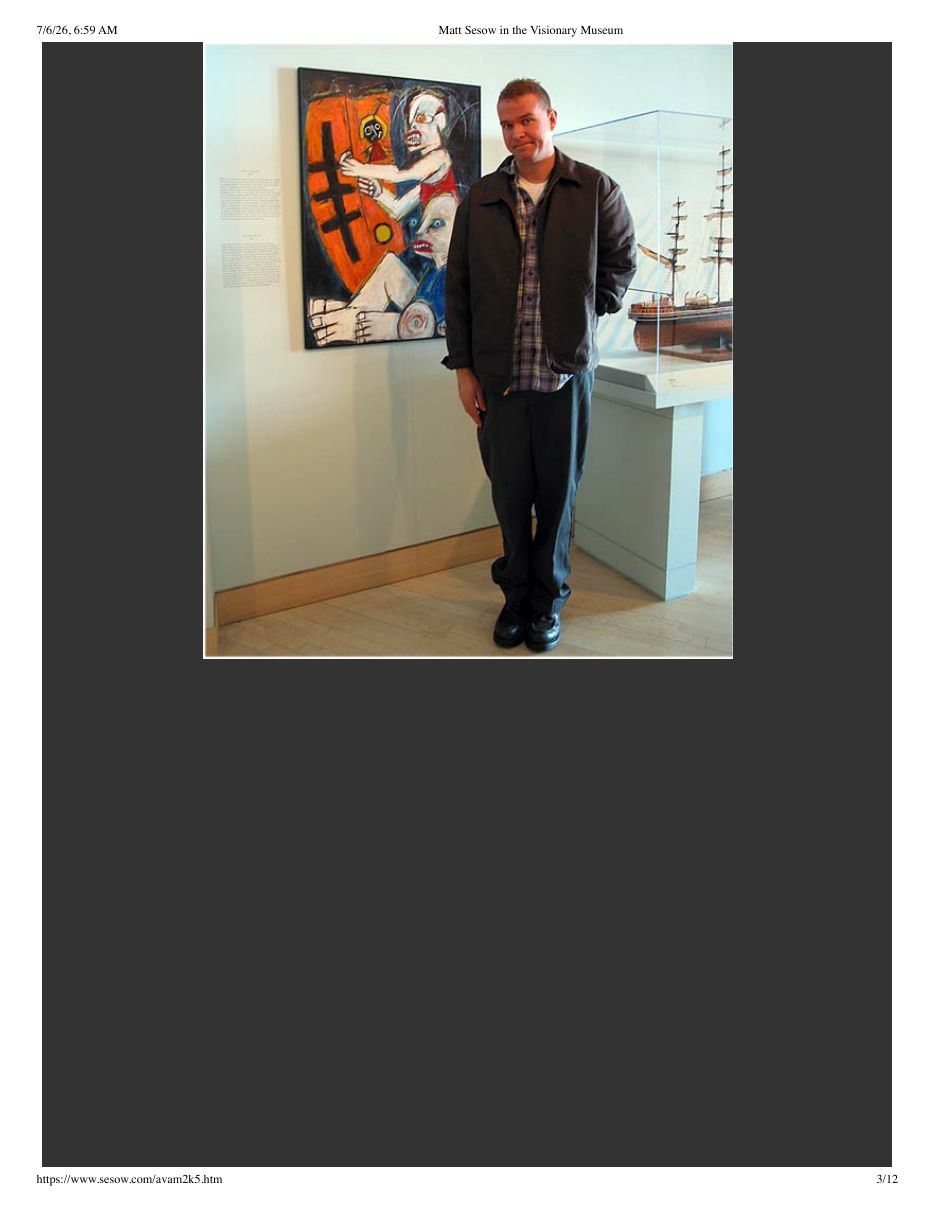
at the exhibit:
https://www.sesow.com/avam2k5.htm
2/12
7/6/26, 6:59 AM
https://www.sesow.com/avam2k5.htm
Matt Sesow in the Visionary Museum
3/12
7/6/26, 6:59 AM
Matt Sesow in the Visionary Museum
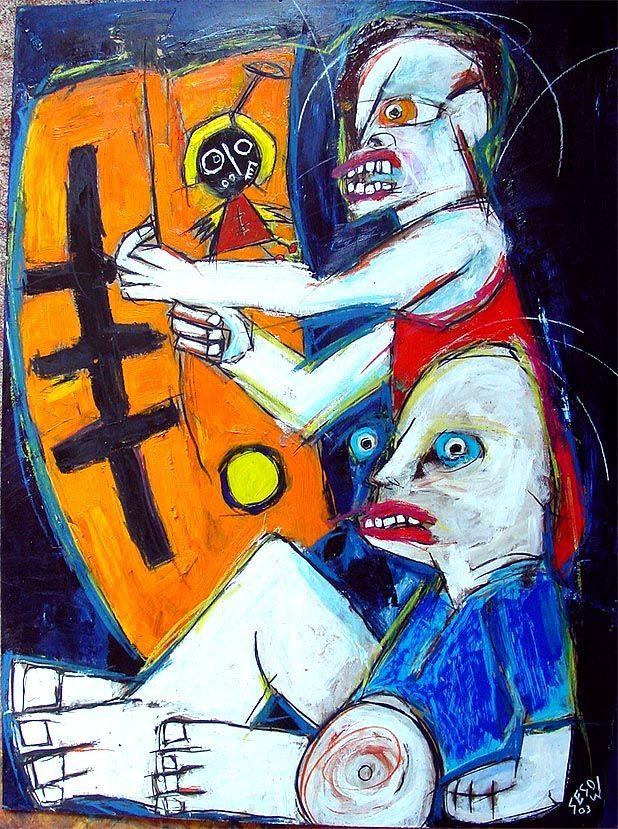
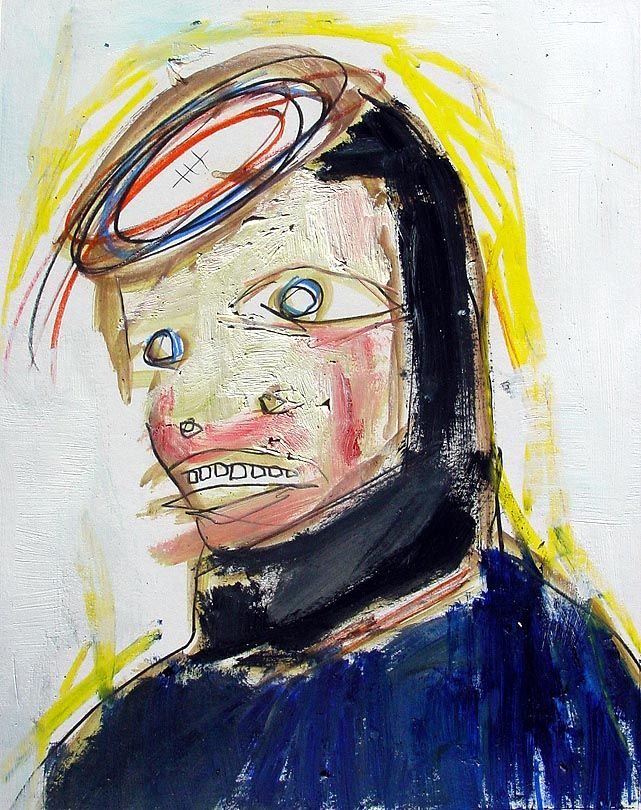
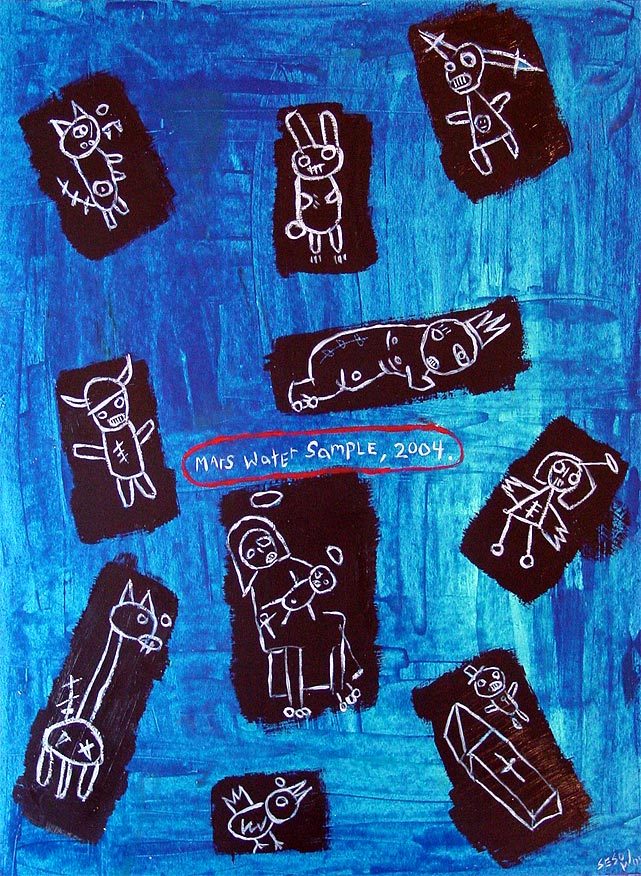
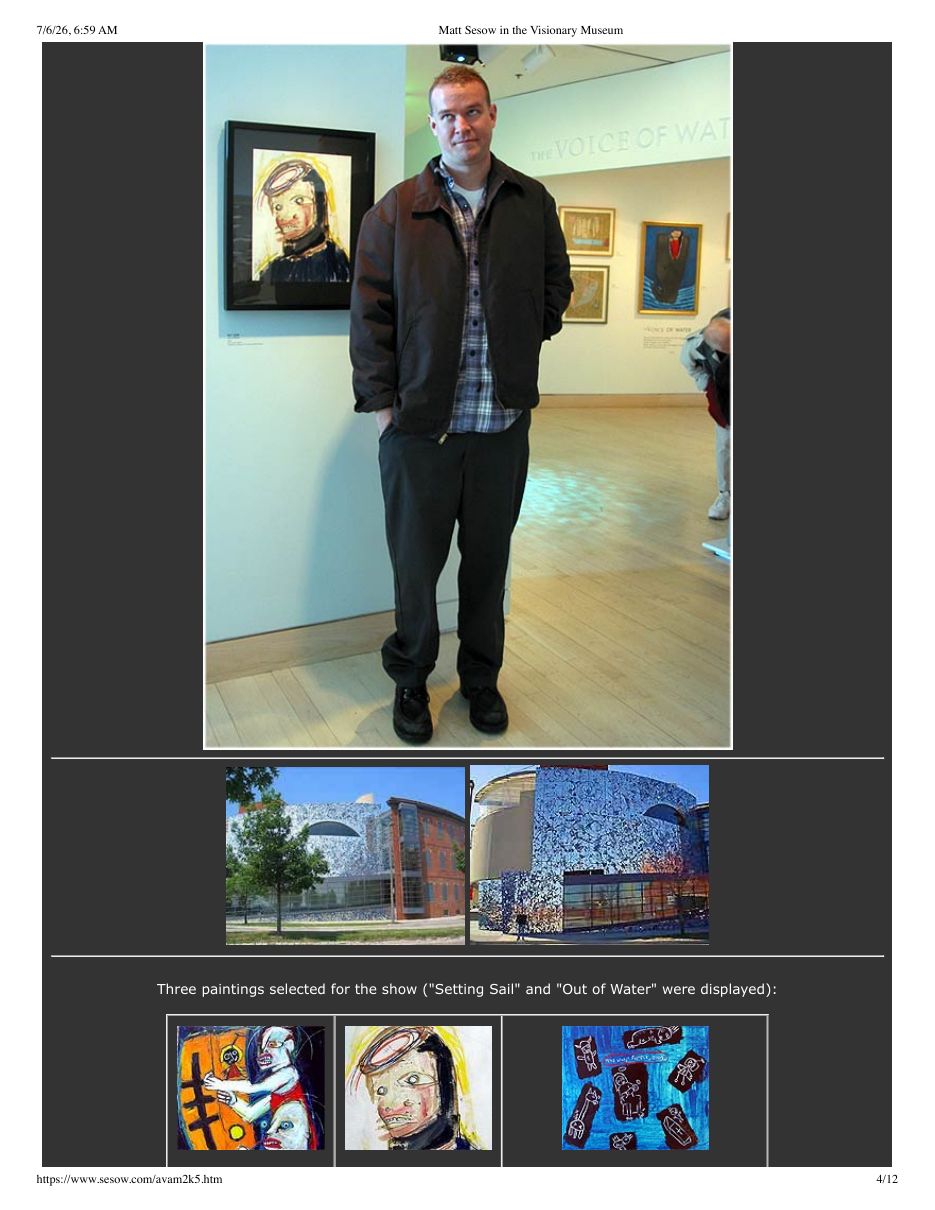
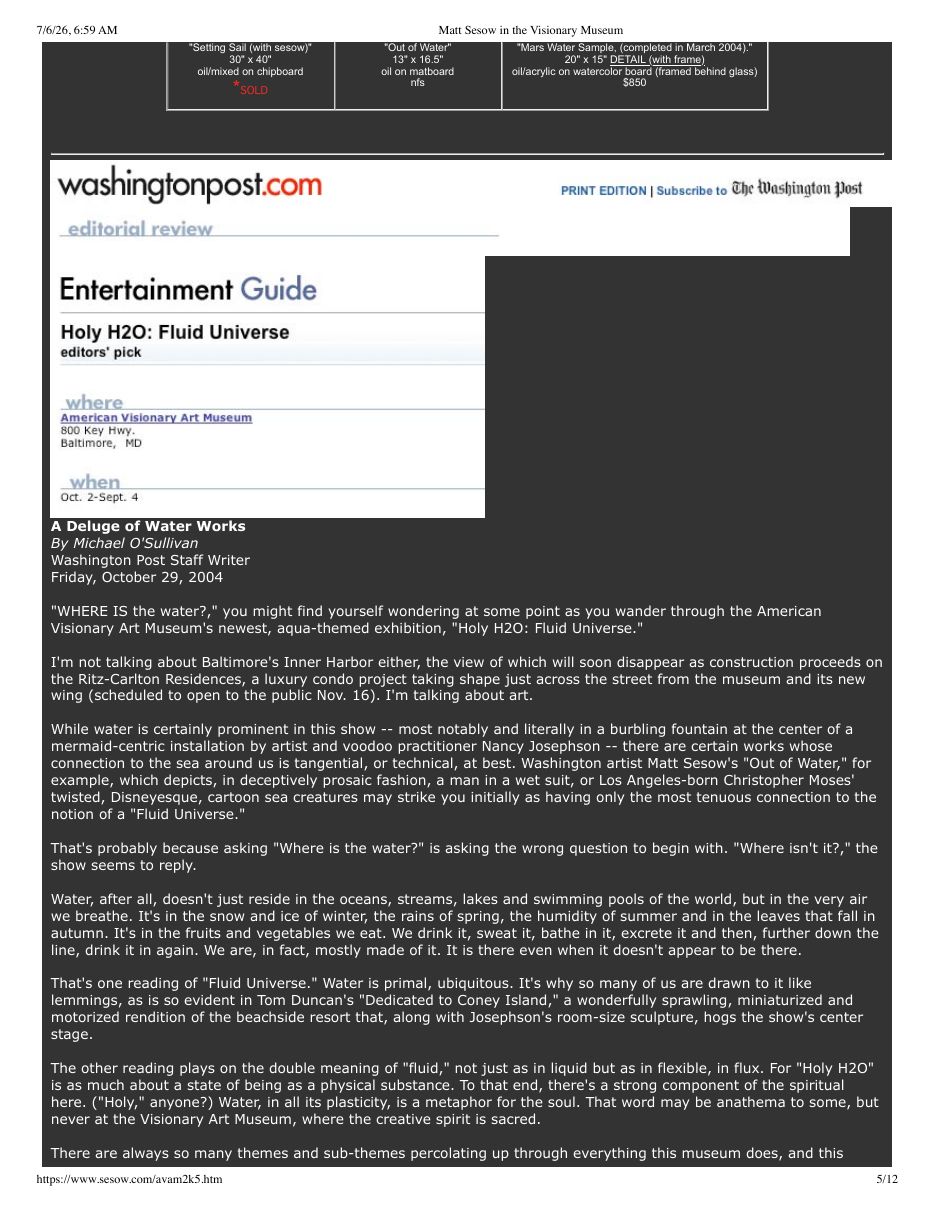
Three paintings selected for the show ("Setting Sail" and "Out of Water" were displayed):
https://www.sesow.com/avam2k5.htm
4/12
7/6/26, 6:59 AM
Matt Sesow in the Visionary Museum
"Setting Sail (with sesow)"
30" x 40"
oil/mixed on chipboard
*SOLD
"Out of Water"
13" x 16.5"
oil on matboard
nfs
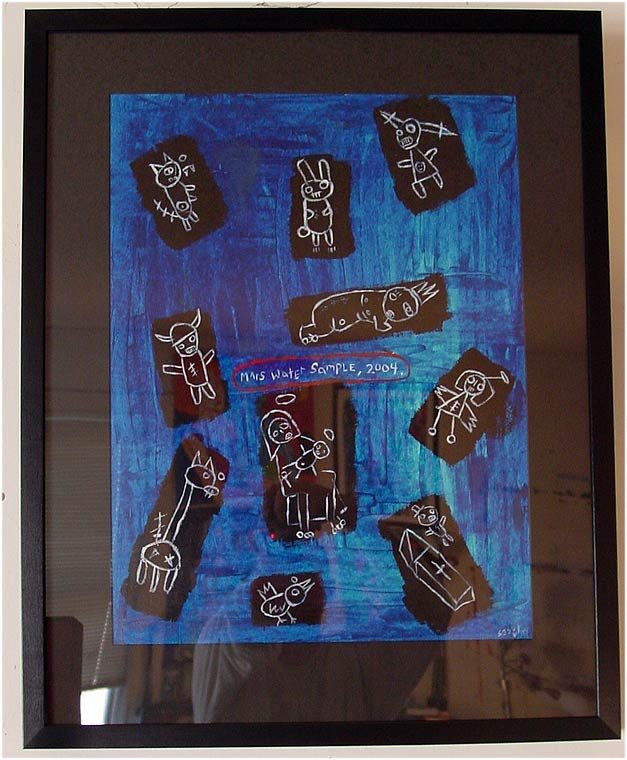
"Mars Water Sample, (completed in March 2004)."
20" x 15" DETAIL (with frame)
oil/acrylic on watercolor board (framed behind glass)
$850
A Deluge of Water Works
By Michael O'Sullivan
Washington Post Staff Writer
Friday, October 29, 2004
"WHERE IS the water?," you might find yourself wondering at some point as you wander through the American
Visionary Art Museum's newest, aqua-themed exhibition, "Holy H2O: Fluid Universe."
I'm not talking about Baltimore's Inner Harbor either, the view of which will soon disappear as construction proceeds on
the Ritz-Carlton Residences, a luxury condo project taking shape just across the street from the museum and its new
wing (scheduled to open to the public Nov. 16). I'm talking about art.
While water is certainly prominent in this show -- most notably and literally in a burbling fountain at the center of a
mermaid-centric installation by artist and voodoo practitioner Nancy Josephson -- there are certain works whose
connection to the sea around us is tangential, or technical, at best. Washington artist Matt Sesow's "Out of Water," for
example, which depicts, in deceptively prosaic fashion, a man in a wet suit, or Los Angeles-born Christopher Moses'
twisted, Disneyesque, cartoon sea creatures may strike you initially as having only the most tenuous connection to the
notion of a "Fluid Universe."
That's probably because asking "Where is the water?" is asking the wrong question to begin with. "Where isn't it?," the
show seems to reply.
Water, after all, doesn't just reside in the oceans, streams, lakes and swimming pools of the world, but in the very air
we breathe. It's in the snow and ice of winter, the rains of spring, the humidity of summer and in the leaves that fall in
autumn. It's in the fruits and vegetables we eat. We drink it, sweat it, bathe in it, excrete it and then, further down the
line, drink it in again. We are, in fact, mostly made of it. It is there even when it doesn't appear to be there.
That's one reading of "Fluid Universe." Water is primal, ubiquitous. It's why so many of us are drawn to it like
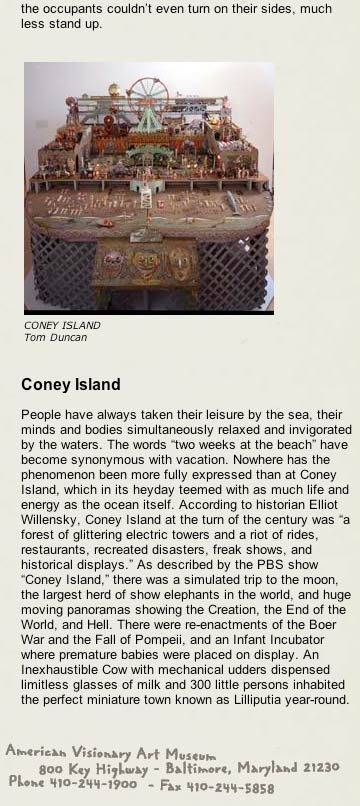
lemmings, as is so evident in Tom Duncan's "Dedicated to Coney Island," a wonderfully sprawling, miniaturized and
motorized rendition of the beachside resort that, along with Josephson's room-size sculpture, hogs the show's center
stage.
The other reading plays on the double meaning of "fluid," not just as in liquid but as in flexible, in flux. For "Holy H2O"
is as much about a state of being as a physical substance. To that end, there's a strong component of the spiritual
here. ("Holy," anyone?) Water, in all its plasticity, is a metaphor for the soul. That word may be anathema to some, but
never at the Visionary Art Museum, where the creative spirit is sacred.
There are always so many themes and sub-themes percolating up through everything this museum does, and this
https://www.sesow.com/avam2k5.htm
5/12
7/6/26, 6:59 AM
Matt Sesow in the Visionary Museum
exhibition is no exception. Pollution, the history of the ship-borne slave trade, ritual ablution, even hints of the River
Styx make appearances here. One could argue that, by throwing so many ideas in the soup, the museum has
unintentionally diluted its own thesis.
I would argue that the opposite is true, that the show is, paradoxically, more, not less coherent for all its liquidity. Yes,
the show is slippery at times and takes many forms. Just as soon as you think you've gotten your hands on it, it runs
through your fingers. And yet it provides refreshment and rejuvenation, even as it frustrates our desire to hold it still.
Just like water.
HOLY H20: FLUID UNIVERSE -- Through Sept. 4 at the American Visionary Art Museum, 800 Key Hwy., Baltimore.
410-244-1900. www.avam.org. Open Tuesday-Sunday 10 to 6. $9; children, seniors and students $6; groups of 10 or
more $5 per person; ages 4 and under free.
With next month's opening of the Jim Rouse Visionary Center, a converted whiskey barrel warehouse housing
classroom, exhibition and public program space, the museum's prices will increase by $2 in all categories, beginning
Nov. 16. Children ages 4 and under will still be admitted free.
https://www.sesow.com/avam2k5.htm
6/12
7/6/26, 6:59 AM
Matt Sesow in the Visionary Museum
From the AVAM website:
https://www.sesow.com/avam2k5.htm
7/12
116126, 6:59 AM
AMERICAN
VISIONARY
‘ART MUSEUM
batps:/ www sesow.com/avam2k5 htm
Matt Sesow in the Visionary Museum.
FLUID UNIVERSE
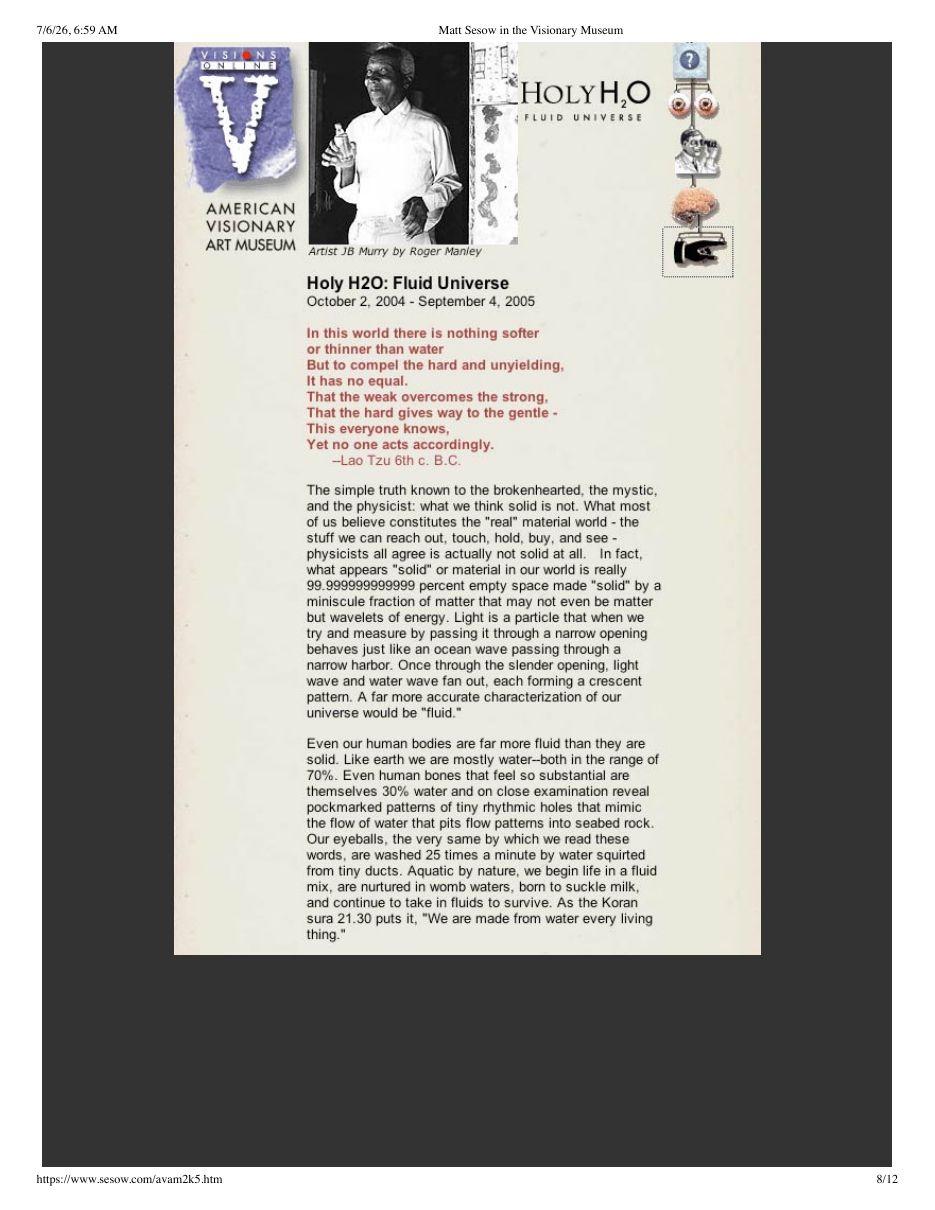
Artist JB Murry by Roger Manley
Holy H20: Fluid Universe
October 2, 2004 - September 4, 2005
In this world there is nothing softer
or thinner than water
But to compel the hard and unyielding.
It has no equal.
That the weak overcomes the strong
That the hard gives way to the gentle -
This everyone knows,
Yet no one acts accordingly.
-Lao Tzu 6th c. B.C
The simple truth known to the brokenhearted, the mystic,
and the physicist: what we think solid is not. What most
of us believe constitutes the "real" material world - the
stuff we can reach out, touch, hold, buy, and see -
physicists all agree is actually not solid at all. In fact,
what appears “solid” or material in our world is really
‘9999999999999 percent empty space made “solid” by a
miniscule fraction of matter that may not even be matter
but wavelets of energy. Light is a particle that when we
try and measure by passing it through a narrow opening
behaves just like an ocean wave passing through a
narrow harbor. Once through the slender opening, light
wave and water wave fan out, each forming a crescent
pattem. A far more accurate characterization of our
Universe would be “fluid.”
Even our human bodies are far more fluid than they are
solid. Like earth we are mostly water-both in the range of
70%. Even human bones that feel so substantial are
themselves 30% water and on close examination reveal
pockmarked pattems of tiny rhythmic holes that mimic
the flow of water that pits flow pattems into seabed rock
Our eyeballs, the very same by which we read these
words, are washed 25 times a minute by water squirted
from tiny ducts. Aquatic by nature, we begin life in a fluid
mix, are nurtured in womb waters, born to suckle milk,
and continue to take in fluids to survive. As the Koran
sura 21.30 puts it, "We are made from water every living
thing.”
[page 8 machine-read (OCR) from the image]
116126, 6:59 AM
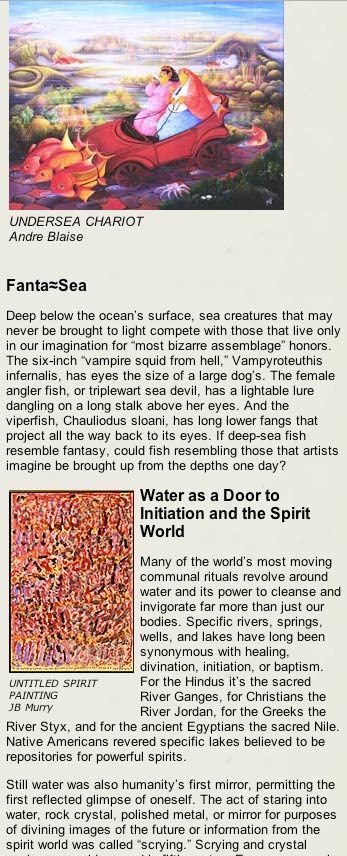
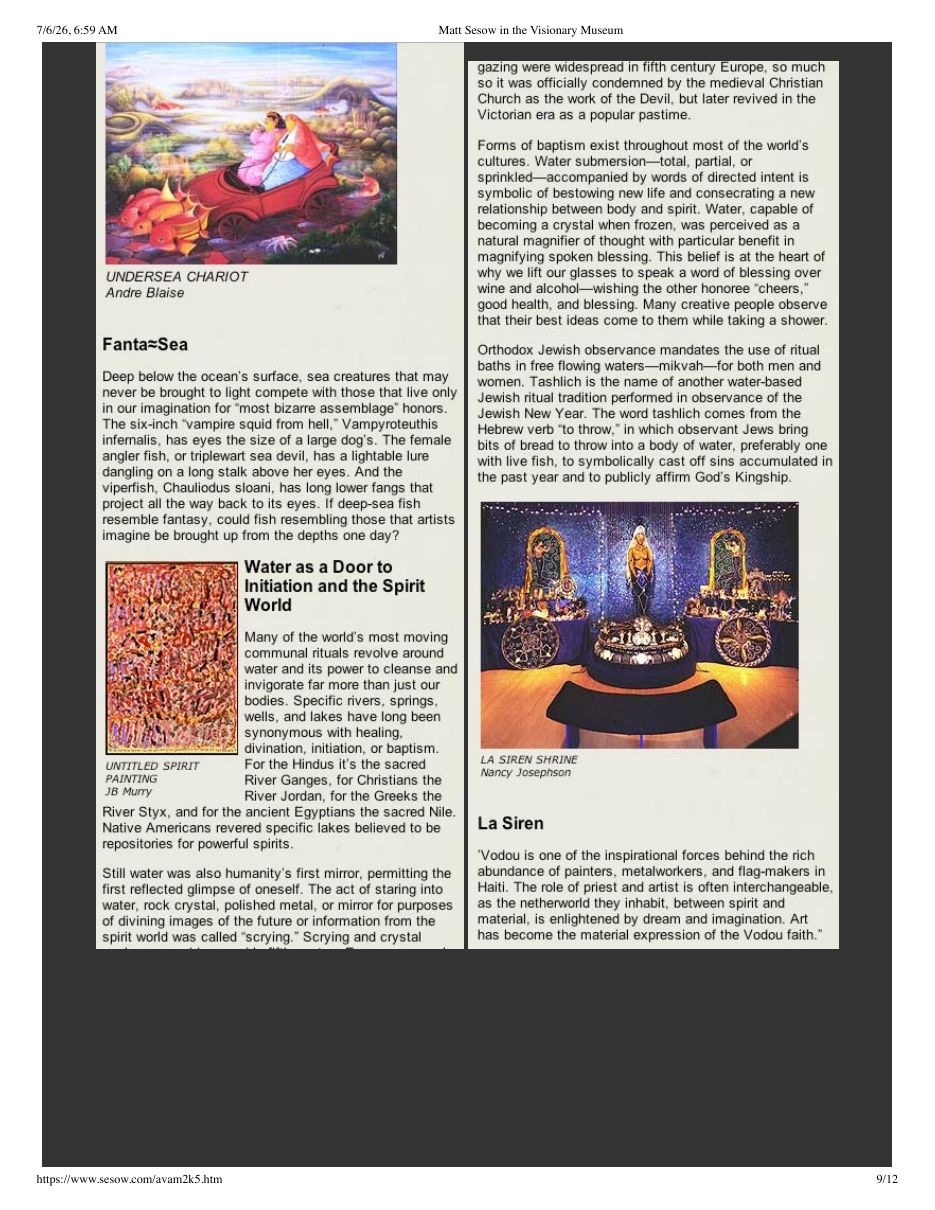
UNDERSEA CHARIOT
Andre Blaise
Fanta=Sea
Deep below the ocean's surface, sea creatures that may
never be brought to light compete with those that live only
in our imagination for "most bizarre assemblage" honors.
The six-inch ‘vampire squid from hell,” Vampyroteuthis
infernalis, has eyes the size of a large dog's. The female
angler fish, or triplewart sea devil, has a lightable lure
dangling on a long stalk above her eyes. And the
viperfish, Chauliodus sloani, has long lower fangs that
project all the way back to its eyes. If deep-sea fish
resemble fantasy. could fish resembling those that artists
imagine be brought up from the depths one day?
Water as a Door to
“| Initiation and the Spirit
| World
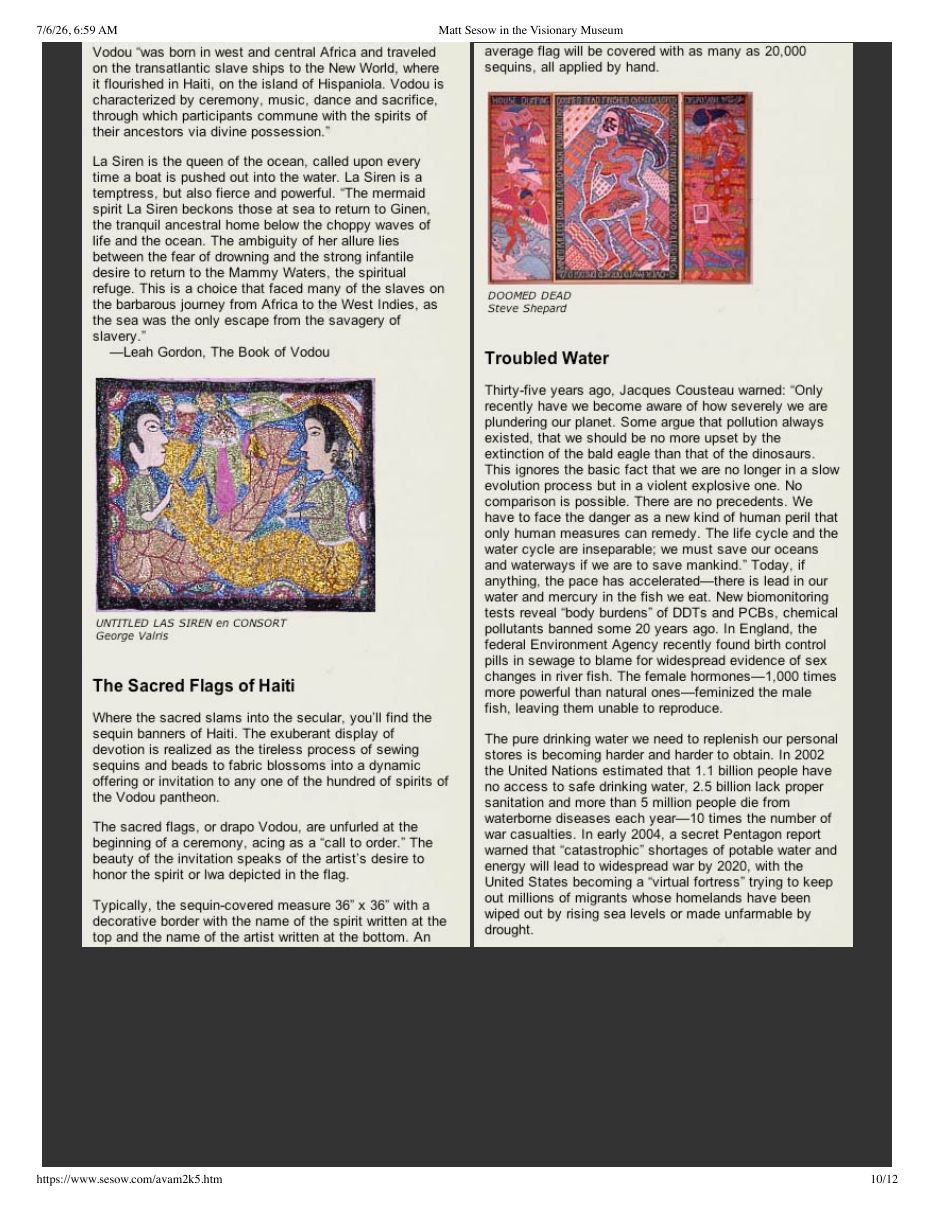
#44) Many of the world's most moving
| communal rituals revolve around
water and its power to cleanse and
invigorate far more than just our
bodies. Specific rivers, springs,
wells, and lakes have long been
synonymous with healing
divination, initiation, or baptism
For the Hindus it's the sacred
PAINTING River Ganges, for Christians the
38 Murry River Jordan, for the Greeks the
River Styx, and for the ancient Egyptians the sacred Nile.
Native Americans revered specific lakes believed to be
repositories for powerful spirits
UNTITLED SPIRIT
Still water was also humanity's first mirror, permitting the
first reflected glimpse of oneself. The act of staring into
water, rock crystal, polished metal, or mirror for purposes
of divining images of the future or information from the
spirit world was called “scrying.” Scrying and crystal
batps:/ www sesow.com/avam2k5 htm
Matt Sesow in the Visionary Museum,
gazing were widespread in fifth century Europe, 50 much,
80 it was officially condemned by the medieval Christian
Church as the work of the Devil, but later revived in the
Victorian era as a popular pastime.
Forms of baptism exist throughout most of the world’s
cultures. Water submersion—total, partial, or
sprinkled—accompanied by words of directed intent is
symbolic of bestowing new life and consecrating a new
relationship between body and spirit. Water, capable of
becoming a crystal when frozen, was perceived as a
natural magnifier of thought with particular benefit in,
magnifying spoken blessing. This belief is at the heart of
why we lift our glasses to speak a word of blessing over
wine and alcohol—wishing the other honoree “cheers,
good health, and blessing. Many creative people observe
that their best ideas come to them while taking a shower.
Orthodox Jewish observance mandates the use of ritual
baths in free flowing waters—mikvah—for both men and
women. Tashlich is the name of another water-based
Jewish ritual tradition performed in observance of the
Jewish New Year. The word tashlich comes from the
Hebrew verb “to throw,” in which observant Jews bring
bits of bread to throw into a body of water, preferably one
with live fish, to symbolically cast off sins accumulated in
the past year and to publicly affirm God's Kingship.
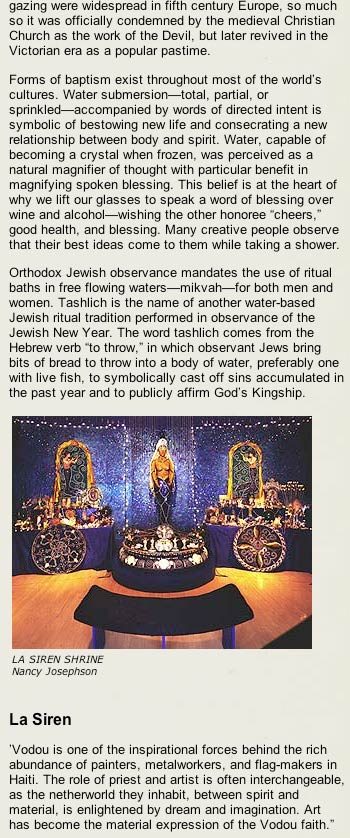
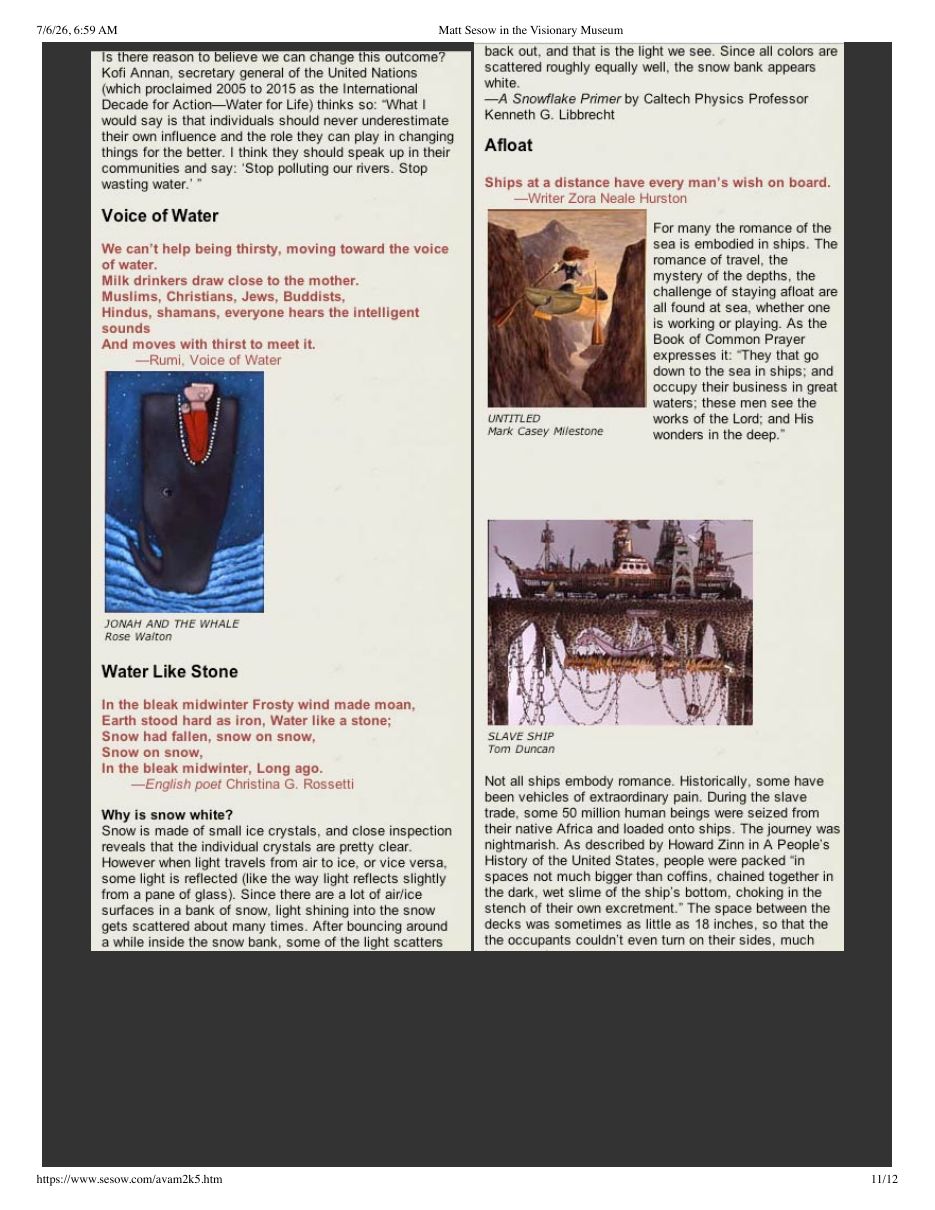
LA SIREN SHRINE
‘Nancy Josephson
La Siren
‘Vodou is one of the inspirational forces behind the rich
abundance of painters, metalworkers, and flag-makers in
Haiti. The role of priest and artist is often interchangeable,
as the netherworid they inhabit, between spirit and
material, is enlightened by dream and imagination. Art
has become the material expression of the Vodou faith.”
[page 9 machine-read (OCR) from the image]
116126,6:59 AM
Vodou ‘was born in west and central Africa and traveled
on the transatlantic slave ships to the New World, where
it flourished in Haiti, on the island of Hispaniola. Vodou is
characterized by ceremony, music, dance and sacrifice,
through which participants commune with the spirits of
their ancestors via divine possession.”
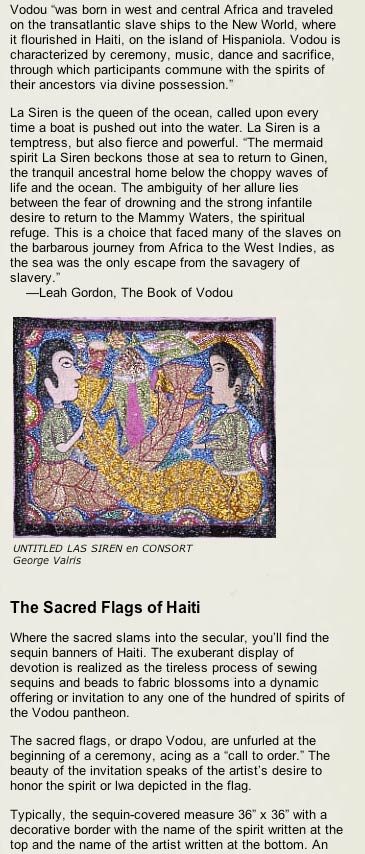
La Siren is the queen of the ocean, called upon every
time a boat is pushed out into the water. La Siren is a
temptress, but also fierce and powerful. “The mermaid
spirit La Siren beckons those at sea to retum to Ginen,
the tranquil ancestral home below the choppy waves of
life and the ocean. The ambiguity of her allure lies
between the fear of drowning and the strong infantile
desire to retum to the Mammy Waters, the spiritual
refuge. This is a choice that faced many of the slaves on
the barbarous journey from Africa to the West indies, as
the sea was the only escape from the savagery of
slavery.”
—Leah Gordon, The Book of Vodou
UNTITLED LAS SIREN en CONSORT
George Vainis
The Sacred Flags of Haiti
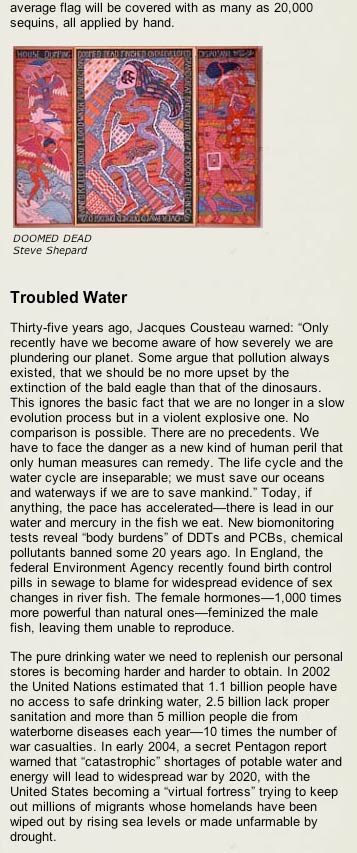
Where the sacred slams into the secular, youl find the
sequin banners of Haiti. The exuberant display of
devotion is realized as the tireless process of sewing
sequins and beads to fabric blossoms into a dynamic
offering or invitation to any one of the hundred of spirits of
the Vodou pantheon.
The sacred flags, or drapo Vodou, are unfurled at the
beginning of a ceremony, acing as a “call to order.” The
beauty of the invitation speaks of the artist's desire to
honor the spirit or lwa depicted in the flag
Typically, the sequin-covered measure 36” x 36” with a
decorative border with the name of the spirit written at the
top and the name of the artist written at the bottom. An
batps:/ www sesow.com/avam2k5 htm
Matt Sesow in the Visionary Museum,
‘average flag will be covered with as many as 20,000
sequins, all applied by hand.
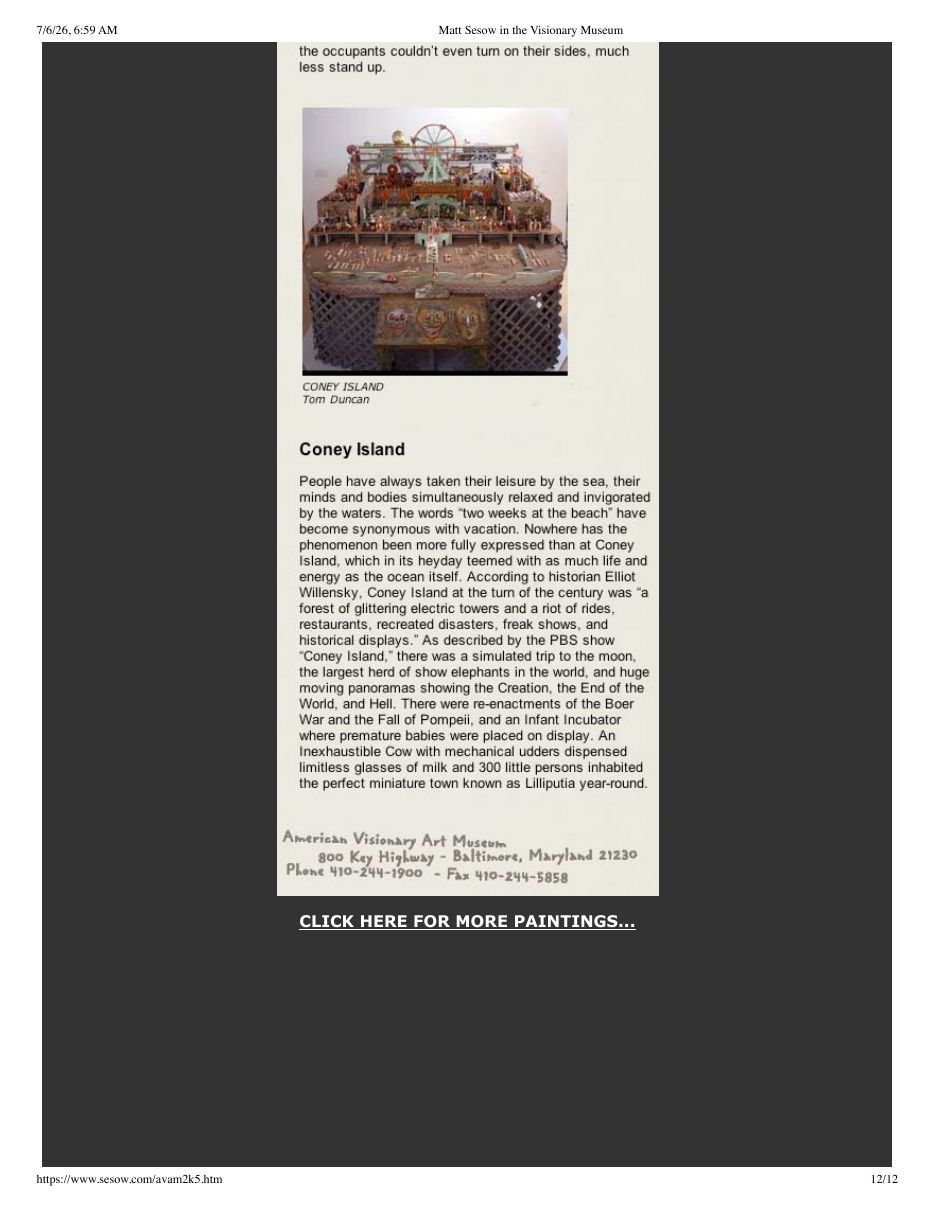
DOOMED DEAD
‘Steve Shepard
Troubled Water
Thirty-five years ago, Jacques Cousteau wamed: “Only
recently have we become aware of how severely we are
plundering our planet. Some argue that pollution always
existed, that we should be no more upset by the
extinction of the bald eagle than that of the dinosaurs.
This ignores the basic fact that we are no longer in a slow
evolution process but in a violent explosive one. No
comparison is possible. There are no precedents. We
have to face the danger as a new kind of human peril that
only human measures can remedy. The life cycle and the
water cycle are inseparable; we must save our oceans
and waterways if we are to save mankind.” Today, if
anything, the pace has accelerated—there is lead in our
water and mercury in the fish we eat. New biomonitoring
tests reveal “body burdens” of DDTs and PCBs, chemical
pollutants banned some 20 years ago. In England, the
federal Environment Agency recently found birth control
pills in sewage to blame for widespread evidence of sex
changes in river fish. The female hormones—1,000 times
‘more powerful than natural ones—feminized the male
fish, leaving them unable to reproduce.
The pure drinking water we need to replenish our personal
stores is becoming harder and harder to obtain. In 2002
the United Nations estimated that 1.1 billion people have
no access to safe drinking water, 2.5 billion lack proper
sanitation and more than 5 million people die from
waterbome diseases each year—10 times the number of
war casualties. In early 2004, a secret Pentagon report
warned that “catastrophic” shortages of potable water and
energy will lead to widespread war by 2020, with the
United States becoming a “virtual fortress” trying to keep
out millions of migrants whose homelands have been
wiped out by rising sea levels or made unfarmable by
drought
[page 10 machine-read (OCR) from the image]
116126, 6:59 AM
Ts there reason to believe we can change this outcome?
Kofi Annan, secretary general of the United Nations
(which proclaimed 2005 to 2015 as the Intemational
Decade for Action—Water for Life) thinks so: “What |
would say is that individuals should never underestimate
their own influence and the role they can play in changing
things for the better. | think they should speak up in their
‘communities and say: ‘Stop polluting our rivers. Stop
wasting water
Voice of Water
n't help being thirsty, moving to
ard the voic
rinkers draw close to the mother.
ms, Christians, Jews, Buddists,
s, € the
telligent
tit
JONAH AND THE WHALE
Rose Walton
Water Like Stone
In thi
Why is snow white?
Snow is made of small ice crystals, and close inspection
reveals that the individual crystals are pretty clear
However when light travels from air to ice, or vice versa,
some light is reflected (like the way light reflects slightly
from a pane of glass). Since there are a lot of airlice
surfaces in a bank of snow, light shining into the snow
gets scattered about many times. After bouncing around
a while inside the snow bank, some of the light scatters
batps:/ www sesow.com/avam2k5 htm
Matt Sesow in the Visionary Museum.
back out, and that is the light we see. Since all colors are
scattered roughly equally well, the snow bank appears
white,
—A Snowflake Primer by Caltech Physics Professor
Kenneth G. Libbrecht
Afloat
For many the romance of the
sea is embodied in ships. The
romance of travel, the
mystery of the depths, the
challenge of staying afloat are
all found at sea, whether one
is working or playing. As the
Book of Common Prayer
expresses it: “They that go
down to the sea in ships; and
‘occupy their business in great
waters; these men see the
works of the Lord; and His
wonders in the deep.”
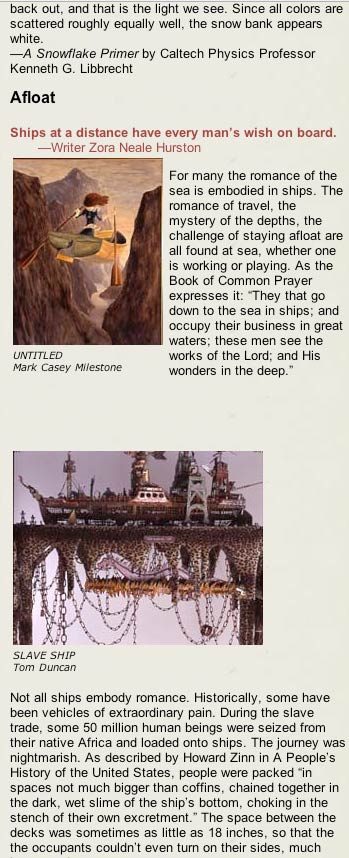
UNTITLED
Mark Casey Milestone
SLAVE SHIP
Tom Duncan
Not all ships embody romance. Historically, some have
been vehicles of extraordinary pain. During the slave
trade, some 50 million human beings were seized from
their native Africa and loaded onto ships. The journey was
nightmarish. As described by Howard Zinn in A People's
History of the United States, people were packed “in
spaces not much bigger than coffins, chained together in
the dark, wet slime of the ship's bottom, choking in the
stench of their own excretment.” The space between the
decks was sometimes as little a8 18 inches, so that the
the occupants couldn't even tum on their sides, much
[page 11 machine-read (OCR) from the image]
btps:/wow ses
.w-con/avam2kS itm
Matt Sesow in the Visionary Museum.
the occupants couldn't even tum on their sides, much
less stand up.
CONEY ISLAND
Tom Duncan
Coney Island
People have always taken their leisure by the sea, their
minds and bodies simultaneously relaxed and invigorated
by the waters. The words “two weeks at the beach” have
become synonymous with vacation. Nowhere has the
phenomenon been more fully expressed than at Coney
Island, which in its heyday teemed with as much life and
energy as the ocean itself. According to historian Elliot
Willensky, Coney Island at the tum of the century was “a
forest of glittering electric towers and a riot of rides,
restaurants, recreated disasters, freak shows, and
historical displays." As described by the PBS show
“Coney Island,” there was a simulated trip to the moon,
the largest herd of show elephants in the world, and huge
moving panoramas showing the Creation, the End of the
World, and Hell. There were re-enactments of the Boer
War and the Fall of Pompeii, and an Infant incubator
where premature babies were placed on display. An
Inexhaustible Cow with mechanical udders dispensed
limitless glasses of milk and 300 little persons inhabited
the perfect miniature town known as Lilliputia year-round.
American Visionary Art Museum
800 Key Highway - Baltimore, Maryland 21230
Phone 410-244-1900 - Fax 410-244-5958
CLICK HERE FOR MORE PAINTINGS.
[page 12 machine-read (OCR) from the image]