Saved copy · 3 pages
Click a page to open it — scroll or pinch to zoom, drag to move, arrow keys for the next page.
The full text of this page is printed above, under “Text of the original page”, with the machine-read text of its clippings.
Full text
Text taken from the saved copy (where a page was only an image, it was machine-read and may contain errors — check against the page image before quoting). Copyright remains with the original publisher; kept for the historical record.
7/6/26, 6:57 AM
Sesow in MSDC magazine, 2006
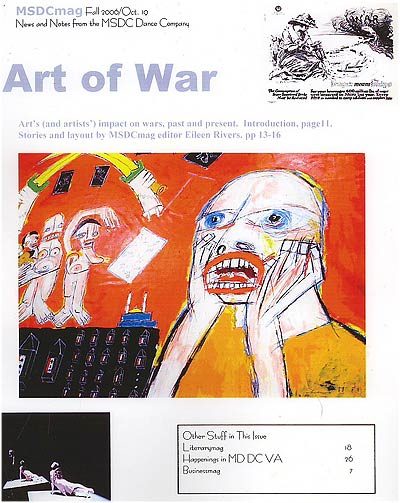
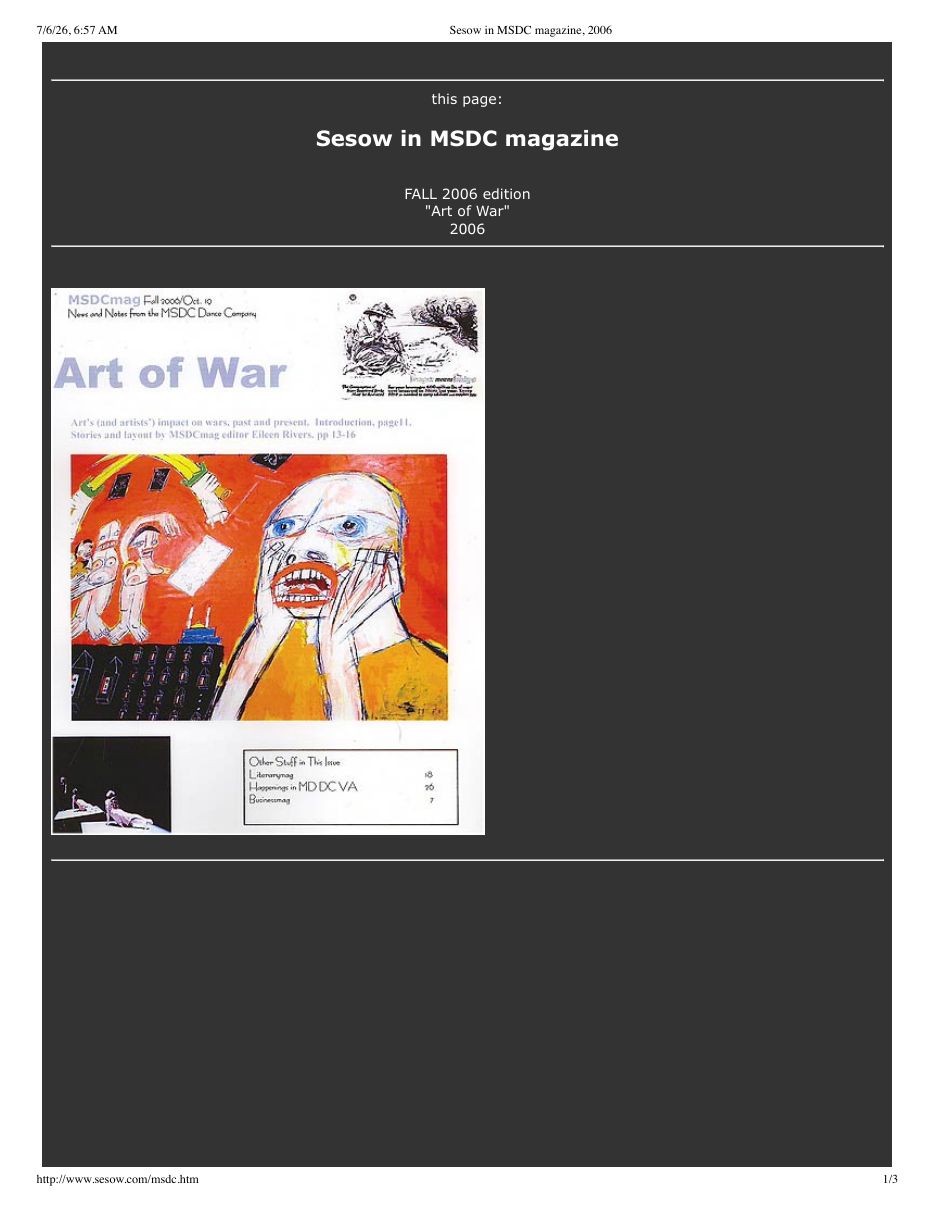
this page:
Sesow in MSDC magazine
FALL 2006 edition
"Art of War"
2006
http://www.sesow.com/msdc.htm
1/3
116126, 6:57 AM
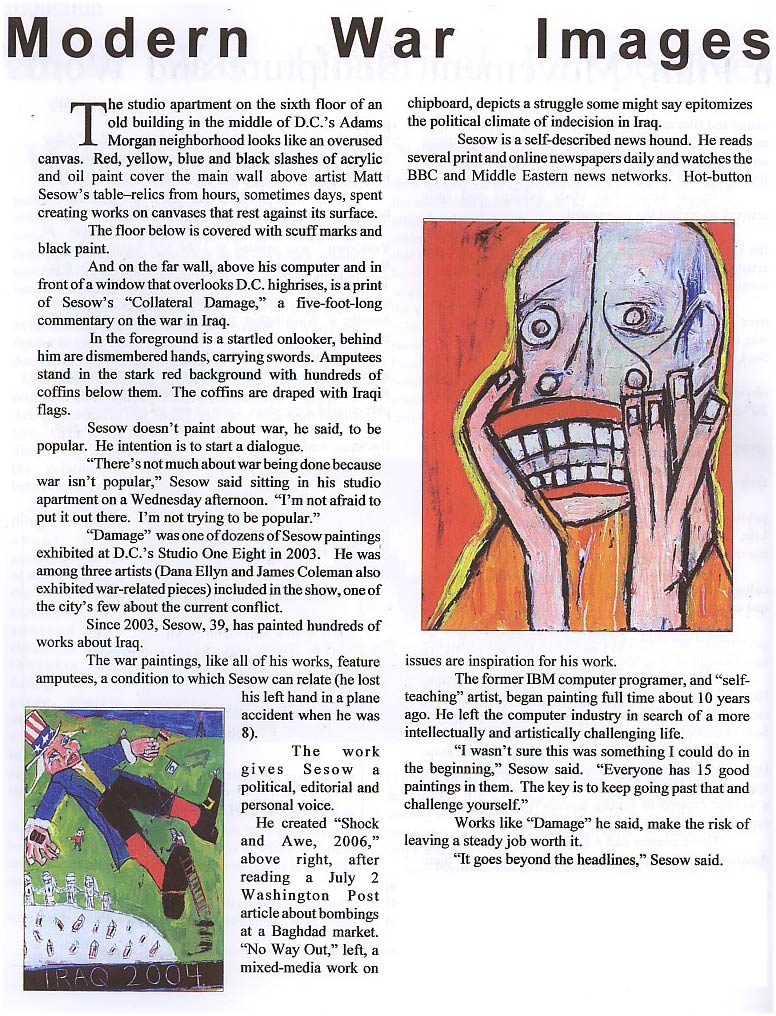
Modern
he studio apartment on the sixth floor of an
| old building in the middle of D.C.’s Adams
Morgan neighborhood looks like an overused
canvas. Red, yellow, blue and black slashes of acrylic
and oil paint cover the main wall above artist Matt
Sesow’s table-relics from hours, sometimes days, spent
creating works on canvases that rest against its surface.
The floor below is covered with scuff marks and
black paint.
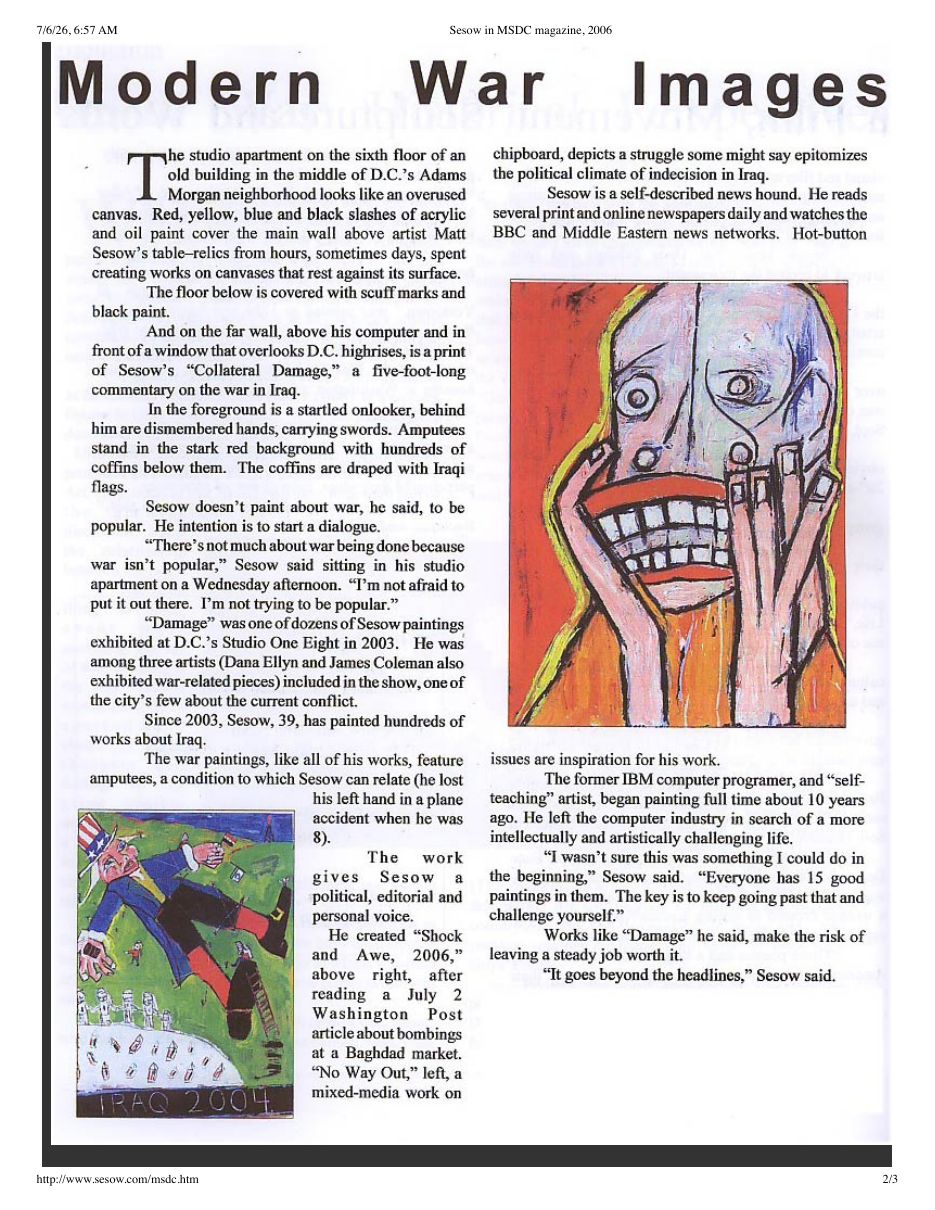
And on the far wall, above his computer and in
front of a window that overlooks D.C. highrises, is a print
of Sesow’s “Collateral Damage,” a five-foot-long
commentary on the war in Iraq.
In the foreground is a startled onlooker, behind
him are dismembered hands, carrying swords. Amputees
stand in the stark red background with hundreds of
coffins below them. The coffins are draped with Iraqi
flags.
Sesow doesn’t paint about war, he said, to be
popular. He intention is to start a dialogue.
“There’s not much about war being done because
war isn’t popular,” Sesow said sitting in his studio
apartment on a Wednesday afternoon. “I’m not afraid to
put it out there. I’m not trying to be popular.”
“Damage” was one of dozens of Sesow paintings
exhibited at D.C.’s Studio One Eight in 2003. He was
among three artists (Dana Ellyn and James Coleman also
exhibited war-related pieces) included in the show, one of
the city’s few about the current conflict.
Since 2003, Sesow, 39, has painted hundreds of
works about Iraq.
‘The war paintings, like all of his works, feature
amputees, a condition to which Sesow can relate (he lost
his left hand ina plane
accident when he was
8).
The work
gives Sesow a
political, editorial and
personal voice.
He created “Shock
and Awe, 2006,”
above right, after
reading a July 2
Washington Post
article about bombings
at a Baghdad market.
“No Way Out,” left, a
mixed-media work on
batp:/www.sesow.com/msde htm
Sesow in MSC magazine, 2006
War
Images
chipboard, depicts a struggle some might say epitomizes
the political climate of indecision in Iraq.
Sesow is a self-described news hound. He reads
several print and online newspapers daily and watches the
BBC and Middle Eastern news networks. Hot-button
issues are inspiration for his work.
‘The former IBM computer programer, and “self-
teaching” artist, began painting full time about 10 years
ago. He left the computer industry in search of a more
intellectually and artistically challenging life.
“J wasn’t sure this was something I could do in
the beginning,” Sesow said. “Everyone has 15 good
paintings in them. The key is to keep going past that and
challenge yourself.”
Works like “Damage” he said, make the risk of
leaving a steady job worth it.
“Tt goes beyond the headlines,” Sesow said.
28
[page 2 machine-read (OCR) from the image]
7/6/26, 6:57 AM
Sesow in MSDC magazine, 2006
CLICK HERE FOR MORE PAINTINGS...
http://www.sesow.com/msdc.htm
3/3