history.sesow.com/Press Room/2007

Press archive · 2007

SOLO in Maine

Text of the original page

sesow at Rougette Gallery, Rockland Maine

Solo Sesow at Rougette Gallery, Rockland, Maine

June/July 2007

Rockland, Maine

5 images from the original page · click to enlarge

SOLO in Maine, 2007: image 01 from the original sesow.com press page
maine1.jpg
SOLO in Maine, 2007: image 02 from the original sesow.com press page
maine2.jpg
SOLO in Maine, 2007: image 03 from the original sesow.com press page
maine3.jpg
SOLO in Maine, 2007: image 04 from the original sesow.com press page
maine4.jpg
SOLO in Maine, 2007: image 05 from the original sesow.com press page
maine5.jpg

Searchable text of the clippings

Machine-read (OCR) from the scans above on October 11, 2026. Spelling and line breaks may be wrong; check against the image before quoting.

Image 01 maine1.jpg view scan

Rougette Gallery

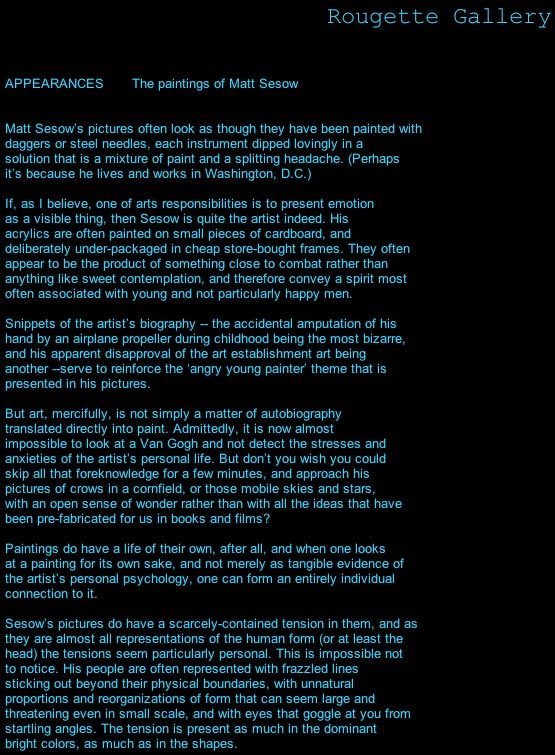
APPEARANCES The paintings of Matt Sesow

Matt Sesow’s pictures often look as though they have been painted with daggers or steel needles, each instrument dipped lovingly in a

solution that is a mixture of paint and a splitting headache. (Perhaps

it's because he lives and works in Washington, D.C.)

If, as | believe, one of arts responsibilities is to present emotion as a visible thing, then Sesow is quite the artist indeed. His

acrylics are often painted on small pieces of cardboard, and deliberately under-packaged in cheap store-bought frames. They often appear to be the product of something close to combat rather than anything like sweet contemplation, and therefore convey a spirit most often associated with young and not particularly happy men.

Snippets of the artist's biography — the accidental amputation of his hand by an airplane propeller during childhood being the most bizarre, and his apparent disapproval of the art establishment art being another -serve to reinforce the ‘angry young painter’ theme that is presented in his pictures.

But art, mercifully, is not simply a matter of autobiography translated directly into paint. Admittedly, it is now almost

impossible to look at a Van Gogh and not detect the stresses and anxieties of the artist's personal life. But don't you wish you could skip all that foreknowledge for a few minutes, and approach his pictures of crows in a comfield, or those mobile skies and stars, with an open sense of wonder rather than with all the ideas that have been pre-fabricated for us in books and films?

Paintings do have a life of their own, after all, and when one looks at a painting for its own sake, and not merely as tangible evidence of the artist's personal psychology, one can form an entirely individual ‘connection to it

‘Sesow’s pictures do have a scarcely-contained tension in them, and as they are almost all representations of the human form (or at least the head) the tensions seem particularly personal. This is impossible not to notice. His people are often represented with frazzled lines

sticking out beyond their physical boundaries, with unnatural proportions and reorganizations of form that can seem large and threatening even in small scale, and with eyes that goggle at you from startling angles. The tension is present as much in the dominant

bright colors, as much as in the shapes.

Image 02 maine2.jpg view scan

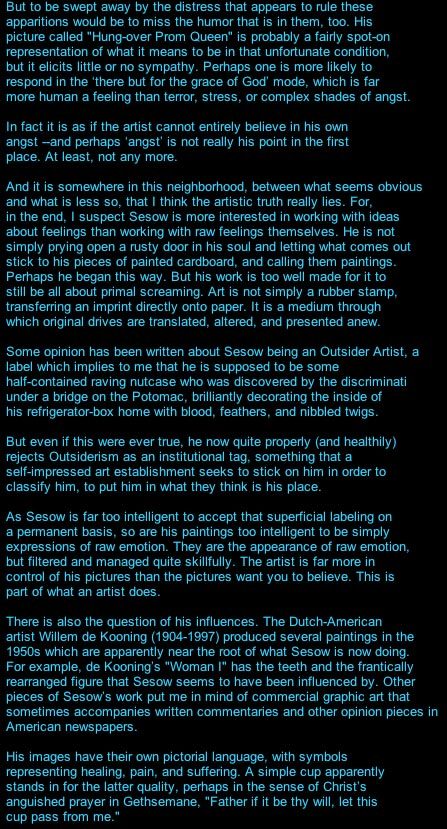
But to be swept away by the distress that appears to rule these apparitions would be to miss the humor that is in them, too. His picture called "Hung-over Prom Queen’ is probably a fairly spot-on representation of what it means to be in that unfortunate condition, but it elicits litle orno sympathy. Perhaps one is more likely to respond in the ‘there but for the grace of God’ mode, which is far more human a feeling than terror, stress, or complex shades of angst.

In fact itis as if the artist cannot entirely believe in his own angst —and perhaps ‘angst’ is not really his point in the first place. At least, not any more.

‘And it is somewhere in this neighborhood, between what seems obvious and what is less so, that | think the artistic truth really lies. For,

in the end, | suspect Sesow is more interested in working with ideas about feelings than working with raw feelings themselves. He is not simply prying open a rusty door in his soul and letting what comes out stick to his pieces of painted cardboard, and calling them paintings. Perhaps he began this way. But his work is too well made for it to

still be all about primal screaming. Art is not simply a rubber stamp, transferring an imprint directly onto paper. It is a medium through

Which original drives are translated, altered, and presented anew.

Some opinion has been written about Sesow being an Outsider Artist, @ label which implies to me that he is supposed to be some half-contained raving nutcase who was discovered by the discriminati under a bridge on the Potomac, brilliantly decorating the inside of

his refrigerator-box home with blood, feathers, and nibbled twigs.

But even if this were ever true, he now quite property (and healthily) rejects Outsiderism as an institutional tag, something that a self-impressed art establishment seeks to stick on him in order to classify him, to put him in what they think is his place.

‘As Sesow is far too intelligent to accept that superficial labeling on ‘a permanent basis, so are his paintings too intelligent to be simply expressions of raw emotion. They are the appearance of raw emotion, but filtered and managed quite skillfully. The artist is far more in control of his pictures than the pictures want you to believe. This is part of what an artist does.

‘There is also the question of his influences. The Dutch-American artist Willem de Kooning (1904-1997) produced several paintings in the 1950s which are apparently near the root of what Sesow is now doing.

For example, de Kooning's "Woman |" has the teeth and the frantically rearranged figure that Sesow seems to have been influenced by. Other pieces of Sesow’s work put me in mind of commercial graphic art that Sometimes accompanies written commentaries and other opinion pieces in ‘American newspapers,

His images have their own pictorial language, with symbols representing healing, pain, and suffering. A simple cup apparently stands in for the latter quality, perhaps in the sense of Christ's anguished prayer in Gethsemane, "Father if it be thy will, let this cup pass from me."

Image 03 maine3.jpg view scan

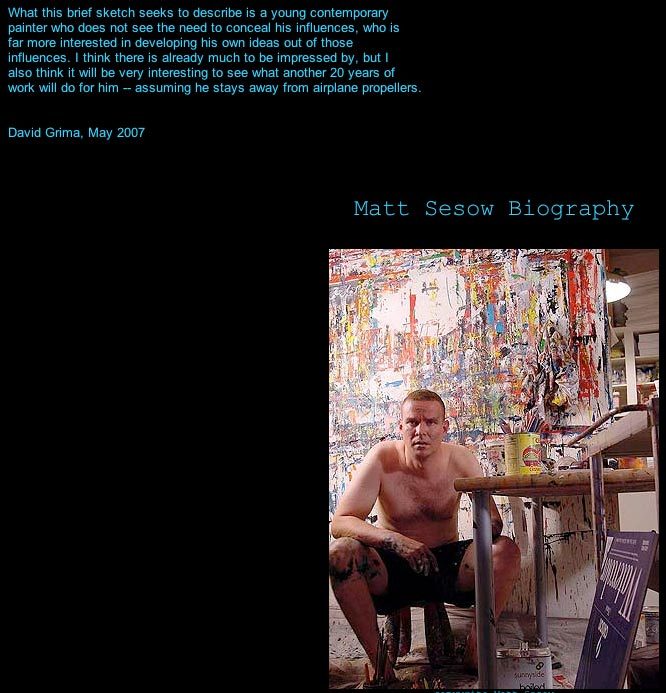
‘What this brief sketch seeks to describe is a young contemporary painter who does not see the need to conceal his influences, who is far more interested in developing his own ideas out of those

influences. | think there is already much to be impressed by, but | also think it will be very interesting to see what another 20 years of ‘work will do for him — assuming he stays away from airplane propellers.

David Grima, May 2007

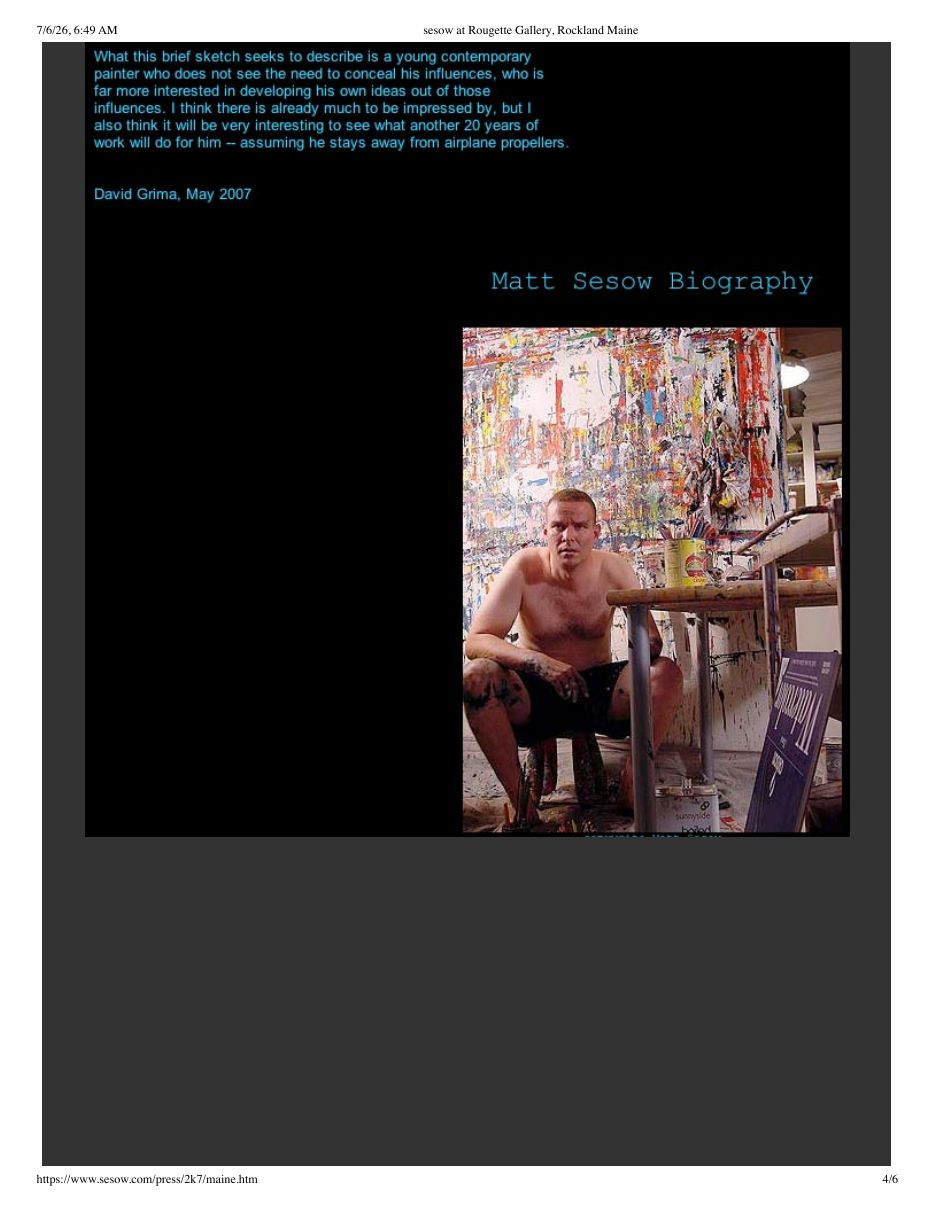
Matt Sesow Biography

Image 04 maine4.jpg view scan

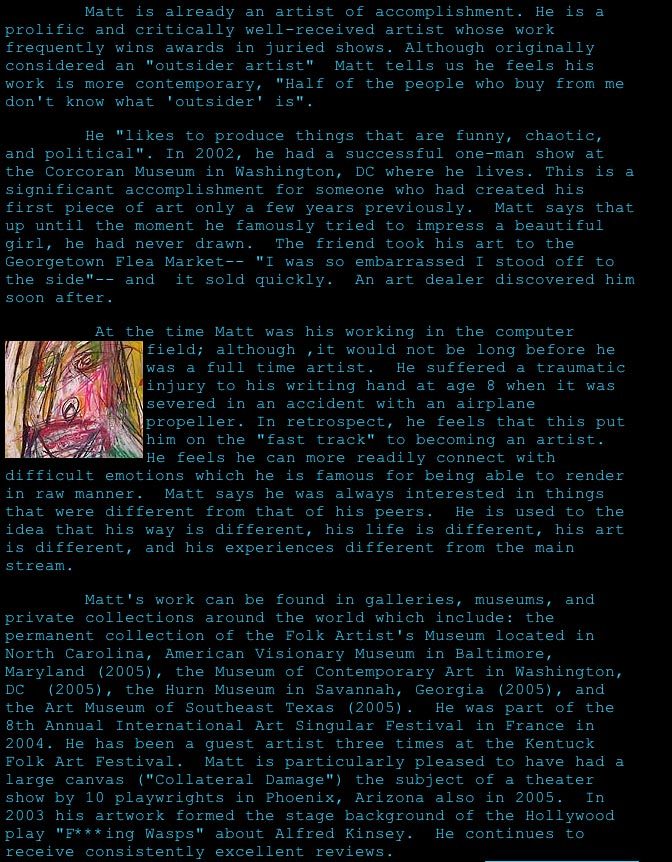
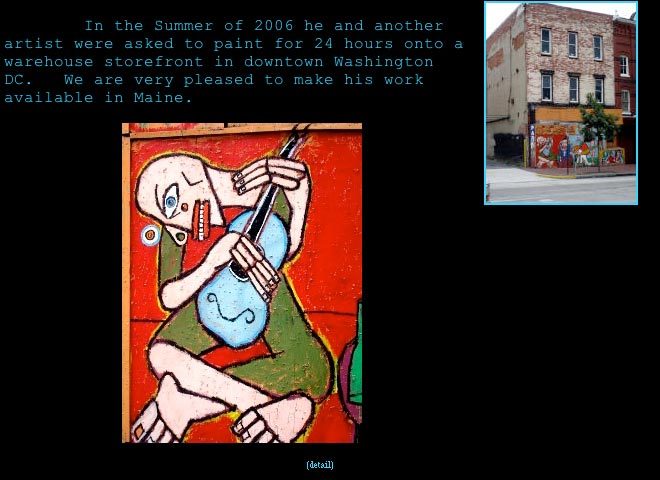
Matt is already an artist of accomplishment. He is a prolific and critically well-received artist whose work frequently wins awards in juried shows. Although originally considered an “outsider artist" Matt tells us he feels his work is more contemporary, “Half of the people who buy from me don't know what ‘outsider’ is".

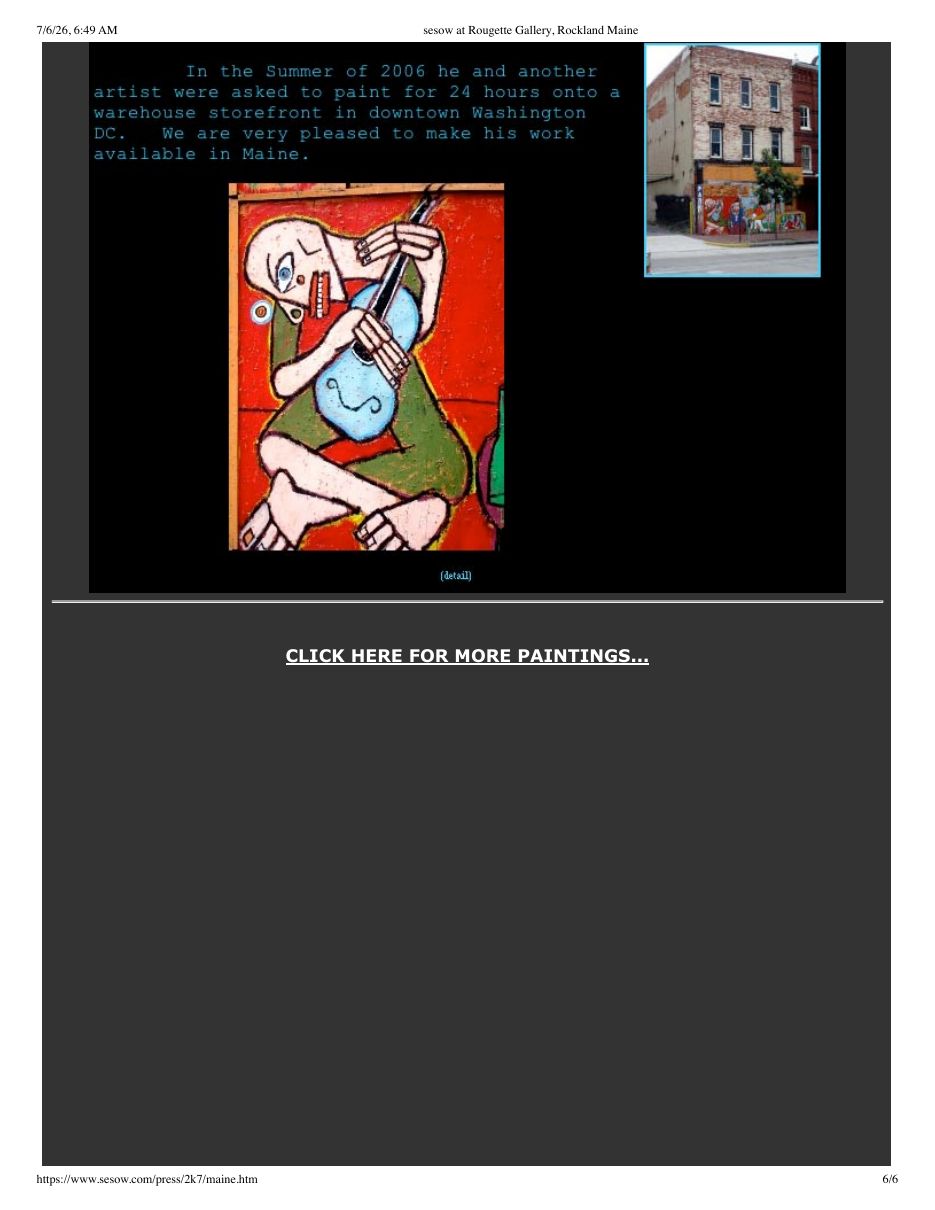
He "likes to produce things that are funny, chaotic and political". In 2002, he had a successful one-man show at the Corcoran Museum in Washington, DC where he lives. This is a significant accomplishment for someone who had created his first piece of art only a few years previously. Matt says that up until the moment he famously tried to impress a beautiful girl, he had never drawn. The friend took his art to the Georgetown Flea Market-- "I was so embarrassed I stood off to the side"-- and it sold quickly. An art dealer discovered him soon after.

At the time Matt was his working in the computer Z field; although ,it would not be long before he was a full time artist. He suffered a traumatic injury to his writing hand at age 8 when it was severed in an accident with an airplane propeller. In retrospect, he feels that this put Shim on the "fast track" to becoming an artist. He feels he can more readily connect with difficult emotions which he is famous for being able to render in raw manner. Matt says he was always interested in things that were different from that of his peers. He is used to the idea that his way is different, his life is different, his art is different, and his experiences different from the main stream.

Matt's work can be found in galleries, museums, and private collections around the world which include: the permanent collection of the Folk Artist's Museum located in North Carolina, American Visionary Museum in Baltimore Maryland (2005), the Museum of Contemporary Art in Washington, DC (2005), the Hurn Museum in Savannah, Georgia (2005), and the Art Museum of Southeast Texas (2005). He was part of the 8th Annual International Art Singular Festival in France in 2004. He has been a guest artist three times at the Kentuck Folk Art Festival. Matt is particularly pleased to have had a large canvas ("Collateral Damage") the subject of a theater show by 10 playwrights in Phoenix, Arizona also in 2005. In 2003 his artwork formed the stage background of the Hollywood play “F***ing Wasps" about Alfred Kinsey. He continues to receive consistently excellent reviews.

Source and citation

Cite as: “SOLO in Maine.” Matt Sesow press archive, 2007. history.sesow.com/press/2007-solo-in-maine.html. Accessed [date].

Clippings and photographs are kept here so the record survives if the original pages go offline. Copyright in each article stays with its publisher and author; corrections and permission requests to sesow@sesow.com.

Saved copies — every page, full text

The original page as it was saved, every page as an image you can zoom.

Every outside source cited on this page, kept here as page images you can zoom and as complete, searchable text — so nothing depends on a link that may disappear. Use your browser’s Find (Ctrl/Cmd+F) to search all of it.

Saved copy · 6 pages
PDF

PDF, page 1
Page 1
PDF, page 2
Page 2
PDF, page 3
Page 3
PDF, page 4
Page 4
PDF, page 5
Page 5
PDF, page 6
Page 6

Click a page to open it — scroll or pinch to zoom, drag to move, arrow keys for the next page.

The full text of this page is printed above, under “Text of the original page”, with the machine-read text of its clippings.