Press February 1, 2006
Connect Savannah — “Faces of Folk” art review by Bertha Husband
Magazine article · 2006-02-01
'Faces of Folk' — Through Feb. 28 @ The Hurn Museum (Culture | Art Review by Bertha Husband)
Connect Savannah
Click a page to open it — scroll or pinch to zoom, drag to move.
Full text
Photographed by Matt Sesow from his press packets, October 18, 2026; text transcribed from the photos by Claude.
CULTURE | Art Review by Bertha Husband — Connect Savannah 02.01.06 — www.connectsavannah.com — page 19
'Faces of Folk'
Through Feb. 28 @ The Hurn Museum
IN ONE OF THE SMALL galleries reserved for intimate, temporary exhibitions at the Hurn Museum, there are currently showing twelve works by nine artists under the title of "Faces of Folk."
In a variety of sizes, styles and media the viewer is confronted with the theme of portraiture. The works have been carefully chosen from emerging artists in the Museum's collection, and what initially stood out for me was the overall painterly accomplishment, experimentation with media and clearly modernist influences that were apparent, and that we generally do not expect from artists labeled, "folk."
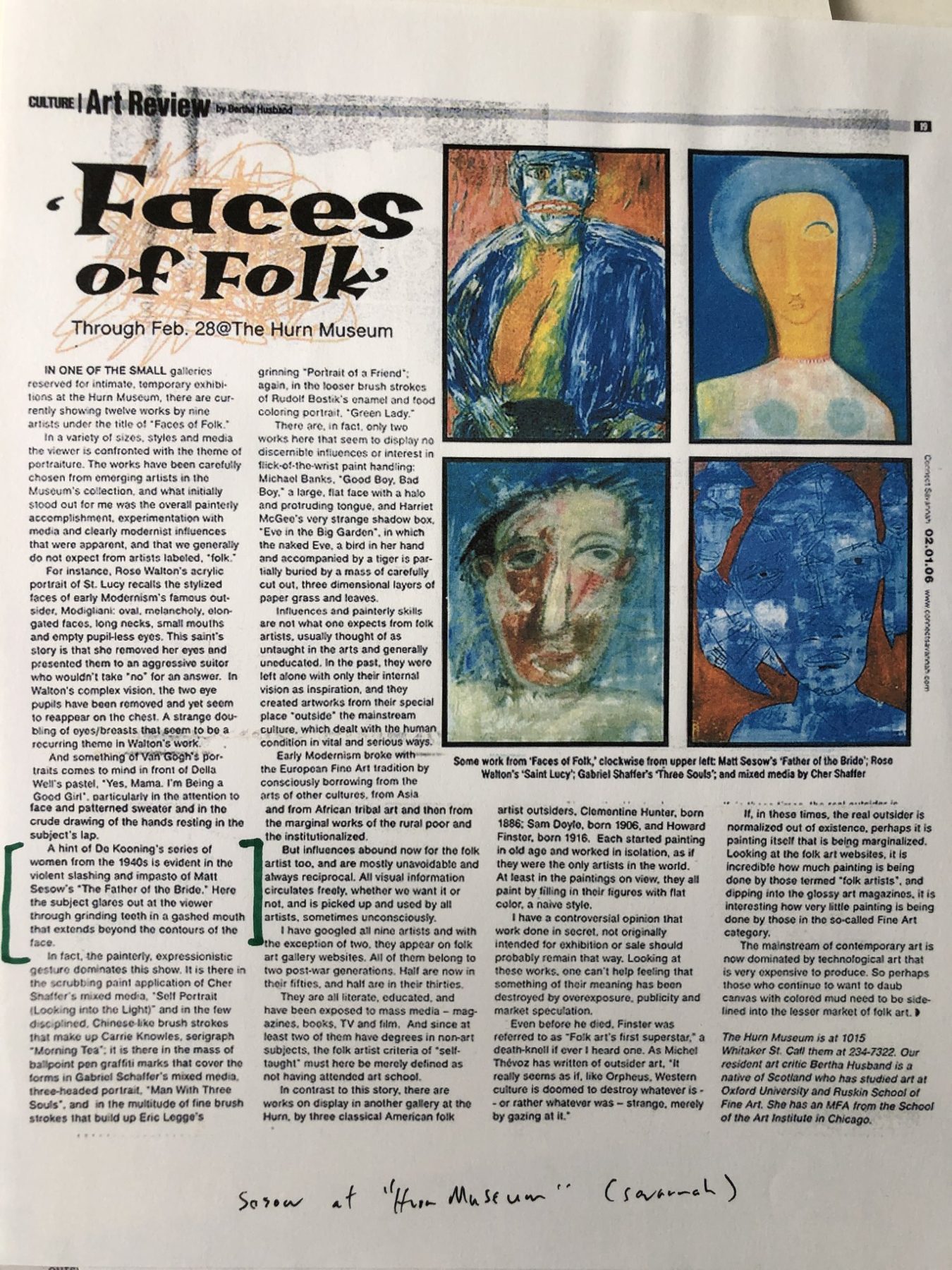
For instance, Rose Walton's acrylic portrait of St. Lucy recalls the stylized faces of early Modernism's famous outsider, Modigliani: oval, melancholy, elongated faces, long necks, small mouths and empty pupil-less eyes. This saint's story is that she removed her eyes and presented them to an aggressive suitor who wouldn't take "no" for an answer. In Walton's complex vision, the two eye pupils have been removed and yet seem to reappear on the chest. A strange doubling of eyes/breasts that seem to be a recurring theme in Walton's work.
And something of Van Gogh's portraits comes to mind in front of Della Well's pastel, "Yes, Mama. I'm Being a Good Girl", particularly in the attention to face and patterned sweater and in the crude drawing of the hands resting in the subject's lap.
[bracketed in green:] A hint of De Kooning's series of women from the 1940s is evident in the violent slashing and impasto of Matt Sesow's "The Father of the Bride." Here the subject glares out at the viewer through grinding teeth in a gashed mouth that extends beyond the contours of the face.
In fact, the painterly, expressionistic gesture dominates this show. It is there in the scrubbing paint application of Cher Shaffer's mixed media, "Self Portrait (Looking into the Light)" and in the few disciplined, Chinese-like brush strokes that make up Carrie Knowles, serigraph "Morning Tea"; it is there in the mass of ballpoint pen graffiti marks that cover the forms in Gabriel Schaffer's mixed media, three-headed portrait, "Man With Three Souls", and in the multitude of fine brush strokes that build up Eric Legge's grinning "Portrait of a Friend"; again, in the looser brush strokes of Rudolf Bostik's enamel and food coloring portrait, "Green Lady."
There are, in fact, only two works here that seem to display no discernible influences or interest in flick-of-the-wrist paint handling: Michael Banks, "Good Boy, Bad Boy," a large, flat face with a halo and protruding tongue, and Harriet McGee's very strange shadow box, "Eve in the Big Garden", in which the naked Eve, a bird in her hand and accompanied by a tiger is partially buried by a mass of carefully cut out, three dimensional layers of paper grass and leaves.
Influences and painterly skills are not what one expects from folk artists, usually thought of as untaught in the arts and generally uneducated. In the past, they were left alone with only their internal vision as inspiration, and they created artworks from their special place "outside" the mainstream culture, which dealt with the human condition in vital and serious ways.
Early Modernism broke with the European Fine Art tradition by consciously borrowing from the arts of other cultures, from Asia and from African tribal art and then from the marginal works of the rural poor and the institutionalized.
But influences abound now for the folk artist too, and are mostly unavoidable and always reciprocal. All visual information circulates freely, whether we want it or not, and is picked up and used by all artists, sometimes unconsciously.
I have googled all nine artists and with the exception of two, they appear on folk art gallery websites. All of them belong to two post-war generations. Half are now in their fifties, and half are in their thirties.
They are all literate, educated, and have been exposed to mass media – magazines, books, TV and film. And since at least two of them have degrees in non-art subjects, the folk artist criteria of "self-taught" must here be merely defined as not having attended art school.
In contrast to this story, there are works on display in another gallery at the Hurn, by three classical American folk artist outsiders, Clementine Hunter, born 1886; Sam Doyle, born 1906, and Howard Finster, born 1916. Each started painting in old age and worked in isolation, as if they were the only artists in the world. At least in the paintings on view, they all paint by filling in their figures with flat color, a naive style.
I have a controversial opinion that work done in secret, not originally intended for exhibition or sale should probably remain that way. Looking at these works, one can't help feeling that something of their meaning has been destroyed by overexposure, publicity and market speculation.
Even before he died, Finster was referred to as "Folk art's first superstar," a death-knell if ever I heard one. As Michel Thévoz has written of outsider art, "It really seems as if, like Orpheus, Western culture is doomed to destroy whatever is - or rather whatever was – strange, merely by gazing at it."
[illegible partial line]
If, in these times, the real outsider is normalized out of existence, perhaps it is painting itself that is being marginalized. Looking at the folk art websites, it is incredible how much painting is being done by those termed "folk artists", and dipping into the glossy art magazines, it is interesting how very little painting is being done by those in the so-called Fine Art category.
The mainstream of contemporary art is now dominated by technological art that is very expensive to produce. So perhaps those who continue to want to daub canvas with colored mud need to be sidelined into the lesser market of folk art.
The Hurn Museum is at 1015 Whitaker St. Call them at 234-7322. Our resident art critic Bertha Husband is a native of Scotland who has studied art at Oxford University and Ruskin School of Fine Art. She has an MFA from the School of the Art Institute in Chicago.
[Caption:] Some work from 'Faces of Folk,' clockwise from upper left: Matt Sesow's 'Father of the Bride'; Rose Walton's 'Saint Lucy'; Gabriel Shaffer's 'Three Souls'; and mixed media by Cher Shaffer
[Handwritten: Sesow at "Hurn Museum" (Savannah)]
Research notes
- Artists listed on this magazine article ('Faces of Folk' — Through Feb. 28 @ The Hurn Museum (Culture | Art Review by Bertha Husband)): Carrie Knowles, Cher Shaffer, Della Well, Eric Legge, Gabriel Shaffer, Harriet McGee, Michael Banks, Rose Walton, Rudolph Bostic.
Where this record comes from
- Matt Sesow press packet (photographed by Matt, 2026-10-18)
Cite as: Sesow, Matt. “Connect Savannah — ‘Faces of Folk’ art review by Bertha Husband.” Matt Sesow Career Chronicle, 2006. history.sesow.com/e/2006-connect-savannah-faces-of-folk-review.html. Accessed [date].
Were you there? Do you have a photo, a clipping or a memory of this? Please write to sesow@sesow.com or use Ask Matt a question, and it will be added here.
Also in 2006
- Media Artist Talk — Matt Sesow speaks about his art at George Washington University
- Exhibition “Don Giovanni,” Rebus Works, Raleigh, NC
- Exhibition Hollywood, CA: “Theater of Note”
- Press Molly Knight, DC Style Magazine
- Exhibition Two-Person Show — with Dana Ellyn
- Exhibition Two-Person Show — with Justin Kaufman
- Exhibition “Soul Mining,” Gallery One Eight, Washington, DC
- Milestone Curated and created paintings from DC Street Banners for “Banners from the Fringe”
- Exhibition 24-hour mural painting — Washington, DC Fringe Festival
- Press “Fringe for the Eyes” — Washington Post Going Out Gurus, July 2006
- Press “24 Hours of Color” — Ward 2 News on the Fringe mural, 2006
- Exhibition “Cupidity,” Gallery Neptune, Washington, DC
- Exhibition Outsider Art in the Hamptons
- Exhibition “The Many Faces of Folk Art” — Hurn Museum of Contemporary Folk Art, Savannah
- Press Washington City Paper — “Remastered” Critic’s Pick
- Press Sacramento Bee — Critic’s Pick, Pamela Skinner Gallery Dog and Cat Group Show
- Press MSDC Magazine — “Art of War” article
- Press “The Pain Practitioner” Magazine
- Press “Ideas in Pictures” #5 — two drawings by Matt Sesow
- Press N&O Newspaper — Raleigh
- Press Days of Action, Calls For Peace
- Media Exit Clov CD covers — painting on two CD covers by DC band Exit Clov
- Milestone Paints in Morocco — Essaouira and Marrakech
- Exhibition Merrill-Jennings Galleries, Davidson, NC
- Exhibition “Art of War” — Studio One Eight, March 2006
- Press The Examiner, October 28, 2006 — “a loose collective of non-art-school visionaries”
- Press The News & Observer — Raleigh
- Exhibition Live painting — painted onstage and in the lobby during the Opera Company of North Carolina’s multimedia…