Saved copy · 2 pages
Let them eat rock: What price freedom in All You Can Eat?
San Francisco Bay Guardian, Issue 43.02 (Stage) (Robert Avila) · October 8–14, 2008 · original address
Robert Avila's review of the foolsFURY / Steve Morgan Haskell rock play All You Can Eat, whose set
Click a page to open it — scroll or pinch to zoom, drag to move, arrow keys for the next page.
Full text
Full text as published. Copyright remains with the original publisher; reproduced here for the historical record (machine-read pages may contain small errors — check the page images).
Let them eat rock: What price freedom in All You Can Eat?
Let them eat rock What price freedom in All You Can Eat?
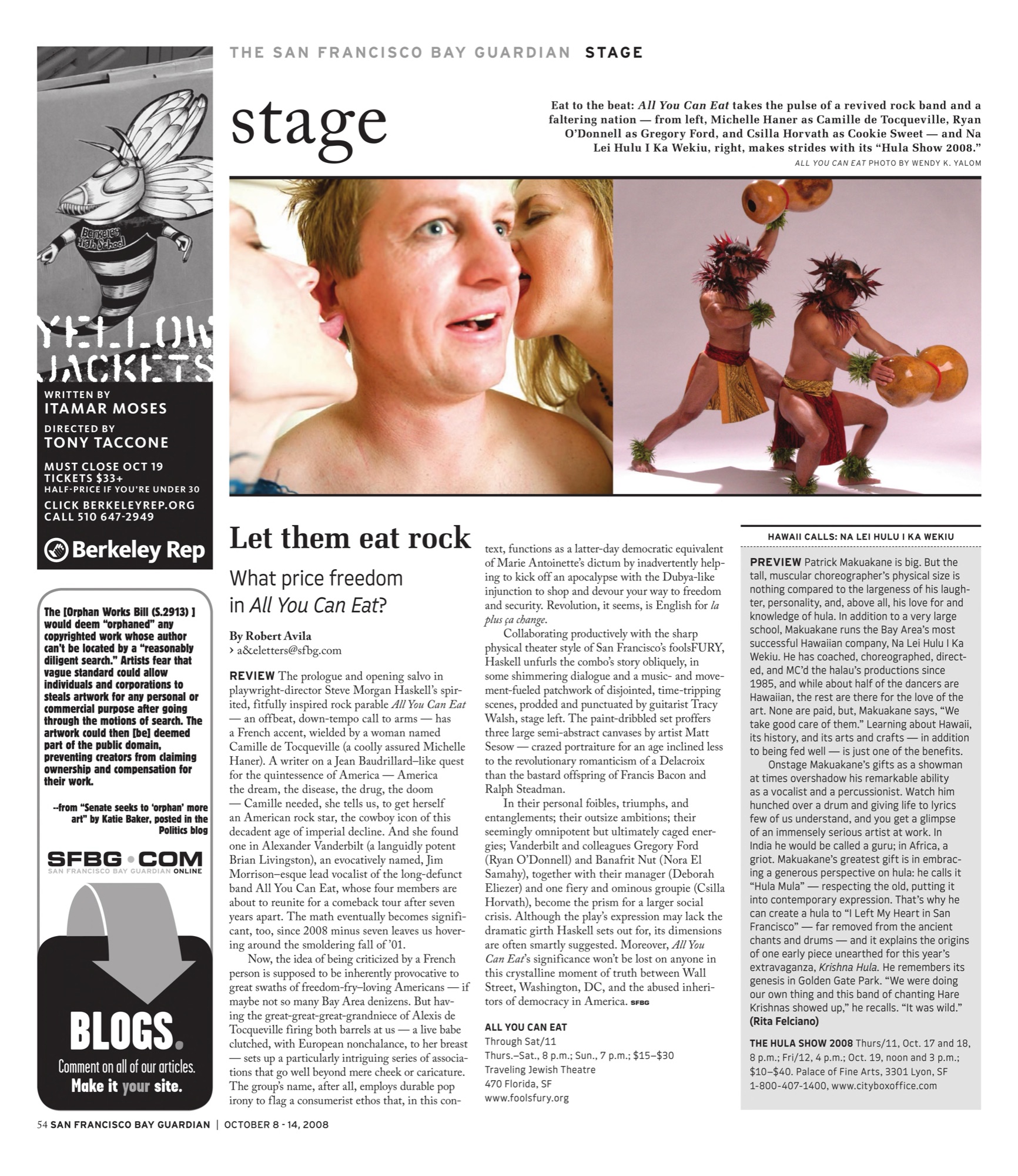
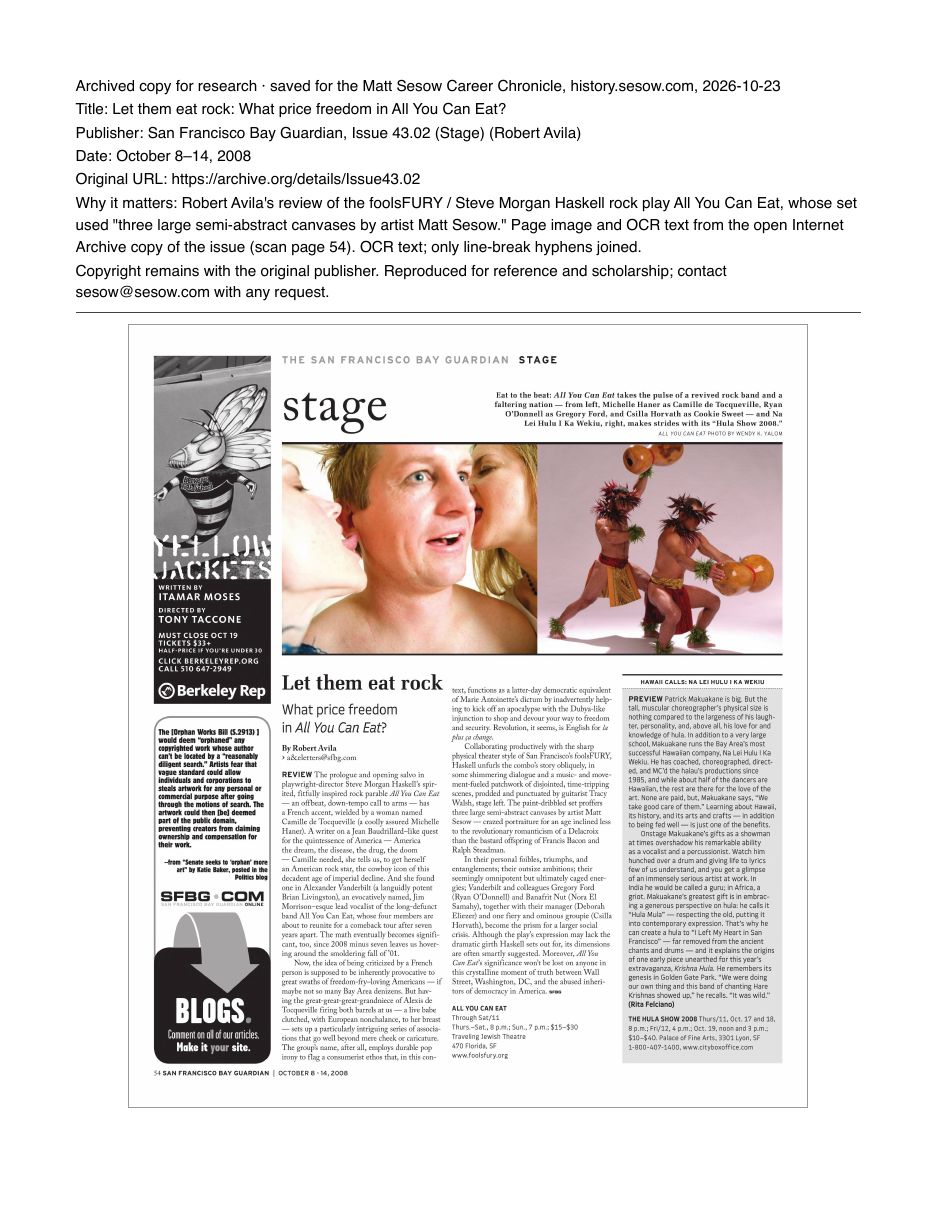
By Robert Avila > a 8celetters@sfbg.com REVIEW The prolog ue and opening salvo in playwrightdirector Steve Morgan Haskell’s spirited, fitfully inspired rock parable All You Can Eat — an offbeat, down-tempo call to arms — has a French accent, wielded by a woman named Camille de Tocqueville (a coolly assured Michelle Haner). A writer on a Jean Baudrillard-like quest for the quintessence of America — America the dream, the disease, the drug, the doom — Camille needed, she tells us, to get herself an American rock star, the cowboy icon of this decadent age of imperial decline. And she found one in Alexander Vanderbilt (a languidly potent Brian Livingston), an evocatively named, Jim Morrison-esque lead vocalist of the long-defunct band All You Can Eat, whose four members are about to reunite for a comeback tour after seven years apart. The math eventually becomes significant, too, since 2008 minus seven leaves us hovering around the smoldering fall of’01. Now, the idea of being criticized by a French person is supposed to be inherently provocative to great swaths of freedom-fry-loving Americans — if maybe not so many Bay Area denizens. But having the great-great-great-grandniece of Alexis de Tocqueville firing both barrels at us — a live babe clutched, with European nonchalance, to her breast — sets up a particularly intriguing series of associations that go well beyond mere cheek or caricature. The group’s name, after all, employs durable pop irony to flag a consumerist ethos that, in this context, functions as a latter-day democratic equivalent of Marie Antoinette’s dictum by inadvertently helping to kick off an apocalypse with the Dubya-like injunction to shop and devour your way to freedom and security. Revolution, it seems, is English for la plus ça change.
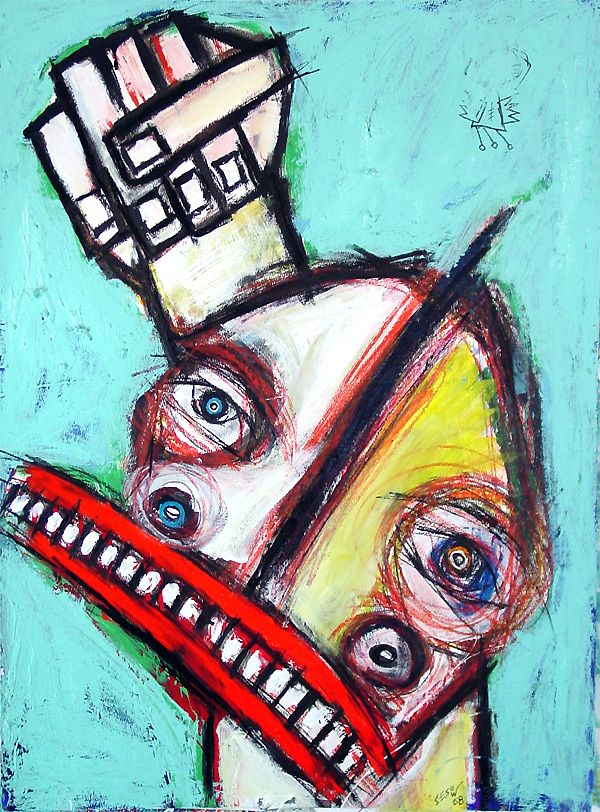
Collaborating productively with the sharp physical theater style of San Francisco’s foolsFURY, Haskell unfurls the combo’s story obliquely, in some shimmering dialogue and a music- and movement-fueled patchwork of disjointed, time-tripping scenes, prodded and punctuated by guitarist Tracy Walsh, stage left. The paint-dribbled set proffers three large semi-abstract canvases by artist Matt Sesow — crazed portraiture for an age inclined less to the revolutionary romanticism of a Delacroix than the bastard offspring of Francis Bacon and Ralph Steadman. In their personal foibles, triumphs, and entanglements; their outsize ambitions; their seemingly omnipotent but ultimately caged energies; Vanderbilt and colleagues Gregory Ford (Ryan O’Donnell) and Banafrit Nut (Nora El Samahy), together with their manager (Deborah Eliezer) and one fiery and ominous groupie (Csilla Horvath), become the prism for a larger social crisis. Although the play’s expression may lack the dramatic girth Haskell sets out for, its dimensions are often smartly suggested. Moreover, All You Can Eat’s significance won’t be lost on anyone in this crystalline moment of truth between Wall Street, Washington, DC, and the abused inheritors of democracy in America, sfbg ALL YOU CAN EAT Through Sat/11 Thurs.-Sat., 8 p.m.; Sun., 7 p.m.; $15-$30 Traveling Jewish Theatre 470 Florida, SF www.foolsfury.org