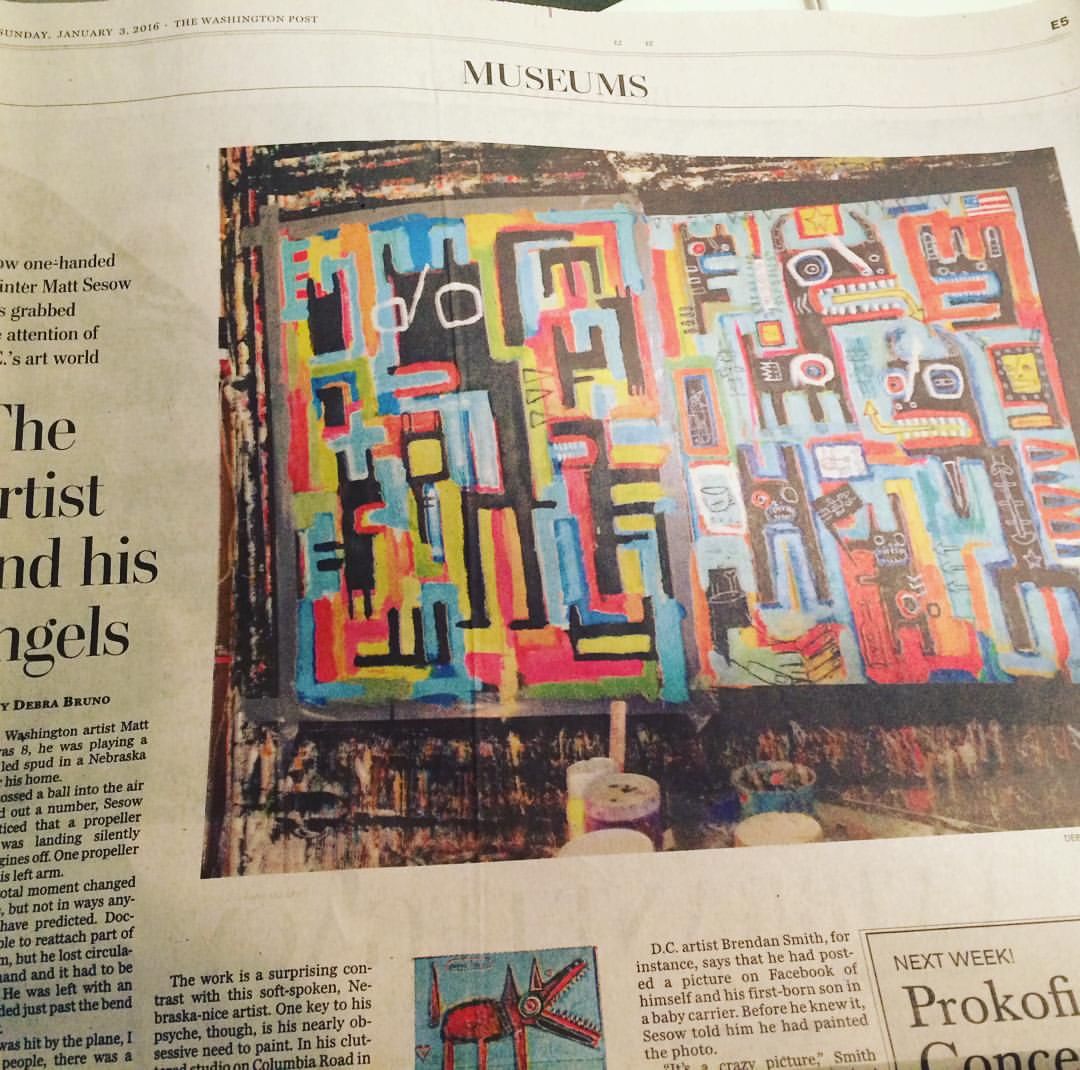
here's the Washington Post Article: https://www.washingtonpost.com/entertainment/museums/the-saga-of-matt-sesow-how-a-one-handed-artist-is-seizing-dcs-art-world/2015/12/30/ad2798d8-a438-11e5-9c4e-be37f66848bb_story.html?tid=ss_fb
Saved copy · 9 pages
The saga of Matt Sesow: How a one-handed artist is seizing D.C.'s art world
Columbia Daily Tribune (Missouri) — syndicated from The Washington Post (Debra Bruno, Special To · 2016-01-10 · original address
Syndicated reprint of the Washington Post feature, carrying it to Missouri readers. Live page





Click a page to open it — scroll or pinch to zoom, drag to move, arrow keys for the next page.
Full text
Full text as published. Copyright remains with the original publisher; reproduced here for the historical record (machine-read pages may contain small errors — check the page images).
OSIM NaN ILIA
-39:98-
$1/WK FOR THE FIRST 4 WEEKS,
Tanal vanartine van con
[page 3 machine-read (OCR) from the image]
wuvarreporung you corr
count on, every day.
‘Snare your subscription with end
[page 4 machine-read (OCR) from the image]
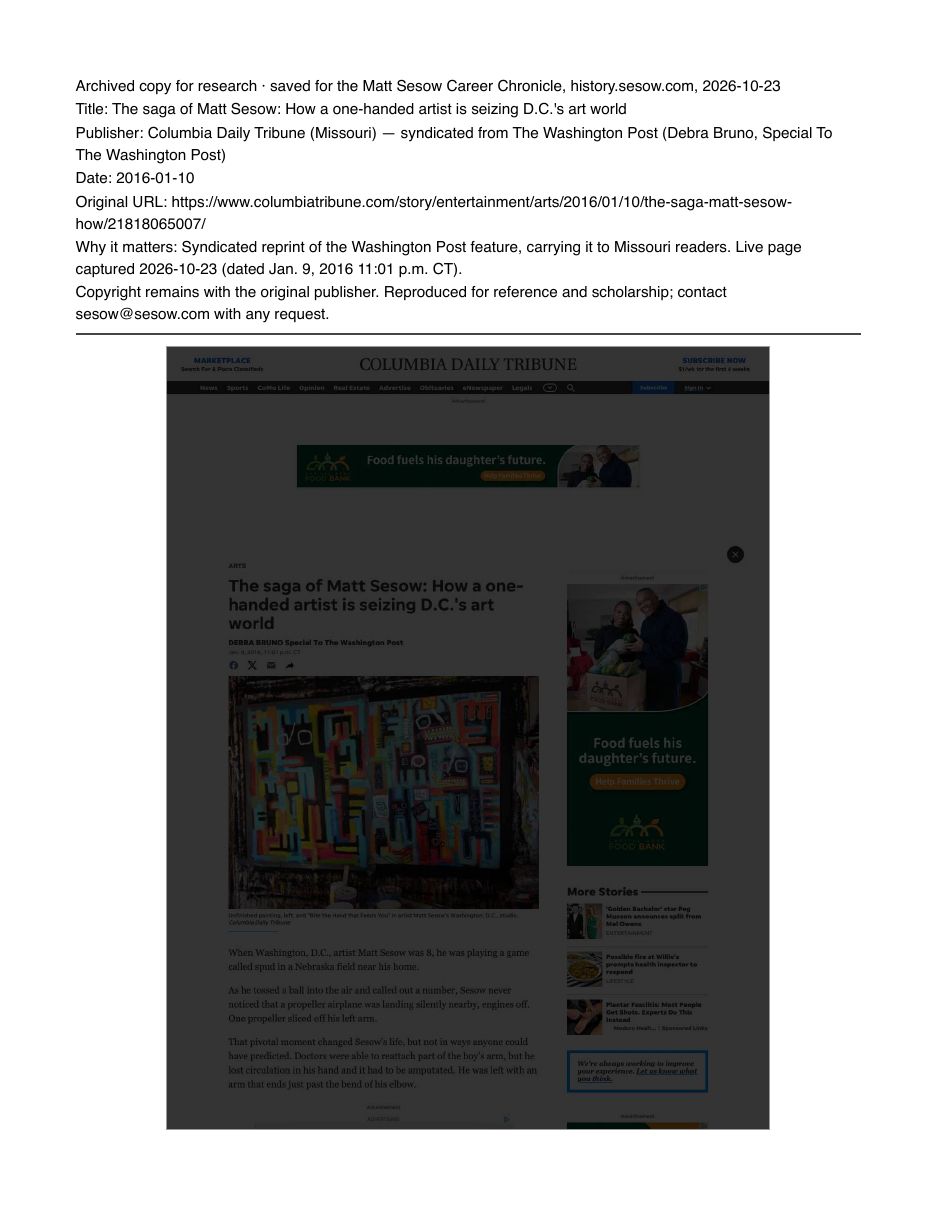
The saga of Matt Sesow: How a one-handed artist is seizing D.C.'s art world The saga of Matt Sesow: How a one-handed artist is seizing D.C.'s art world When Washington, D.C., artist Matt Sesow was 8, he was playing a game called spud in a Nebraska field near his home.
As he tossed a ball into the air and called out a number, Sesow never noticed that a propeller airplane was landing silently nearby, engines off. One propeller sliced off his left arm. That pivotal moment changed Sesow’s life, but not in ways anyone could have predicted. Doctors were able to reattach part of the boy’s arm, but he lost circulation in his hand and it had to be amputated. He was left with an arm that ends just past the bend of his elbow. “When I was hit by the plane, I always tell people, there was a guardian angel there,” Sesow says in a new documentary, “Join Hands,” about the artist and his work. “But was it to protect me or to push me in front of the plane?”
Few people would give a guardian angel credit for a traumatic event, but few people are artists like Sesow.
Sesow, 49, showed promise early on. He taught himself computer programming at 14. After college, which he attended with a scholarship from the Mensa Foundation, he landed a job at IBM and moved to Washington. But for years, he would have nightmares about being hit by the plane. In 1994, he started painting. “Then I stopped having nightmares,” he says. Sesow is possibly one of the District of Columbia’s most prolific artists, producing about 100 paintings a year. He also has an expanding following both in this country and abroad, with a recent show in Barcelona.
Baltimore’s American Visionary Art Museum is planning a one-man exhibition of Sesow’s work in May. Matt Sesow: Shock and Awe is “a great way to show him in full glory,” said museum founder and Director Rebecca Alban Hoffberger.
“There’s so much energy in some of his work,” she said. “And where he got that sense of color — you can’t get that in school.”
One thing that makes him popular among young collectors, many of whom have never bought art before, is his affordable prices.
“People will say to me, ‘I saw that work online,’ ” he says. He’ll tell them, “You can have it for 40 bucks.”
He prefers to sell a piece himself either from Facebook, where his personal page has topped off at 5,000 friends — his fan page is approaching that number — or on other social media. He also organizes visits to his studio.
No painting on his website costs more than $800. Sesow says that galleries hate him because his prices are so low. “Galleries and agents always want me to raise prices,” he says, “but my path is a healing path.”
Sesow is self-taught and his work is primitive, inspired partly by the New York graffiti artist JeanMichel Basquiat. It is full of bright primary colors, slashes of angry faces and packed with iconography that reflects the state of his psyche at the moment, including a “trauma cup” that contains anger and hurt, a scary-looking rabbit, a bull, stars and often a slash of a mouth with jagged white teeth.
The work is a surprising contrast with this soft-spoken, Nebraska-nice artist. One key to his psyche, though, is his nearly obsessive need to paint. In his cluttered studio, Sesow lives like a monk — a very messy monk. The kitchen of his tiny condo no longer holds a refrigerator or stove. When he is hungry, he heats up some frozen spinach and quinoa on a hot plate.
In the corner is a bunk bed where he sleeps. His wife, artist Dana Ellyn, hasn’t stayed overnight in his apartment in 14 years, she said.
“Join Hands” captures Sesow and Ellyn talking about their life together. The couple did a project called “31 Days in July” together, to mark the beginning of the Iraq War. For 10 years, both artists did one painting a day in the month of July, based on something in that day’s news. The two maintain their own apartments, with separate studios, partly because both bought property at an opportune time. But they also like living and working apart and getting together three or four times a week. When he paints, Sesow says, he “can go to a very unhappy, dark place.” Over the years, Sesow has expanded his reach. He was initially reluctant to do art on commission. Now he does, but his subjects might not necessarily see themselves in the finished works. D.C. artist Brendan Smith, for instance, says that he had posted a picture on Facebook of himself and his first-born son in a baby carrier. Before he knew it, Sesow told him he had painted the photo. “It’s a crazy picture,” Smith says. “Soren,” his son, “has giant white teeth and crazy eyes. Most parents would not want their kids depicted this way, but I loved it.”
In fact, Smith commissioned another painting from Sesow of his second son. “Very few people have such a personal style, and it’s authentic, based on his experience,” D.C. artist Scott Brooks said.
About that experience: Sesow admits he has never seen the first eight minutes of “Join Hands,” where he talks about that day in 1974. Filmmaker Leslye Abbey said she managed to film the first time he talked openly about the accident. Sesow starts to cry when he recalls what that event must have been like for his family.
Like the guardian angel that might have accompanied Sesow on that fateful day, another angel plays a role in Sesow’s saga.
Just after the accident and heavily dosed with morphine, the boy had a hospital visitor. This angel told him he had a choice to make: Die now and go to heaven, he says, or “fight and have an
interesting life. I said, ‘Oh, I want to have an interesting life.’ ”