Saved copy · 4 pages
Mattatuck showcases work of artists who flout the typical conventions
Republican-American (Waterbury, CT), p. B1, Accent (Tracey O'Shaughnessy) · 2024-06-22
Connecticut newspaper review of the Mattatuck Museum outsider-art show that included his work.

Click a page to open it — scroll or pinch to zoom, drag to move, arrow keys for the next page.
Full text
Full text as published. Copyright remains with the original publisher; reproduced here for the historical record (machine-read pages may contain small errors — check the page images).
Mattatuck showcases work of artists who flout the typical conventions PRIVATE ARCHIVE COPY — library database item, not for republishing.
=== NewsBank document news/199DA055A0B67360 === Title: Mattatuck showcases work of artists who flout the typical conventions Meta: June 22, 2024 | Republican-American (Waterbury, CT) Author/Byline: BY TRACEY O'SHAUGHNESSY REPUBLICAN-AMERICAN | Page: B1 | Section: Accent 877 Words | Readability: Lexile: 1310, grade level(s): >12 URL: https://infoweb-newsbank-com.dclibrary.idm.oclc.org/apps/news/document-view? p=WORLDNEWS&docref=news/199DA055A0B67360 [FULL TEXT from NewsBank Access World News via DC Public Library]
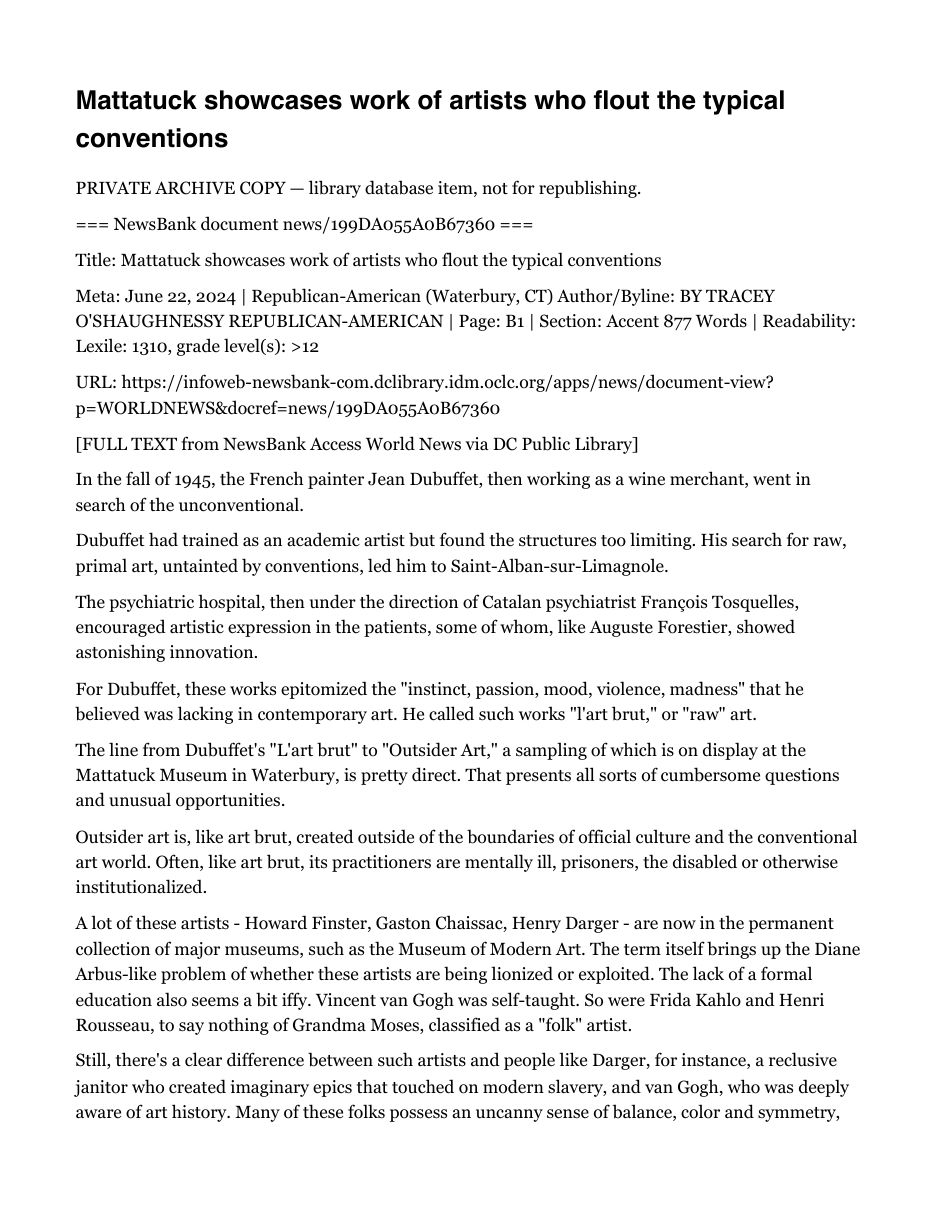
In the fall of 1945, the French painter Jean Dubuffet, then working as a wine merchant, went in search of the unconventional.
Dubuffet had trained as an academic artist but found the structures too limiting. His search for raw, primal art, untainted by conventions, led him to Saint-Alban-sur-Limagnole. The psychiatric hospital, then under the direction of Catalan psychiatrist François Tosquelles, encouraged artistic expression in the patients, some of whom, like Auguste Forestier, showed astonishing innovation.
For Dubuffet, these works epitomized the "instinct, passion, mood, violence, madness" that he believed was lacking in contemporary art. He called such works "l'art brut," or "raw" art. The line from Dubuffet's "L'art brut" to "Outsider Art," a sampling of which is on display at the Mattatuck Museum in Waterbury, is pretty direct. That presents all sorts of cumbersome questions and unusual opportunities.
Outsider art is, like art brut, created outside of the boundaries of official culture and the conventional art world. Often, like art brut, its practitioners are mentally ill, prisoners, the disabled or otherwise institutionalized.
A lot of these artists - Howard Finster, Gaston Chaissac, Henry Darger - are now in the permanent collection of major museums, such as the Museum of Modern Art. The term itself brings up the Diane Arbus-like problem of whether these artists are being lionized or exploited. The lack of a formal education also seems a bit iffy. Vincent van Gogh was self-taught. So were Frida Kahlo and Henri Rousseau, to say nothing of Grandma Moses, classified as a "folk" artist. Still, there's a clear difference between such artists and people like Darger, for instance, a reclusive janitor who created imaginary epics that touched on modern slavery, and van Gogh, who was deeply aware of art history. Many of these folks possess an uncanny sense of balance, color and symmetry,
paired with a naive quality that makes the work instantly recognizable as neither folk nor contemporary, but unorthodox and crude.
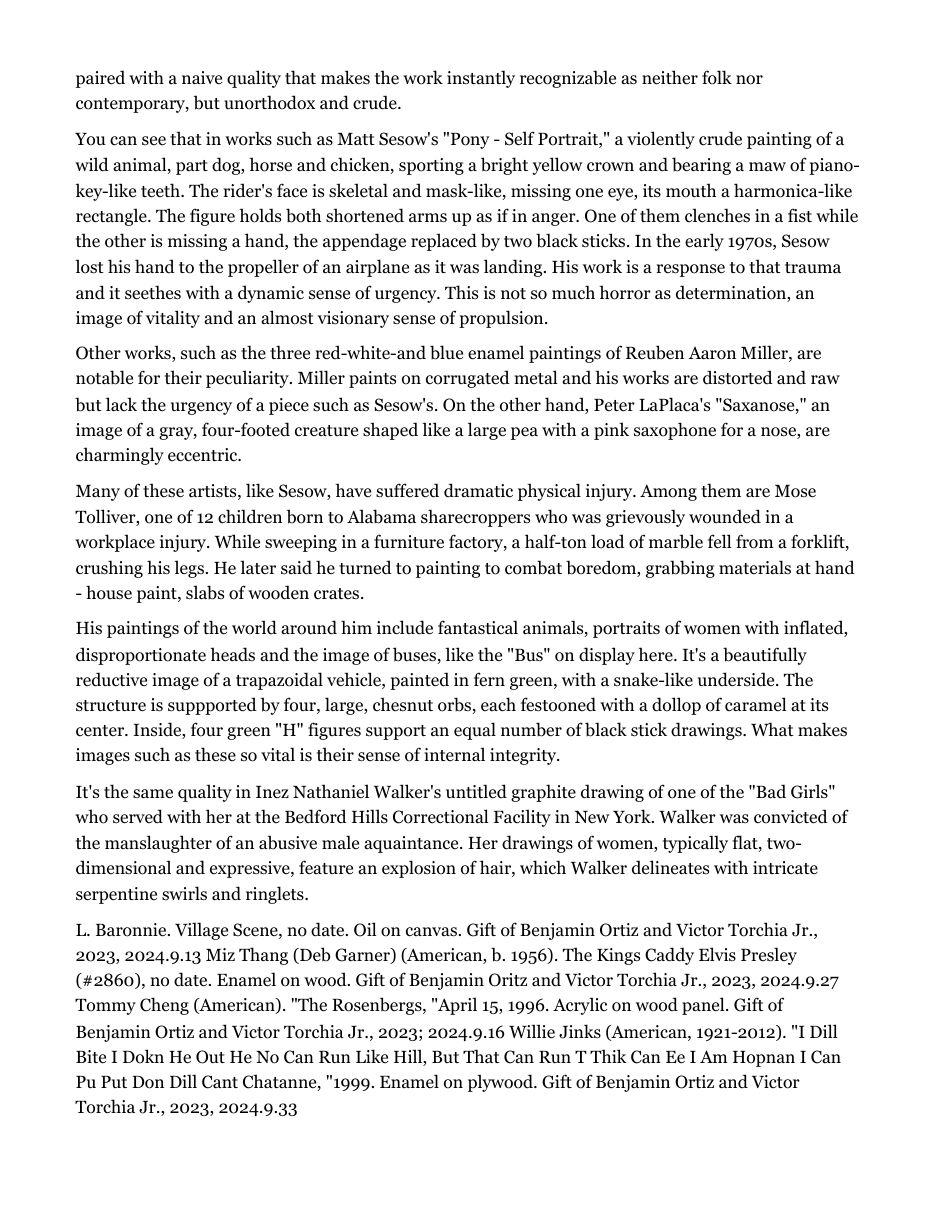
You can see that in works such as Matt Sesow's "Pony - Self Portrait," a violently crude painting of a wild animal, part dog, horse and chicken, sporting a bright yellow crown and bearing a maw of pianokey-like teeth. The rider's face is skeletal and mask-like, missing one eye, its mouth a harmonica-like rectangle. The figure holds both shortened arms up as if in anger. One of them clenches in a fist while the other is missing a hand, the appendage replaced by two black sticks. In the early 1970s, Sesow lost his hand to the propeller of an airplane as it was landing. His work is a response to that trauma and it seethes with a dynamic sense of urgency. This is not so much horror as determination, an image of vitality and an almost visionary sense of propulsion.
Other works, such as the three red-white-and blue enamel paintings of Reuben Aaron Miller, are notable for their peculiarity. Miller paints on corrugated metal and his works are distorted and raw but lack the urgency of a piece such as Sesow's. On the other hand, Peter LaPlaca's "Saxanose," an image of a gray, four-footed creature shaped like a large pea with a pink saxophone for a nose, are charmingly eccentric.
Many of these artists, like Sesow, have suffered dramatic physical injury. Among them are Mose Tolliver, one of 12 children born to Alabama sharecroppers who was grievously wounded in a workplace injury. While sweeping in a furniture factory, a half-ton load of marble fell from a forklift, crushing his legs. He later said he turned to painting to combat boredom, grabbing materials at hand - house paint, slabs of wooden crates.
His paintings of the world around him include fantastical animals, portraits of women with inflated, disproportionate heads and the image of buses, like the "Bus" on display here. It's a beautifully reductive image of a trapazoidal vehicle, painted in fern green, with a snake-like underside. The structure is suppported by four, large, chesnut orbs, each festooned with a dollop of caramel at its center. Inside, four green "H" figures support an equal number of black stick drawings. What makes images such as these so vital is their sense of internal integrity.
It's the same quality in Inez Nathaniel Walker's untitled graphite drawing of one of the "Bad Girls" who served with her at the Bedford Hills Correctional Facility in New York. Walker was convicted of the manslaughter of an abusive male aquaintance. Her drawings of women, typically flat, twodimensional and expressive, feature an explosion of hair, which Walker delineates with intricate serpentine swirls and ringlets.
L. Baronnie. Village Scene, no date. Oil on canvas. Gift of Benjamin Ortiz and Victor Torchia Jr., 2023, 2024.9.13 Miz Thang (Deb Garner) (American, b. 1956). The Kings Caddy Elvis Presley (#2860), no date. Enamel on wood. Gift of Benjamin Oritz and Victor Torchia Jr., 2023, 2024.9.27 Tommy Cheng (American). "The Rosenbergs, "April 15, 1996. Acrylic on wood panel. Gift of Benjamin Ortiz and Victor Torchia Jr., 2023; 2024.9.16 Willie Jinks (American, 1921-2012). "I Dill Bite I Dokn He Out He No Can Run Like Hill, But That Can Run T Thik Can Ee I Am Hopnan I Can Pu Put Don Dill Cant Chatanne, "1999. Enamel on plywood. Gift of Benjamin Ortiz and Victor Torchia Jr., 2023, 2024.9.33
© 2024 Republican-American