Saved copy · 36 pages
Extraordinary Ordinary Interview Episode 50: Dana Ellyn & Matt Sesow
YappyChatterBox Podcast (Paul Sebastian) (Paul Sebastian (host)) · 2024-11-19 · original address
Long-form podcast interviews with Matt and Dana on their lives, the DIY approach, and making art
Click a page to open it — scroll or pinch to zoom, drag to move, arrow keys for the next page.
Full text
Full text as published. Copyright remains with the original publisher; reproduced here for the historical record (machine-read pages may contain small errors — check the page images).
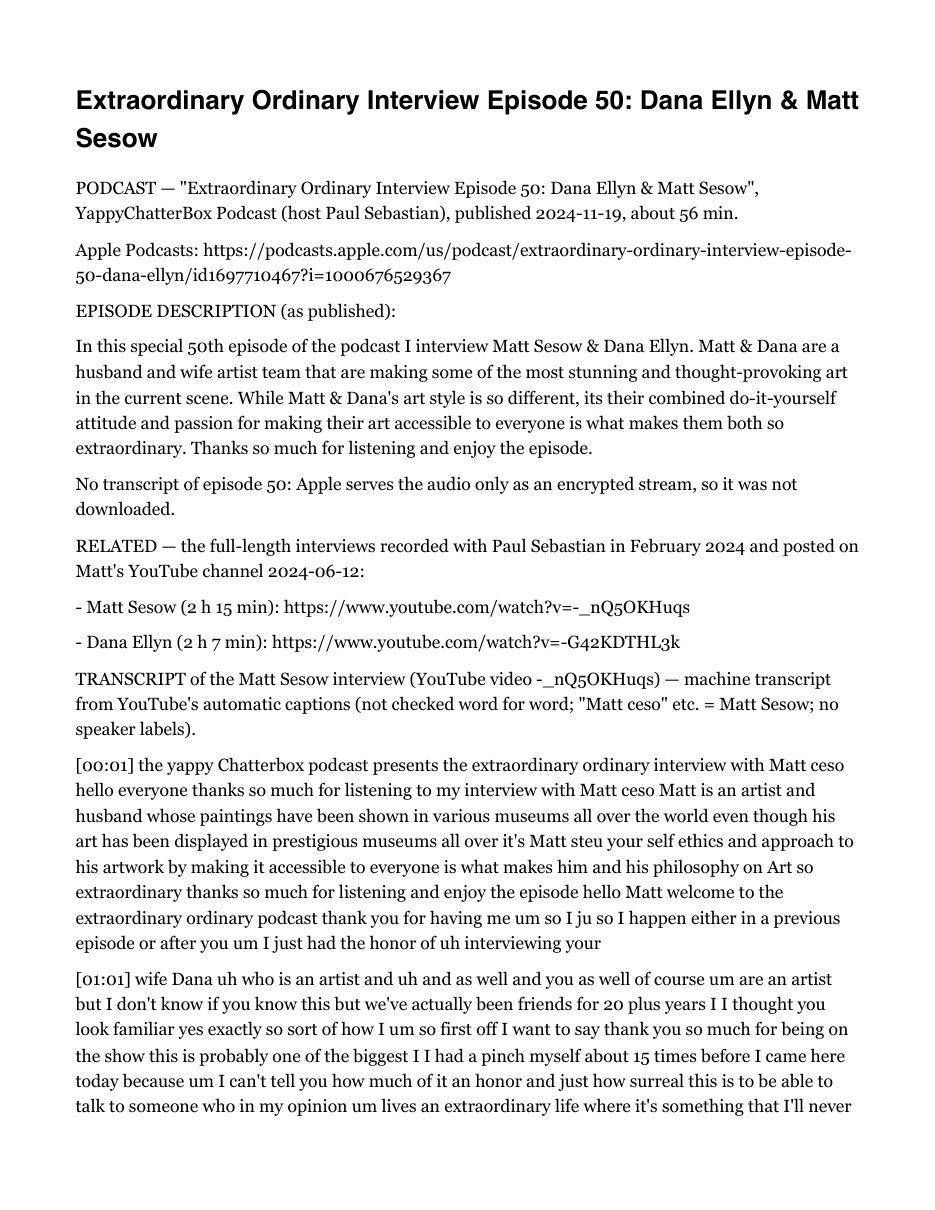
Extraordinary Ordinary Interview Episode 50: Dana Ellyn & Matt Sesow PODCAST — "Extraordinary Ordinary Interview Episode 50: Dana Ellyn & Matt Sesow", YappyChatterBox Podcast (host Paul Sebastian), published 2024-11-19, about 56 min. Apple Podcasts: https://podcasts.apple.com/us/podcast/extraordinary-ordinary-interview-episode50-dana-ellyn/id1697710467?i=1000676529367 EPISODE DESCRIPTION (as published):
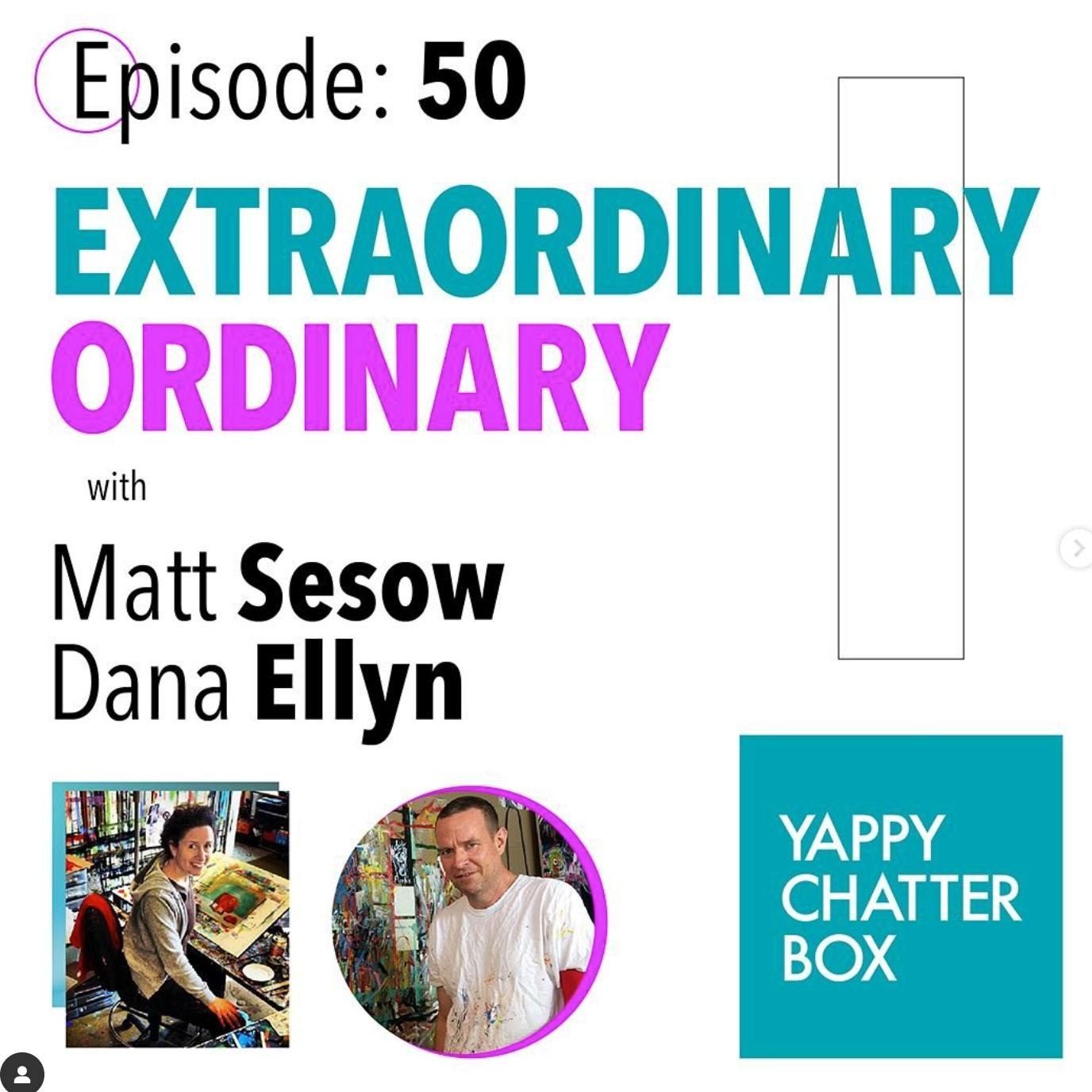
In this special 50th episode of the podcast I interview Matt Sesow & Dana Ellyn. Matt & Dana are a husband and wife artist team that are making some of the most stunning and thought-provoking art in the current scene. While Matt & Dana's art style is so different, its their combined do-it-yourself attitude and passion for making their art accessible to everyone is what makes them both so extraordinary. Thanks so much for listening and enjoy the episode.
No transcript of episode 50: Apple serves the audio only as an encrypted stream, so it was not downloaded.
RELATED — the full-length interviews recorded with Paul Sebastian in February 2024 and posted on Matt's YouTube channel 2024-06-12:
- Matt Sesow (2 h 15 min): https://www.youtube.com/watch?v=-_nQ5OKHuqs - Dana Ellyn (2 h 7 min): https://www.youtube.com/watch?v=-G42KDTHL3k TRANSCRIPT of the Matt Sesow interview (YouTube video -_nQ5OKHuqs) — machine transcript from YouTube's automatic captions (not checked word for word; "Matt ceso" etc. = Matt Sesow; no speaker labels).
[00:01] the yappy Chatterbox podcast presents the extraordinary ordinary interview with Matt ceso hello everyone thanks so much for listening to my interview with Matt ceso Matt is an artist and husband whose paintings have been shown in various museums all over the world even though his art has been displayed in prestigious museums all over it's Matt steu your self ethics and approach to his artwork by making it accessible to everyone is what makes him and his philosophy on Art so extraordinary thanks so much for listening and enjoy the episode hello Matt welcome to the extraordinary ordinary podcast thank you for having me um so I ju so I happen either in a previous episode or after you um I just had the honor of uh interviewing your [01:01] wife Dana uh who is an artist and uh and as well and you as well of course um are an artist but I don't know if you know this but we've actually been friends for 20 plus years I I thought you look familiar yes exactly so sort of how I um so first off I want to say thank you so much for being on the show this is probably one of the biggest I I had a pinch myself about 15 times before I came here today because um I can't tell you how much of it an honor and just how surreal this is to be able to talk to someone who in my opinion um lives an extraordinary life where it's something that I'll never
understand but I hope through this interview that I'll actually be able to kind of get an idea of what you do as an artist um so how I actually met you was is about in the early 2000s uh two friends of mine as myself uh and myself we came down to Washington DC for the weekend um we were just you know having fun as you know [02:01] young 20 somethings would uh visiting the city and stuff like that and we happen to come across sort of like a fair slart show or something like that um so my friend ended up actually buying a painting from you um it was about a postcard sized painting and it had track star on it um so um every time I would go to his house every time I would sort of you know even when I wasn't when I had moved and we sort of fell out of touch I that painting always stuck with me um so in my sort of 20 years of of sort of living my life and going through my life I always came back to you at certain points I would just say oh I wonder what what that artist Matt's doing and I was sort of curious about it so um but then at a certain point in my life my life sort of went a different direction and I said you know what um I want my track star painting from that so um I ended up uh looking at your website more and more frequently um found a [03:02] painting that I just loved um and then uh contacted you and purchased a painting from you and then of course you can't just buy you always can't just buy one uh when I came to visit you um I ended up purchasing a purchasing a couple of more paintings from you um so I have become a fan of your work um so when you uh when you opened up your home and opened up sort of you to be able to kind of come on this little podcast with me I couldn't I couldn't have accepted fast enough or just sort of wanted to plan this so I want to say first off thank you so much for being on the show it is it is going to be so much fun I can't wait this is gonna this is going to be great um I'm already giddy from when uh I spoke to Dana so this is just going to be another two plus more hours of just me on cloud n so um it'll be fun for me too awesome that's fun awesome so um so we're gonna kind of like the old television show this is your life Matt so um where did you grow up I grew up um [04:05] just outside of Lincoln Nebraska uh kind of in a uh I guess you'd call it rural setting um a Housing Development was just kind of created in a corn field and um but that's where my dad and mom built built their house um and so anyways yeah it it was just kind of a I went to kind of a farmer kid school and um it was called Waverly Nebraska Nice um you said uh so parents mother and father brothers and sisters yeah uh older brother and a younger sister got oh so you're the middle child oh yeah okay that might explain y exactly um so at a young age um so were your parents sort of encouraging or how was your home life um did your parents encourage you to be active did they encourage you your interests were they you know what did they do to kind of you know you were [05:05] like well I like to do this I want to do this were they sort of all in or did they let you do what you wanted to do were they kind of just sitting in the background be like okay if he starts to if it starts to get bad we'll we'll guide them the right way but but how encouraging were they with you with sort of your interests as a kid and sort of growing up yeah I they were always and I always have been super supportive um even with my dumb decisions you know trying to almost like learn by by doing um but growing up where I did there was a lot of outdoor time we grew up by a pond which was cool so you could skate on it in the winter or go fishing in the summer so I learned a lot of like that kind of
stuff you know um you know climb trees fall out of trees wipe out on your bike on the dirt road all that good stuff so it was a very physical you know always played Sports and um you know just I guess [06:05] typical 70s yeah 80s upbringing gotcha um and then of course you know you'll get further into the the big story but I'll let you ask that question yeah so were you as a younger kid were you into so you're an artist now were were you when you were younger were you into art at that time or were did you have other interests as a kid no I I didn't really ever like art or think I would ever be involved in any kind of art maybe maybe I'd want to be in a band or something when I was in high school or um I you know I guess I wanted to be good at sports when I was really young and um the big the main thing that really took my my time and my attention growing up was computers I um was lucky enough to purchase an Atari 2600 after detasseling corn One Summer kind of the idea was you work all summer detassel and corn and then you get this check turns out to be [07:06] like you know three bucks an hour or something but um so working in the fields and then I I took my money and and bought a a you know video game system but what turned out there was I guess that kind of got me interested in art in a sense that I saw the games as art and the the colors and the you know the the sound all that like it was it was very it was magic and um one of the early cartridges I bought was basic programming oh okay so you were really so so you kind of were on The Cutting Edge of like video games you know computers that kind of held your interest even at a younger age when you were you know playing your tari and stuff like that yeah yeah I I wanted to learn how to do it like that was it was more than just like oh this is cool now I actually wanted to learn how to how to make those things oh yeah so that that's probably I guess the closest I got to Art and then I eventually taught myself how to program Pascal language and then that got me jobs in high school as a programmer so I [08:08] was actually programming working as a programmer um in the summers oh okay so so that's kind of during your high school so yeah we'll get to that yeah that'll be that's really R kind of neat yeah you don't you don't hear a lot of uh high school kids being into you know computers and programming and all that stuff so yeah um so sort of um so something kind of big happened to you at a younger age um you know if if anyone knows you um sort of they probably know your story um so uh at 8 years old um something sort of um happened in your life that that sort of is is kind of a Perman not permanent or just sort of something that that again that happened and I'll let you kind of explain it you know and so it's because it's kind of very very it doesn't Define you but it's something that um you know I think melded you or just it changed your life [09:10] would you say oh yeah definitely um yeah I I wouldn't be talking to you right now if it didn't happen suppose no I don't think so I think uh I disagree Matt I think your art speaks for itself I'll be speaking to you because you're an artist well I don't I don't think I'd be an artist if it didn't happen yeah oh gotcha okay yeah so um or if I consider even we'll call myself an artist we'll talk about that later um yeah so like I said we had a pond and uh we had out you know also dirt roads very rural and but also we had a small airport nearby so there was a grassy Runway and um you know kids well playing playing by the runway one summer day in the 70s and um the plane was because there's like those small propeller are planes I guess Cessna Piper Cub whatever they're called and um one was
landing and when they land they don't make much noise because I guess they kind of cut the engine or something I don't know how the planes [10:11] work but um the propeller certainly was spinning so what happened is the plane was landing and I had run out onto the the runway because um we were playing this game of called Spud and Spud is a game where everybody gets a number and there's a ball and somebody throws the ball in the air calls out a number not maybe not sure even who which number's who and if your number's called you catch the ball you El Spud everybody has to stop and then you try to hit him with the ball got it basically um so it was my turn to throw the ball in the air and I nobody had ever done this before playing and I decided I was number four and I decided I wonder what happens if I throw the ball in the air and call my own number so I threw the ball in the air called my own number thought it would be really funny so laughing and running and then I woke up in the hospital so you don't remember the incident at all I kind of did for a lot of years like getting hit by something I'd have all these weird dreams but and it was pretty painful but um no I mean I [11:14] think the worst part is all the other kids including my brother and sister saw it happen got so that's like more tragic for me almost than the than what happened to me so what happened was the propeller hit my uh just below my shoulder and the arm was removed basically or barely hanging on and so they they sewed it back on at the hospital um I guess it was a doctor who had just got back from Vietnam so had some experience with that you know we're in Lincoln Nebraska which it's fairly big city it's a college town but um I guess that was lucky that he was there and so there was a lot of debate you know keep the elbow don't keep the elbow oh wait wait I'm sorry I'm get ahead of myself so they they reattached the arm and um what happened is the hand wasn't getting any circulation I guess or enough so turns purple I remember you know seeing a purple hand uh Gang Green or whatever and um so they had to cut the hand off in the hospital and um that was you know like [12:14] the debate elbow no elbow stuff like that you know and little things like that have made such a difference for me having one hand is that um just just an elbow is like having a finger in a weird sense um I guess I'm going down a weird weird path here but um so anyways that that kind of defined me I guess or at the time I me it was a it was a really crazy tragic thing I guess but um the way my family treated it and Mom and Dad and everybody like it was like almost like okay we'll just get back out there and I was I think I was pitching baseball or the pitcher on our little baseball team like the following summer so it was kind of you know get back out there it was always encouraged not to not to you know let it be a victim of it or anything like that like it was just like okay well you know you did you adapt got it uh were you left-handed or right-handed I was left-handed and that was the one I lost so I had to um [13:14] relearn I guess how to write and stuff like that but at eight years old I don't think any of us are great penmanship or anything like that yeah um so when I don't want to dwell on it but I do have just some questions um so you kind kind of you black out as soon as it happens yeah okay I think I I that's what you can remember yeah they said I stopped moving and all that kind of weird stuff so I don't know if I had a near-death experience or anything like that when when you wake up um sort of and you see what goes through I mean do because again you're eight years old so it's it's kind of probably going to be hard to elaborate on just how you felt what was it like stuff like that but if you can you
know when you wake up when you eventually wake up into the hospital when you look over are you do what what sort of what is do you remember what your first reaction was way back then or is it sort of just a blur yeah I think I remember the first time I woke up in intensive care I think my I think my parents were there and um I remember [14:15] looking at my hand and it was all purple and I could barely move the fingers like that's kind of the first thing I remember and then there was kind of like this whole story I have of almost like a guardian angel or something you know saying do you want to live or do you want to um or do you want to die and you know basically go to heaven or whatever that that is and then um or do you want to live have you know fight to live and have an interesting life you know like and I think that might be a way I explained it to myself is that from that moment on I had to you know almost have to like work harder or try you know like try maybe try a different thing you know then maybe selling car insurance or something like that which is a a good job but I'm just saying like I didn't I didn't feel like from that moment on maybe I I had like a different path to take gotcha now did you um you mentioned the fact that they reattached the whole entire arm um how did you go through the process of trying to recover the entire [15:16] arm or was it did you go through like Physical Therapy did you do any of that stuff or was it pretty much um you know they they knew after a short amount of time that it the whole arm was not not recoverable do you remember any of this I think they do right away cuz I remember saying take it off they actually they go oh we're gonna have to remove your hand I go that's okay you know what didn't even seem like a a big deal almost it was it was you know just I was in the hospital I wanted to get better I guess or yeah you wanted to get out of it as an 8-year-old you don't want to be in the hospital so yep so so um so they so you have the the hand removed and and so what is it like like again being eight years old and sort of do you live a do you just begin or just continue to play you know to play games and and do you just sort of grow up and and sort of that type of thing was there any struggle like was it you know was it difficult did you ever sort of get mad [16:17] that you didn't have like that you couldn't sort of use your hand or anything like that like did it ever get frustrating did you ever get angry did you ever get upset that sort of you know that that you couldn't use both hands and sort of that type of thing yeah I mean I I suppose I mean like maybe if I was trying to impress a girl or something you know maybe I was like oh no maybe it's because I have one hand or something I don't know I mean that's kind of a a weird you know thing to say which I don't think is valid but um because look at Dana's with me she's awesome yeah I know yeah but so um yeah I mean but no I definitely didn't look I mean I I broke my arm again the same arm after like CU we were play you know like playing like football or something in the backyard broke it broke it again and that was a weird thing because I would have to wear a cast you know they put a cast on it but the trick with a cast on an arm is you usually have a wrist to keep the cast on so so many days I'd come home from school with my cast in a [17:17] bag because it had fallen off at school so my arm didn't quite heal back great but you know but but you so you were so you just sort of dealt with what happened and sort of went along with it there was never any sort of frustration or you know angry mad anything like that just you know as an 8year-old kid you just sort of dealt with it and went forward yeah I don't think I was angry um I think I
keep all that stuff inside and I had for so long and I probably I'm sure there's lots of anger that I have never really expressed or whatever I mean that's just part of it but I that's why then we'll get to that in the painting like I think sometimes my paintings are so aggressive or I try to make them aggressive because it's like the music I listen to and stuff it's all about that like almost anti-authority anti um I guess normaly like I I I I dwell in the in the um not so much bizarre or or [18:21] weird but in the um kind of like if you know some like if you know it's almost like conspirator like you know that what you're seeing on TV maybe that doesn't make any sense you know they're lying to you or something or or there is kind of like a a sense that maybe you don't know the whole story something so I would take like a contrarian viewpoint on something just and just dive into as far as I could to you know whether it's politics or you know y p um vaccines I mean who knows yeah exactly um so so normal sort of everyday High School like life um what in you know what did you do it was high school just sort of just High School like a regular high school kid Nebraska you know like I noticed you played football like sort of uh were you did you get more into computers and sort of technology and stuff when you were in high school yeah I think I played Sports just to kind of be contrarian to coaches [19:22] who maybe didn't want me to be on the team or they cuz I was I didn't really enjoy it I don't think sport after a while like I was kind of like just doing it to prove a point I think in the end especially football like I remember our last game when we lost I was like so happy I was like oh God I have to do this again because I didn't like the practices and stuff and it was just seemed like a waste of time to me but um because at the time I was basically learning computers teaching myself all this stuff with my free time like I would spend pretty much all my free time on the computer had an apple to at the time so like in school I was you know re that we had a computer class and the teacher you know she didn't I mean she was great but she didn't really understand them like I had a couple other kids did so we would actually like for example she'd say oh hey um you know this computer over here isn't working can you guys see if you can fix it and what what I had done is open up the the computer the apple and I pulled one of the chips up just so you know I knew it wouldn't Boot and then I you know [20:22] basically have the whole whole class to screw around and I'm like oh at the end go look I fixed it oh nice says little stupid things like that but um yeah I mean I was I was my mind wasn't really in the uh you know I was looking I think I was living in the future a little bit once I started to really get into computers I was like okay this is this is this is it this is this is good that's what so that that in all intents and purposes that was going to be your sort of um your what you were going to do yeah you know going forward yeah so I got you know went to college in Tulsa univ University of Tulsa okay yep um computer science or computer information systems it was kind of like computers with business gotcha and um because I was really bad at Kel I mean I love the computer stuff I wanted to be a programmer but um yeah some of that some of the more I didn't get so much into the engineering side as far as like the the electronics of it and stuff but I was more into software [21:22] and um so I got a job with IBM right out of college which was sweet so that's how I got here to DC is they hir me um it was a perfect job for me because I was a tester so I got to write code to you know build like automation software and stuff like that but then I also got to point out problems got
defects in a sense okay which I think is part of my personality that I thrive on seeing like looking past the the whatever the the main um talking point is of something or not what's what's the right word I'm think of you know like the main narrative like if the narrative is oh yeah this works I you know like an like a programmer would give me the code say okay this all works now but you need to test it and I would always am I kind of I would say I don't believe you there's going to be a problem with this and so I do that that it's kind of been my whole life I guess so so college at Tulsa was just normal College taking classes Did you sort of foray into any other type of stuff at College like oh [22:24] hell yeah okay like outside of computers like did you know what else what else sort of like interest you in college you know yeah that's good so what happened in college is when I really started to have to take classes on computers I was like this is kind of boring like after a while I was like this like you know isn't really as interesting as I was hoping it would be so I started um I worked on getting a radio station set up so that because growing up in Lincoln was really fortunate for me in Nebraska that a lot of the good bands that were going across country stop in Lincoln and play so I'd get to occasionally see like some really cool bands and stuff and I and we had a really good College radio station so then when I got to Oklahoma it was like it was classical station which I mean I love classical music now but I don't know anything about it but um but I was like God where's the punk rock where's the you know where's the edge where's the and it was just nothing and so I got something started with that a little bit like a like a [23:25] um how I guess it ended up I I tried to get the College radio station to change its format but they wouldn't and now I understand why because who's going to donate to the College radio station if it's you know music people don't listen to yeah me yeah well now they listen to they now they listen to it but back then they weren't listening to it yeah yeah and um so I ended up just volunteering basically at a local radio station and they it Oklahoma they they didn't know what I was playing I was bringing my albums in from home cuz I had a lot of like hardcore stuff and I was playing that and of course they once I finally listen to my show like I was removed but whatever it was they were they were more like disco and whatever that stuff is but um which is fine it's good stuff but um so that was kind of yeah always contrarian and then I I was homecoming King one year got elected into that wow prestigious event that was fun um and even ran I was like a student Senator so I did you know politics and I [24:26] was in a frat cap Sigma nice and um you know it it was good and I really thrived I think in college it was like a kind of like a playground you know it's kind of like okay this you get to do what you want and I really I loved it I loved College yeah so um we you know you you are you an artist now but um so let's just say from college before so up to college um any art inclination did you were did you draw did you did you foray into any type of art um were you interested in art like did you like art um did you have like favorite artists or sort of was that just you know again your 1920 like I was like I really wasn't into that stuff when I was 18 19 it wasn't until I got older but but um did you have like did you like to draw did you like to do art at that time or was it pretty much [25:26] you know like you like just computer and sort of you know homecoming King and all that stuff yeah I I did um at in the University I I worked with the um I guess it was activities or something like like if there was something coming through town I would do the flyers for that and I would do it
by cutting out pictures of these magazines they kind of make them like a punk y all old school Punk yep yep I know that all too well basically using that technique and cutting out the letters and you know it all black and white photocopied stuff and it looked cool I I did a lot of that kind of design and advertising and I I remember I didn't it was a marketing class somebody I guess my fraternity one of my friends told me they said that the professor actually was had all my flyers and was showing the class that this is effective advertising nice that I was that you know was used as an example as a good example I guess so that was nice but um and I guess that kind of hit my dopamine levels a little bit like I it gave me a good feeling I was like oh I'm good at this okay so so it was kind of [26:27] like that kind of got me into visual like trying to you know maybe maybe that led to some of the art stuff and I and when I had a Macintosh one the early Macs I would use that to draw with like mcpain or whatever the old thing was um so I I was doing that and drawing around and I I still have some of that old stuff but um yeah that was probably probably I I liked um when we went to see my grandparents in Florida we'd go to the Salvador Dolly Museum oh I've been there yeah yep yep that place is is wild yeah that's really neat cool because um they have this Masterworks there like the ones that are like 30 ft high and stuff yeah yeah yeah yep yeah so um and we went on one of the tours once there and I listened to the story about why and how and I was like oh okay so it sounds pretty cool I guess and then also when my parents are from the East Coast my mom New York and my dad Vermont so we went to New York City a couple times and we' go like the MoMA um how do they end up in a [27:28] my dad was a teacher the university yeah professor and then my mom was a teacher as well so um yeah I mean they they you know it it's good it's good that to grow up there too because I I mean it was probably a good work ethic that I picked up there gotcha so so in college are you pretty much Dead Set On You know I'm going to work in computers like technology stuff like that um were you you know and you're in Tulsa at the time so so are you looking are you looking to stay in Tulsa and work in computers or was your desire to you know again number one first question you know were you planning coming out of college and working with computers and technology and stuff like that yeah yeah and I wanted to set my you know my goal really high as far as what would be the best computer company back then it was IBM okay so that was kind of my you know I always like to hit set really high goals like that and um so yeah that that that was it and that got that got me out to DC okay so it was so you you so it was [28:30] in DC I'm assuming IBM is everywhere but why was DC sort of its main Hub or um yeah the reason was because IBM came through college and did interviews and that was how I got it I I mean it could have been any IBM like it wasn't Silicone Valley but I did work for IBM in Silicone Valley for a while but um yeah it was just because I came out here interviewed I loved it I was like this is cool gotcha what what did you like so much about DC that that made you want to work coming right out of college cuz that's a pretty big experience to go from Tulsa Oklahoma to Washington DC working for IBM how was that yeah I I think it was when I had the interview the it was like the keybridge Marriott it's really funny because every time we walk walk or see it i' always point out to Dan I go hey that's where my first interview um it was in a hotel and I remember walking across the keybridge to Georgetown and finding the record stores and getting the local cassettes and the
[29:31] local music and I was like oh yeah this is you know Minor Threat and all Black Flag I you know like it's yeah there's a lot of great great music here and that's that's kind of why I think yeah I want to talk about because finding it this is something I've known about you but this this that that whole conversation can dwell we'll do that off off record this is about you not about where we are and what music you're into and that's actually um to kind of as an aside I'm Al uh the friends actually as a side note we can kind of go back the friends that I came to DC with are the ones that introduced me to that type of music so we are talking about the stuff that you know that we are both big fans of so um when you I don't want to get into it because it we could have a whole conversation that has nothing to do with why we're here but but no okay so so uh just to go back um so you pretty much said I'm I'm you know you did your interview the record stores that you liked and you said this is it I'm here gotcha um so so [30:34] what's it like what do you do for IBM I mean at that time when was this do you do you know what time yeah it was 1988 okay 89 and um yeah it was testing software we were doing um a lot of stuff with image processing it was like I think one of the big projects would be like digitizing the Vatican books or something like that I mean I I never was on that specific project but where I was working in Bethesda we did a lot of image image related stuff which now just seems so you know everywhere obvious you you go to the Internet there's all pictures but that that was very expensive and very hard back in the early days of course and then some work with like OCR you know which I guess IBM was going to charge a lot of money for that and now you can get it for free pretty much so um but I loved it it was it was a really good chance for me to to show my abilities as far as like my brain cuz there were things that I figured out that nobody else had done [31:35] yet testing which was really cool like you know installing some Hardware that could do Automation and writing code for that it I mean it was very rewarding um um and then I started painting yeah so um so you said so were you did you just stay in in DC like um you know you mentioned well I'm saying like when you worked so you got the job with IBM did you was it was it pretty much DC you mentioned you were in Silicon Valley at some point so did you move or or did you okay so so you weren't just in DC the entire time so like IBM so you lived in Silicon Valley for a while and okay yeah so I worked with um yeah we we had the opportunity to move to Silicone Valley once they closed our division was either go to Silicon Valley or Raleigh North Carolina I went to both Silicon Valley of course music scene yep of course and um or San Jose and um so but I was I had I was already [32:35] painting at the time but anyways I I worked in computers and painted at the same time and I can tell you why later but um yeah I worked at Netscape I worked at AOL oh okay I worked at some startups when I got back to DC um so what brought you back to DC uh done with a peace core I was in the peace cor okay so wow okay so this is all okay there's a lot of story yeah so um okay so your so ibbm DC you go to Silicon Valley you're you're living there okay um do you do you when you're there do you decide to go into the Peace Corp or do you work in that sort of Silicon Valley area for a while I was I I was actually like for Netscape and stuff like that is that in Silicon Valley or okay yeah so I did I worked for IBM I got married I mean it's like and then came back to DC went back to Silicone Valley I can't
[33:35] I think I'm only gone back three times I Dan always laughs at me because I can't remember how many but but the the thing that always got me back here is I bought a place in Adams Morgan when I first started working and I tried to sell it I couldn't sell it I mean now of course it'd be worth a ton of money but you couldn't you couldn't you know it was a different city back then um but uh yeah yeah it was yeah so so once once I got my job with Netscape it was kind of a important job but then there wasn't anything to do like we were working on the new web browser the mail part of it I can't remember but but my job wasn't really there wasn't anything to do yet it was boring I was just sitting around doing nothing and I was like I'm just wasting my time so joined the peace score nice so you also but you did mention that you were you started to dab in painting at the time correct yeah I started here in DC in 1994 when you were working for IBM okay so even so right [34:36] out of college so pretty much around that time your first job okay so how does it start like how does how does the when like what what makes you pick up a brush or a a pen or or a you know what was your what was your first drawing let's say let's put it that way and and what made you pick up that Implement to do that first drawing so what it was was um I was going on a date and this girl lived in a later became my wife um not Dana and um uh went to her group house because she you know people live in group houses down here I guess or I don't know if they still do if the kids do that it's a very effective way to save money oh of course yeah in any big city y bunch of them sharing a house and a lot of um them are a few of them were in bands and they knew everybody knew you know knows somebody in a band down here and so it was at Mount Pleasant so I I just I have my place in i'ms Morgan so I [35:37] walked over there I get there and there like some had been an art school and they were sitting around drawing on this big table in their dining room and you know I'm trying to be cool you know and I'm a computer nerd and they go to me go oh do you know how to paint Matt I go sure I just lied so I just picked it up and there was the city paper there which is kind of the it was it was a cool thing back in the early 80s or 90s and um there would be like ads for bands and stuff so I would just look I looked I think the first thing I drew out of there was probably like you know for some ad or something or just a person standing you know like just a kind of a port portrait type thing and then ah and then I did another and another another and those guys all went off and smoked their pot or did whatever they did and I stayed and kept drawing and drawing and then I was just like oh man and after a while people started liking what I was doing because I was trying to be contrarian of course with my art I was like oh let's you know let's make the lips crazy and the heads and the you know the all the colors are [36:37] off and weird and Scratchy then I started like oh like the the my Lin started to get a little angry and it felt good to kind of leave it on the canvas or the not the canvas paper at that time and then um so then what would happen is they would start hanging my pictures up on the wall the group house and everybody would kind of because it was kind of like came like a little Gallery there so I'd have like maybe you know 40 or 50 little drawings on their wall and then they would have like parties and and people were buying them from me no way I was selling my art off the wall and um you know they were just put up with push pins and stuff I was like oh this feels good were you only doing art at the group home or or that that group house or were you doing art at your own house in Adams Morgan yeah at first it was just there but but then every time I would go and do it there and then but
yeah then I set up just something on my kitchen table Yeah and um would just paint there so you would paint parttime while you were working at IBM oh yeah [37:37] yeah definitely like nights I can remember one day we had a snow day one of very few and um I I I was supposed to be working I spent the whole day painting oh yeah my Florida was a did some really good work that day I was like oh I think I like this nice so I I started in ' 94 and then I finally went full-time painting as a job in 2000 I think 2000 yeah okay so so you're doing so you're working uh at IBM and and eventually moving out to Silicon Valley so the whole time you're sort of in that corporate job you're also painting as well did it ever stop or did you pretty much did did painting and sort of the corporate worldle go hand inand up to the point where you decided to not do the corporate world anymore yeah I mean I always yeah I would I would spend all my free time probably painting mhm and then oh but also I did film or videos yeah I did actually I did that before I even started painting I think in 93 I was at a party and this guy was like [38:40] saying I can't F what he said he said he said oh I'm doing a film and he goes have you ever worked on film I oh yeah sure lying and um and so I got to be like a gaffer or something on this guy's film he really really really great guy David and um uh he had like this pict pixel 2000 camera this wasn't what he filmed this like in real film the movie he was making but he said he had this little Fisher Price camera cuz I told him oh I'd like to do film someday maybe and he lent it to me and it was like it would film on cassettes okay and um so I I had it for like the weekend before I'd see him again i' return it to him so I just I spent all weekend making him a short film about myself and I used like VHS to to dub it back and forth and stuff I think I had two tapes I must have that took forever and I had a Mac Quadra computer so I bought some oh wait this is a second one okay first one was just tape to tape just dubbing took forever took all weekend I I did a painting or [39:41] painting I did a film I wrote it filmed it same day I called it sees the day and I was just like I I mean I need to put it out there because we just went and saw some film by toe the philosopher or poet of naal Gallery of Art and I was watching going oh my God kind of looks a little bit like what I was doing but nice in some respect the the theme so it was a basically a talk with myself um I was both characters in the film and I think there was three and it was about loss it was about losing it was about me losing a bike I think it was but it it represented my hand yeah I didn't even know it till after I like years later I'm like oh that's what that's about and I end up killing the bad me who's sad and then like be conf that The Confident me lives is it's very very I mean God I I've had shows and I can't get anyone to any of these like museums or galleries to show my films because I think they're pretty bad do you still have them oh God yeah oh yeah oh nice yeah yeah I need to get them out [40:42] there are they on the website no they used to be but then I think all the plugins became outdated I never updated I I have them though hard drives and stuff but yeah I did a bunch and actually I just heard from one of the people the the um the niece of I guess she used to be my niece um my sister's are my wife's sister and she was like oh do you still have that film and like now she's like a doctor or something she's like God I'd really love to see that again nice and she couldn't find onl so I gotta do all that anyways long story so um yeah so I did films first little videos one like I entered contest in DC they used to have like a film night at the place called Chief Fikes Mamba room in Adams more and they would uh they'd have a film contest every year and I entered that I got the you
know the the dopam I guess it's called right dopamine hits of like it felt really good when I got like you know second or third place I was like oh this is awesome I want to do this nice so I really like that attention that [41:42] basically painting gives me now every day yeah so so you're you're your paint are you taking yourself serious as sort of an artist in the way of you know you're doing you know your painting at this group house you know just it seems like for fun um you know or just to you know to do it you know you're scratching that that sort of artist itch um does does it get Ser does that point get serious with you like you know they're putting it up in thumbtacks you know you're they're selling it like that do you do you think oh wait I've got something here like maybe I should start sort of uh you know going a little bit more in depth with it or is it just for fun it was a joke to me kind of still has but um it it was yeah it was because I was driving through Georgetown in my old beater car with my then girlfriend I guess and there was a art festival in Georgetown going on and it was a two-day [42:42] Festival so people were outside selling art and stuff she goes ah we should we should you should show your paintings here and I go well not today because we were going to go I was going to go scout out locations for like one of my dumb little videos and so she me stop and goes oh just ask them they okay yeah you can do it they said they that I could do it Sunday which was the next day so the next day I pull out whatever crappy art I had and and drove to Georgetown and just set myself in front of a storefront you know just on the sidewalk and maybe I don't know if I a blanket or I just had all these little paintings out and I was getting ready to hadn't sold anything all day I was there all day I was like God this is stupid and then and they were like 40 bucks you know 60 bucks whatever and um had some canvas I mean it it's pretty wild and then getting ready to leave um I was like let's just go this is dumb and so I remember calling on a pay phone she called her parents saying oh we're not g [43:42] to we're not going to stick around because they were going to come visit and watch and see what I was doing and they go Oh wait we're we're coming we're coming just wait a bit longer so I said okay sure so I stayed a little B longer and then all of a sudden this lady who was visiting her son and Town um she stopped She Goes oh my God and she went just flipped out and she saw my art she's like oh and so it turns out she was like a an art dealer oh wow from Connecticut so Dan hates the story because it's like my first time ever I basically got an agent so she signed me up no yeah wow I had an agent the first day and um I that time and that was just your first time selling like you just decided to S yeah okay cuz it was mostly in the house like you said that you were buying some art like tacked up on the walls and stuff like that but this was the first sort of now did she buy a piece she bought everything she bought everything what was that like I didn't believe her I didn't and then then I was you know I was working at IBM making whatever IBM money and um she sent me a [44:44] contract and I had supposedly good people I could trust look at this contract it was very it was pretty binding now that I think about it but yeah she had like right a first refusal of everything I did and I was and I'm I'm like like painting like crazy I'm doing you know like three or four paintings a day probably when while working at IBM yeah probably at my at my Peak and then but I had to run everything by her so this is 94 95 there's no real internet there's no digital cameras so I had to buy a Polaroid and I would take pictures of every painting Polaroids so an actual physical picture I'd be
sending in the mail to her and she'd said whether she wanted them or not what was the feeling of her like were you like like you said you didn't believe her like what do you how do you react to a woman coming up to you and saying I want to be your art agent and I want to buy everything are you flabbergasted or or is it just like you just rolled with it yeah I didn't I didn't you know because I wasn't making [45:44] big money she was charging a lot once when I first started she would charge more than I charge now um she was great though I wouldn't be where I am without her either so it was it it had to happen cuz I was introduced to like the folk art Outsider Art but what what happened with that is a lot of those people in that art type are not educated not just definitely selftaught like I'm definitely selftaught they're selftaught but a lot of them might actually be Fringe like out out like they didn't maybe go to college or they didn't teach themselves how to program you know and and and I started to feel like I it wasn't it wasn't me like I was kind of being labeled at something that I didn't think was really it didn't I didn't feel comfortable in it um and people still call me the outsider Vision whatever folkart I I don't know what I am I just I just like to throw stuff at the canvas gotcha was that art that you did back [46:44] then similar to what you do now or was it completely different um yeah pretty much I've always had like the lips the teeth the you know the scratchy stuff the color scheme um yeah pretty much the same I use a lot of the same uh paint Brands and stuff that I did back then um luckily we have a really great art store here in DC UT trctor it's now called Dick Blick but that was really fortunate because they have really good quality paint and then um this isn't an ad no no no of course but um so um yeah it's it's all the same pretty much but one of the most transformative moments in my art career was when career whatever I call it but um was when the movie Bosak came out and I'd been painting I think it came out like 98 or 99 David Bowie is uh as Andy Warhol y yeah because Andy Warhol is a Pittsburgh guy so that was yeah so but it was I I've watched that movie I've [47:46] watched that movie recently and yeah yeah it's funny yeah Andy Warhol uh as David Bo as Andy war is pretty good yeah so it was like a it was the day it opened it was a Dupont Circle I remember the day I was like oh Baska it's an art movie I'll go see that and I went all by myself first one I remember even they passed out like a survey after the film to what you liked about it and stuff it so funny very weird but I went I remember watching the scene where because I didn't even know his art and and there like an art dealer pulling looking at all the his paintings when he's kind of discovered and I was like that kind of happened to me and I and she's looking she showing stuff I started I started crying I was like oh my God I can totally do this um so that's really what got me I was like ah and then I realized iconography use that more like use my you know language and definitely was influenced probably more by the film than actual boscat paintings but I have done a recent show at um at [48:46] Old Dominion University uh and they had it was a solo show of mine of all of my work from like 94 to now or two years ago and um there was original bats in the show and so the curator actually curated in boscat with my work so I have sh with boscat I guess I'm just showing the influence and the similarities and stuff and um you know I I I agree a lot of my stuff does look a little bit like it or a lot of like it but I'm not sitting looking at a book or ever I've never looked at one of his paintings and
go oh I'm gonna but I can see like maybe some of my Rising some of my iconography is very similar like that that line drawing and um but I think now I've pain him more than he did I'm sure is it in the is it in the movie he calls it like ignorant art or something like that stupid ridiculous art yeah that's exactly what I think of mine like when he would do those littes like the one that you said you got the track star that's where I came for that idea do those Smalls just do stupid ridiculous art and just sell them like 20 bucks 30 bucks whatever and I still do that and [49:46] and um there's thousands and thousands of those out there so so you become a you you you find yourself an agent while you're working at IBM um do you start um so you mentioned like net you worked for Netscape did you eventually come back to IBM like or did you so like you worked for IBM then you started working for like AOL Netscape stuff like that so you know when you get this when the person signs you on as their agent are you are you are you still with IBM and then you move forward to those other companies or are you back with IBM kind of I'm just trying to get an understanding of sort of that point in time when it sort of when it changes so so I yeah I was I had the agent all through till 200000 I guess okay um and that's my last job was when here in uh DC in Georgetown Where it All Began I was working at a company and they they were [50:46] um I was a tester there and they um had layoffs and it was another one of those where I didn't have enough stuff to do I would sit around all day go this is really I'm not doing anything I could be painting and um they I got laid off and I just remember they W they told me that and I go thank you I just I was like thank you you're freeing me so on my way walking back to Adams Morgan because I'd walk to work I stopped by this uh CD Warehouse which is a little record store art gallery on M Street and I said hey can I have a show here the way and they go yeah they go sure you know after looked at my stuff and so I I wasn't even home from the day I got laid off when I was walking out I said I'm just going to do it I'm just going to go fulltime nice so you didn't so so it wasn't a thing where you decided I want to go from working in the corporate world to painting you got laid off and you're like all right new new uh situation just came up and I can use that so so um were so did people at [51:47] work know that you were a painter did people like we people fan like we're co-workers fans of your painting heck yes okay yeah because I would go I remember going to meetings and I would have like cuz I use a lot of metal paint sometimes I you see the little paint on my hand now but um I mean my whole arm would be covered like you know paint or gesso or something I have I'd smell of probably turpentine and booze I'm sure but you know from painting the night before and um yeah oh yeah and then I had a I had an opening at the corkran Museum G uh Gallery I guess White Walls Gallery it's kind of downstairs but um they get I got a show there and all the people I worked with came like a lot lot of them a lot of my friends from work came and that and they bought um you know bought paintings I still have um sales to some of those people I worked with from back then um very supportive because they were all super creative people like all of them are like you know bands again and like bands I like I was like oh I'm working with some is really cool nice um yeah so so you [52:47] mentioned that you decided to go into the Peace Corp MH um so was the Peace cor did you go into the Peace Corp um while you were working at IB or working in the corporate world yeah okay so I I was in San Jose I was going to the peace SC I was going to go as a single person because I wasn't
married yet but my girlfriend at the time she's like I want to go to peace score too so we got married so she' come with I I had apped twice for the peace cor I got him both times second time with her and went to the Solon islands that was your first so what makes you decide to go join the peace SC cuz again if if I were to ask my boss hey or you know I'm going to join the Peace Corp you know more than likely you're not going to be working for the company while you're with the Peace Corp not at all yeah so no I quit yeah so what made you decide to join the peace score what was what was that sort of what what was that choice I think I wanted to be challenged I think I was [53:49] kind of like this is computer stuff I mean I like it but it only goes so far like I want to I'd rather create the whole program myself rather than just be a cog in you know which isn't realistic of course you're not going to create your own especially now with coding teams doing everything but um yeah I needed to have more more contact with the end product basically it's the Adam Smith type thing which I learned that in my liberal arts education but you know where you have where the worker is more satisfied when the worker has direct um contact whether with the end product or even the customer like which I can get into all this whole theories of whyo painting so much because I do get the total I get every step of the way I get to meet with I you know I I love it I buy the I buy the materials I do the shipping I do everything do the website that's a whole another thing we go down to but um yeah so peace SC so we went Solon Islands did you choose that or or no they choose it for you and I I it's a [54:53] little tough so what happened was got to there I was just you know the computers were kind of getting in into the salon a little bit like the Peace Corp office had a computer and they needed help with that I was like I could I can do this for you I could do all your computer stuff you know maybe just work at the office I work in the city the main city but now put me out where there was no electricity no water it's all ring catchment it was it was really rough really remote and um wife was there she came with she freaked out after a few months quit I'm like I'm staying I have to do this what was it like what was it that that made you like what was it that that made you stay and sort of what did you like about it so much I didn't stay that much longer what happened was because we had like a two-way you had you like a shortwave radio so you there was a way if you called the phone company in the big city they could hook you in we could do like a two-way radio [55:53] call and um cuz it was really super remote like it was It was kind of interesting too cuz this little island in the middle of nowhere had had a a grassy Runway as well strange I just think of it that way all comes back it all comes back right very interesting huh there may be some icons there but anyways um so yeah she wanted to leave she left and then um we were married and I was like okay and I was trying to stay teach and I did for a bit and then but she was like I want you to come home you got to come home I was like yeah my man you I got to go be with my wife or this isn't right cuz it was going to so I did I I I left too and I guess like about a month later they evacuated everybody out of the country because all the peace C because um like Civil War type thing gotcha so I I feel bad that I left early in this in that sense but I felt that I did the right thing because I had a wife and then of course we got divorced a little bit thereafter so I [56:54] was like so anyways that that was a little tough but um the uh the peace cord was great because it it really it was Uber challenging and I would recommend it to people who who have
something to give like that and you know if you um you do it though I would say go single because the divorce rate is so high oh for couples I mean I you know because it might be for certain PE like certain people can handle the Solomon Islands and just sort of like you said no water but then certain people can and that's just you know it happens so you're in the Solomon Islands you're painting at the time are you painting in the Solomon Islands how how access how is how accessible is paint like how accessible can you do it I mean is this accessible like are you able to get the paint that you need the paint that you want the canvases the the material that you need are you able to get it yeah I I no I couldn't get anything there cuz it [57:54] was so so what did you paint with I brought it with me okay like so you know you can only bring so much on your two-year Adventure I my was your bag full of a lot of it yeah yeah and uh probably not how do you preserve it like how do you keep like you know are you are and again are you concentrating more on painting than sort of your job with a p score I I think that is probably another thing I think that well there was so much free time I mean I would I would remember going like three or four days without seeing another human mhm that's like that's like um prison almost you know solitary confinement it was it was tough and you know there bats and there there's no air conditioning there's no fan it's hot it's are you living with your wife at the time and then when she leaves are you just living is it just you two living together and that's it yeah it was at the school and but nobody would live at the school other than us okay the people would come and yeah it was about the size of this kitchen place it was really tiny but um [58:54] I mean it was lovely it was great it was you know World Bank built it I guess and but yeah it was really tough yeah so so your paint so you're painting you're doing the Peace Corp uh your ex-wife leaves you you decide to come back to now do you come back to DC or do you come go back to California like Silicon Valley that type of thing yep came back here lived in the apartment about the size of the because because I had my place still that IID bought when I was at IBM and was renting it out to somebody so there was a renter in there MH and um so yeah I just moved moved into a little place in New Pont Circle there wasn't wasn't a kitchen just had a a room in a bathroom it was so hard actually it wasn't it was it was it was Utopia compared to what I just left oh yeah of course yeah so then I just took like some you know computer job out in Virginia I did take like the subway to the bus like I was still like in peace cor mode for a long time like I was just [59:54] like oh whatever I can do that you know killer stuff and then um yeah and then that marriage went away and uh but yeah I was painting the whole time um now you did a second stint with the peace core correct oh I did geek core oh that's right okay and geek core was better because geek core was much more suited to me where I actually got to do computer work in Bulgaria um teaching what was ISO 9000 so it's all about testing it's all about repeatable processes it's about you know you build something can you do it again can you can you use good practices you know right at my alley it was it was good to teach I was you know teaching to these people I guess because it was I don't know how many years after the Soviet Union but there was still a lot of Soviet Union looking stuff around there when I was there but um it was great it was only it was only for a month gotcha was that how soon after the Peace Corp did you do the geek core stuff um probably within a year okay cuz
[1:00:54] I I wanted still to do that kind of thing that challenge or something I guess overseas um did you paint while you were in Bulgaria as well yeah I mean your paint that was a dumb that's a dumb question because you pretty much everywhere everywhere but and that when I I found a gallery and got him to show my work okay and it was you could you could get equip you could get material you know not a little probably you didn't have to Lug it all from here like you did to the Solomon Island yeah it was a really really nice setup they they put me up in a really nice Department it was good I liked it was fun did you always know that that was going to be a temporary thing the geek cor thing like okay yeah those are only month long gotcha um and then Dan even got accepted after I think before we were married but then we were kind of talking we're like I don't know okay so so um but we uh oh anyway so yes I did yeah bulgary yep gotcha so you're doing so um do you go back into the corporate world [1:01:56] um sort of after geek core and sort of after the the the peace core stuff yeah that's when I started working for startups I I had worked at AOL before the Peace Corp and I almost went back to AOL but then I realized that it was too far out like because it's really far commute if you didn't have a car because I I didn't have a car at that time still have't um and um so that was that was tough I mean AOL was a good job I I liked it but I just it was I don't know so was AOL was AOL your last corporate job corporate yeah okay on the stock market yeah okay yeah so the the other ones but you did some startups and stuff too I think I did three startups after that and then um all computer related yep okay oh yeah yeah one was like uh don it was before venmo it was before all the online payment systems but it was a a way for political parties to have donations sent online that was one down here in downtown DC right across from ordana kind of worked before I even knew her [1:02:56] which is pretty interesting gotcha um and then another one was like a um Health Care type for doctors for processing like keeping their processes automated I can't remember what that one was either and then um and then my last one was a web development websites testing for that and that was the last one that was the I'm out of here yeah so that's sort of where we'll kind of start to go so when you're working for these sort of startups or stuff like that does the desire to start to do art like I'm I'm assuming you're you're you're making your art you're selling your art you know you're you're sort of have that duality of you know you're you're an artist selling your paintings making I assume a fairly decent yeah back I don't think I was yeah I guess I was making okay but yeah well I mean like you were able you [1:03:56] were starting to see the fruits of your labor let's say like you were starting to realize that okay maybe I can do this art thing yeah fulltime yeah because I I had created my own website in 96 so I was probably the I'm I hope somebody could check this I was probably the first person to sell their Art Online oh okay ever I mean I mean there's a a book in here from 95 or 96 that highlights my web page oh wow like one of those like old it's kind of like a text Booky looking thing mhm um entertainment and on the web or something like that so um yeah yeah I've been doing this a long time and so what I I knew what to do was to keep email you know everybody's email address so like it was just basic business stuff and so I built up a good collector base I already had one when I when I left the corporate world and worked for full time okay so was it hard was it hard to do both like you know let's say we'll go from sort of those three startups before you decided to go full-time
[1:04:56] was it hard for you to do both like to be a like to sell your art be an artist that type of thing and then have to go to work you know no okay no I did both yeah I was very like one of my funny stories from IBM was I remember go actually seeing black flag at the 9:30 Club here and this is probably like God I don't know what was that probably 90 five or something I don't know can't remember have to look but um and I remember going into my boss's my boss say he he called me into his office that morning and he goes hey I got to talk to you about something and my ears were ringing so bad still and he was telling me that he was GNA nominate me for his job because he was leaving as a manager I was like oh okay thanks and I was yeah yeah I was like okay maybe this might be different gotcha I think I was wearing a tie at the time yeah so so um do you start to lose interest with with those three [1:05:57] startups um progressively because you're get you you know you have that sort of successful art business like you're you're becoming sort of or would you say like were you getting bigger um when you were with those three startups or was it pretty much just like consistent throughout you know coming back from yeah I was coming back from like Bulgaria and stuff like that you know were you were you starting to you know were you starting to was that shift happening yeah I was showing all over the place um yeah I was getting a lot of good shows and while I was working and um yeah I guess that's what yeah is that the question well did at what point like you know did you see the did you see the end of the corporate world coming like and were you okay yeah what happened was yeah when you're working for the three startups you know progressively working as you're working for them are you saying okay you know [1:06:58] I'm not going to I don't want to work I want to you know this is the last place that I'm going to work I'm going to quit tomorrow or something like that you know yeah it was the I wasn't working I mean it was like there was too much idle time like I wouldn't even want to take lunch like I don't you know like I I want to work constantly I think I'm just that obsessive compulsive or whatever and I felt like I was just I had all this time I was burning that I could be painting or start my own business business which is what I did and and I just realized that there was way too much idle time and I was just like this is this is just I'm not my full potential I wasn't being my best that I could be so what is the Tipping Point or or where what happens when you finally say Okay um this is the last startup that I'm working for this is the last time I'm going to work in a corporate setting you know what was that sort of when did that happen or when did that switch lip um you know or how do [1:07:58] you tell yourself that you're ready to do that um I think it was cuz I was completely independent the divorce was through I had a 600 square maybe 550 foot place that was mine I owned it in Adams Morgan I had a wall that I could paint on I get to do whatever I want all day in there and I'm like if I get all day just to paint I'm gonna kick some major butt like I I knew I could just because I saw the competition and that's all any of this says is you just got to outdo the other people who are doing what you're doing and sell it for less and be better and be be a good value for the money and that I knew that that would work and I was like all I got to do is just do it like it it really came down to that for me because I I knew enough about what I because my big thing is I see other people who were art doing art in DC man they were charging so much money for stuff and everybody was always telling me raise your prices raise your prices I'm like no I'm I'm I'm the businessman here MH and
[1:09:00] uh it's worked wonderfully like I think if anyone listens to this and takes anything from what I'm saying is if you want to be a painter just do it better than everybody else and don't charge don't charge very much money like you're not Picasso I'm not Picasso I'm not basat um you don't want to be those people either because I think what happens is you stop painting for what got you into it in the first place at least for me like I I I get so upset when either I'm I mean I all the galleries I ever worked with they always said raise your prices you know and and I was just like oh my it just made me not want to paint so many times I like this isn't fun anymore like it's just money it's dumb were you were you nervous to go into the office that day and say I'm done or or were you scared of what going to happen they laid me off that okay so that that third so that that final sort of startup laid you off [1:10:01] okay yeah I think I had I think I had uh quitters remorse from the Peace Corp you know I like I'm not gonna quit I'm not gonna you know like it's kind of like the football thing too like I'm I'm gonna stay in football just to show I can do it and that's the only time I said oh I I need to quit because of family I need to go be with my wife and that's that bit me I was like ah so that that's why I've never I can't do that ever again yeah um so how does the first is there any change I mean do you does what shifts or what changes when you no longer have to go into a corporate job I mean were you you know were you you know not sure of what the first six months were going to be like you know sort of or were you pretty much prepared to just go forward from there yeah I was prepared yeah because I like I said on my way walking home that day I secured a show so I just started working towards that show and I haven't asked to [1:11:04] be in a show up since then so like in 25 years I've I've they just or 24 years they've just fell in my lap all these opportunities um and it was just through hard work and just busting as hard as I could MH yeah yeah um do you remember sort of um so your style so you kept that same style throughout this whole time you know um so you mentioned about sort of Galleries and shows and stuff like that um you know it seems like you started your gallery shows or your sort of independent your shows fairly early um so so you were already you know you were still in the corporate world when you started doing Gallery shows and stuff like that do you remember your first gallery show uh I think well probably something here in DC I would do probably like a group show um probably at a bar huh um so let's say do [1:12:05] you remember your first sort of professional your first professional show like the first where you know what what any sort of normal person like myself or a friend of mine who doesn't really know a lot about art but knows about Gallery shows do you remember that one where the the first sort of like the Matt you know seu oh like a solo show like gallery show you know like that type of thing the one that you could say the the the one that I I've made it you know what I mean like that type of thing that that's got to be the Visionary Museum I mean that wasn't that long ago and that was a g so that's at a museum okay so let's let's let's go with that I mean how does how does that happen like how do you do you does someone like email you or call like someone get your cell phone number or something and calls you and says Matt we're from the Visionary Museum in Baltimore we'd like your paintings please like how does it work the way it started was like a street festival so I
[1:13:07] was doing all the street festivals all the ways to get exposure I could early on which I tell that would be the advice I give everyone is like you got to get your stuff out there even if you're the best painter in the world No One's Gonna know you and the internet get off the like don't trust Instagram and all that crap to get it for you so um I was selling up at the suo festival in Baltimore and that's kind of like you know the coolest Baltimore's awesome and you know it's like John Waters might be there you know who knows there the great bands and um the owner of the gift shop at The Vision Art Museum saw my work and he bought a bunch of my littles like you did or your friend did and um and then it started there and then I'd go the next year maybe he' buy another one and then I guess eventually I just introduced myself to the director at the Museum Rebecca hoffberger who is an angel amazing person and um and Ted Ted also with the gift shop um but um [1:14:09] so the uh yeah she put me in a group show which I was like okay so it didn't start yeah she put me but that wasn't when I I mean it was nice it was like two paintings and I still wasn't very confident and it was nice and I felt very honored but then it was probably like seven or eight years later she just called me out of the blue and asked me if I wanted a solo show and I don't I don't think I think it was the only the first solo show they ever had at the vision ER Museum okay and she kind of explained it to me that you know she's been watching me so you gotta keep working everybody and um saw that my prices you know like that I was doing it for the right reasons she she understood my story understood what a lot of the imagery that I use um the icons and you know it's just consistent being consistent and I've always painted the same way and I don't I probably even charge less for some of my work now than I did when I started um selling on the streets of Georgetown so it it's it's [1:15:10] all about being true and being real and then she gave me that show that was up for a year okay so that was just that wasn't a permanent thing that was just um sort of like a showcase or like a you were there for a certain amount of time yeah and but now they have my work in the so so how does that so how does that feeling when she comes you and says we'd like to display your stuff for a year I mean what is what what does that like how do you how do you process that so the interesting thing was about that because I was I'd already been painting what 20 years or so I guess maybe more than that I don't know how many years but a long time and so a lot of the old stuff I used to paint came from a emotional place that was raw and was first time and took a lot of energy and some of the things that they wanted for the show they were like oh can you do kind of this again or that again oh so they didn't take the stuff that you had already had they wanted they wanted both did they want old and new stuff or did they just want all new stuff well they [1:16:11] it was mostly people loaning their work that they had in their private collections so like people had paintings and they would loan them to the museum for a year and then I had to create some new stuff to go with it and what I found very it was very very difficult because of course this is You Make It or Break It on your mum show and so I really really pushed myself probably too hard did they did they ask for specific things like were they very specific or did they let you be the artist and did they just say well we want new paintings well yeah they y they I had total freedom but they never ever said oh we want you to paint a specific thing they were just like you know might have some space to fill over here you could do this or that and I was like yeah of course you know kind of like saying yeah I can do that but the time and it took me so much energy it took it was exhausting but I did it and I've I have a lot of stories like that where I basically pushed myself so
[1:17:12] hard that I can't even believe I did it like I've done plays like slept on the floor of play like in Hollywood I've done a thing there where um it's just crazy stories but you know that kind of thing where you're just like like you push yourself to the Limit and I was doing that I've been doing that for so long and that's why to skip ahead to Dana she saved my life Dana did because she basically because I was we we'll get into this to the other interview but like she came over visited me one time up in my place was Morgan she just cried she goes how do you live like this it was I mean just crap all over just pain just I mean I would go to bed pain all over me all the time and it's just it wasn't healthy like I I I've been so much healthier now that I'm with her but um yeah it was it was yeah far so so you do sort of a year-long show at the Baltimore Visionary Museum um are you working with them sort of are is it your [1:18:12] in like explain how it works like they ask for 50 paintings and they're going to display all of them for a year or do they ask for a few um do you get your own sort of like wing of the place how does that work yeah like rebec Rebecca came to my studio and I showed her what I had and um she would tell me you know she would pick stuff and then I would I collected from collectors the the images that they had and then I would show the the people that were willing to to loan the work and so they gave me a a big room so was it's you know oh so it wasn't just your stuff that you showed no no it all my stuff oh okay you would ask people that had owned you asked people to yeah so people who own my work they would loan it to the museum got it and then the museum would like frame it up really nice so people got really good frames and yeah everything it's good deal just don't have the painting for a year yeah but it but have their name on it you like from the collection of and stuff so that was pretty cool you know big openings all that good stuff it it I [1:19:13] mean was it was transformative to me and then funny thing after well well so anyway so the current relationship is that they have the stuff in the permanent collection but I also work with the gift shop and give like they'll come down and buy a 100 or 200 paintings at a time oh okay and then resell them in the gift shop so what I do is I sell them for really cheap to the gift shop and then that way they can keep my prices the same as what anyone would get from me on the website oh so they get they get Originals at oh yeah oh no I always thought it was just like prints and stuff no I've sold they've probably sold like I don't know four or five thousand of my parents W that's awesome easily yeah so so you have the yearlong stint um at what point um is it soon after that that you start that they asked to do in a permanent collection or is it some time after it was pretty much right away because I actually to truth be told I offered I said if you guys want to keep any of these you can have all of them anything you wanted that IID created for the show okay and I think they took all of them but a couple was [1:20:14] that uh you know because you asked them did it feel different like how different was that when they when they said did you offer thinking that they weren't going to take them or did you kind of have an idea that they were going to kid to do them permanently I really didn't I really didn't think about it I was just like I was so honored and I was like you know you can just have them I didn't I didn't even I probably should have read it written off on taxes or something to but I always got to go that's we just whatever it's it's so much more valuable I for me to give them away and be in that museum than not being up there because that museum one of our first dates we Dan and I we were up in Baltimore we went to the Visionary Art Museum Museum right when they open and I told her I
go one day I'm going to have a show here oh nice yeah and that and then they did yeah it's just that whole you get focus and Mantra and all that good stuff yeah yeah I I I've been there before so there's a possibility where I might have seen one of your paintings there which is kind of cool um so what's it like what what's the feel or we'll do [1:21:15] two things what's the feeling of having a permanent collection that you'll know for as long as that museum is there your paintings people will see it so a hundred years from now people will see your paintings um how does that feel like are you is it exciting or is it just are you appre I mean of course you're I would assume that you're appreciative of it but yeah but what how does that feel to know that for as long as that museum is there your paintings will be viewed by you know countless Generations yeah it's it's really cool but to me the most important thing is that my paintings are in people's homes M because I think that that will out of the museum probably yes and um you know not having children like that is probably like people who have like that satisfaction you get from having a child although I wouldn't know but you know you're GNA you're carrying on your your genes and everything and and that act of creation and and I recently heard a [1:22:16] interview and they were talking about UFOs but um the whole idea of creating and leaving something behind how that transcends time like you're just you're you're almost Eternal all of a sudden so I think the creation of paintings for me is substitution for having children in that sense and and if it gives anyone any Joy that's incredibly positive for me or if they hate my work that's fine too just that they have a reaction or you know it's it's very satisfying um because when I paint it's the moment I'm just in the moment I'm I'm not not even I don't care about my paintings after they're done they just go in the drawing rack and I hope to sell them and if somebody came up to me and said they liked a painting of mine that I've had forever I'd probably give it to them because otherwise I'm G to paint over it you know yep because I'm GNA paint something else but luckily I have enough materials to paint on that I I don't paint over stuff as much as I used to but um yeah it's just that idea [1:23:19] that there will be stuff out there yeah longer than I'm here how many how many paintings are at the Baltimore Visionary Museum of yours uh I think it's 20 I don't know I'd have to look online I yeah could you ask for them back if you wanted them no I never would I don't know but do I don't want them back I mean if they if they wanted to sell them to make money they could do that that wouldn't that wouldn't bother me what about switching out like do you say hey I you know this has been here for that long can I maybe put a new one in do they allow you to kind of like switch out if you wanted TOA or have you ever thought about that no I never thought about that if they wanted to I'd let them I mean i' they could do cuz to me once somebody has a piece of mine I don't it's not they can do whatever they want oh so they actually own them yeah okay I thought maybe it was something where you know I don't again I'm very sort of ignorant when it comes to the art world and stuff how museums work I thought maybe it was you know I would just be so enamored with the fact that you would want that that you'd be like [1:24:19] you know oh no here take them and then but then do you have the ability to say well I want to switch it out yeah they can they can paint over them if they want yeah to me it's the throw in throw them in the harbor if they wanted to yeah totally fine Goa yeah I I that's like when people resell my stuff on eBay or what I'm like good I hope you do I hope you I hope you make whatever money you
want off of it I just glad that you bought it for me in the first place exactly yeah I that just I won't even I don't even want to go in why you would even sell I mean I can understand if you were desperate like if you were you know like I got to pay for a kidney trans well there's a guy now who I love him to death is he buys a bunch of bunch of our work and he he sells them he turns and he because he he gets good deals from us and he pays what everybody else pays but then he'll add like a zero at the end no not at all no Noe I want him to do whatever you want with them I'm done with it and you're getting your art out there it's become you're becoming more popular now now people might be mad that your stuff's so expensive that they're instead of it [1:25:19] buying directly from you but when I'm dead I mean give Dana you know she can charge whatever she wants she's gonna be like I'm Jackson poock and she's Lee kosner she taught she's taught me so much about art history but apparently Lee kosner jacked up all of Jackson Pollock's work once he died oh yeah I mean probably like you would be surprised if any artist once they di their stuff gets jacked up it's with anything like that like sports a memorabilia and stuff it's like everything gets more expensive once you're dead and it's like it's kind of bad like if anything it should be more expensive when you're alive because you have someone there that can explain it or just that you have that person there that you can talk to them or whatever but yeah cuz like even if we had like you know millions millions of dollars we would still be herec in this apartment painting like this because first off we don't want to move out of DC and if you wanted to get a bigger place in DC it would be so expensive exactly it' be impossible and be like why you spend my money on just and it works here you guys have a system it works here yeah so um [1:26:19] so we talked about the museum show and then speaking to Dana you know you talk about the gallery show so like the the you mentioned it the white wall show I would say what it is um so explain to me sort of how you know do you remember the first sort of you know the I've made it or the the big sort of that type of show you know do you remember gallery show yeah like because because because Dana sort of spoke about it that it's like I guess a gallery wants to show your and sell your painting so whether it be like a said a a shop down the street or the white wall the one that we all think about if you think about Gallery shows you know from movies and stuff like that so do you remember sort of that you know the the sort of stereotypical white wall gallery show do you remember your first one yeah I guess when I had the agent early on she got got me a show on Wall Street with a group show mhm I think [1:27:20] that was really cool yeah in New York City is neat and and I had a I'm sorry go go sorry I just I vaguely remember it but oh and I had a big one at hopster University that was a really transformative one because it was a group show as well but um I met a person there that was doing a documentary and I oh yeah there is a they did a documentary on you yeah and that's kind of how it started oh nice and that was cool yeah I mean they're all like for me pretty much showing in New York is like oh you know you made it um but yeah now which is the one that which is the one that stands out to you as sort of the one that you remember for it being sort of the best one or sort of the or sort of the one that says well I you know I've always thought about Gallery shows is you know because again like the stereotypical gallery show did you have one of those where it was like that white wall sort of hoyy toyy you know wine and cheese people bidding like
[1:28:20] a ton so what was that like cuz you're not the CU no offense you don't seem like the type of person that would fit in with that sort of no I I don't I don't do it I haven't done it the but God I would always show up drunk or something just stupid but I just couldn't deal with it I couldn't deal with that attention like it was very very very hard for me and I yeah I mean they're I mean they're nice and the the these galleries bless their heart like they I think they want to make a lot of money off of me and they always try to get me Jack with the prices and you know and I'll just be like you know I'm not going to raise my price and I sell everything and and it's over then they rarely did galleries work with me more more than once I mean there's a there's a few who were consistent I don't do Gallery shows anymore but just because I can do it myself but um it just I don't know like it's like they they don't necessarily [1:29:21] want to know my story like a lot of a lot of like they just kind of want the money yeah and that's why I do I'll just doent museums or universities now you know if I if I do another show who knows maybe I'll will never do another show again um but I have ideas for shows if a university would like to talk to me because I have pretty much collectors in every state and we could show a pretty awesome set of work no matter where I go so I kind of would like to do something in California got but I don't know yeah I mean if they if they don't have a financial interest in it sometimes it's harder to convince them to show me because I could you know I could promise I mean I don't promise a gallery but I I could guarantee they're going to sell 100 of my paintings if you know but but they but they might make the same as if they sold one painting from one of these uh yeah so what do you like picassos what do you like best about G or what is your favorite type of gallery show when when you were doing Gallery shows what was your favorite type um well when I would have a solo I guess yeah let's go [1:30:21] and when it would get a lot of press like if it was written in a paper or any kind of TV or anything um we we had some good ones like here in DC where we' like have a band playing actually my favorite gallery show was with Dana when we got married oh ni okay yeah yeah yeah yeah we got married at a at an opening that's pretty cool oh nice that's awesome um is it e like when when you the the gallery shows that you like is it everything what makes the gallery show fun what makes the gallery show like cuz again you know that's going to be really mean well no no no no I mean because what I would say is my favorite part of a gallery show is when I get my work back oh really because I would think if if if everything didn't sell because I'm like I can sell that what are you guys doing yeah yeah yeah because it so so it seems to me like gallery gallery shows are all pretty much typically what we think of gallery shows are or are they different like because again I would if I were to do a gallery show you know from again you have to have a financial I guess [1:31:22] it's like sort of that Financial in interest that you have to have in order to do one but is it are all Gallery shows those type of hoyy toyy like type of ones or are there good Gallery shows yeah actually I can remember I guess probably one where I really knew I I made it was when I had like my first Solo in Europe like so in Barcelona there was a gallery that I shed a bunch of times with um those the European shows have been awesome those were always just incredible experiences challenging experiences because I would show up whatever City and I would paint the whole show like the week before okay oh nice so you wouldn't bring you would bring maybe bring a couple things but I would probably create 80 to 90% of the show sitting like in a a room the size smaller in this
kitchen I did one like that my first one in Barcelona I didn't see any of the city I just sat in there all day and painted nice it's crazy um what makes a good gallery show the people the the the curator the [1:32:24] space um probably the location like what city it's in because I've definitely committed to do shows in places that didn't turn out the way I thought they would like I would have painted better just staying home and then go just for the opening um because usually what I do is I like to go to the place live there for a month or a week before a couple weeks and paint there and paint what I see and feel um those usually are quite fun but I think the best the best part is when you um when I got to when I got to go to places I never would have gone otherwise but I was only going to those cities because I was having a show like a lot of the European stuff Australia although that wasn't the best show but um yeah yeah um so uh was did any and again we'll kind of we'll kind of end on your sort of gallery shows um would you do or what was your sort of [1:33:26] which is which was one of your favorites or or um if you had to do let's say you had to do one more um how would you again because you're you're you're basically choosing the paintings and stuff right correct or does the so you know if you could do the the the Matt cesu uh gallery show of all Gallery shows what would it be like what would you do if you could if if they if basically I got a building I or a gallery I said Matt do what you want oh I could Cate the heck yeah yeah what would you do would you do just you would you do other people would you no just me and I would have my film videos in it I would have the full story with with um descriptions and um yeah I would probably create all new work for it oh no I wouldn't actually i' want everybody to loan their stuff out so that we could somehow get [1:34:26] them exposure you know if they wanted to ever sell my work or whatever um and I would just do a couple things but I would like to show things that I've done already maybe more than new stuff I of course I would do you know a couple hundred new paintings Smalls y or something that people could buy and take home with them so they could be new collectors that's probably what I would do but yeah and I would want it to be a huge space with with the storefront windows nice would it be in DC um I don't know interesting yeah probably I don't know uh or Manhattan but really I don't know if I I understand New York very well but I yeah probably I don't know maybe wherever you're gonna get the most people gotcha so maybe I don't know China y China there you go um so we'll talk a I want to so your your painting is very sort of iconic and one of the thing it [1:35:27] it what it attracted one of it was one of the things that attracted me to your art is that it's like you said it has that sort of unconventional um to kind of use the frame ignorant art sort of G you know um so what do you you know what do what do you like about your art and what do you you know and what do you try to put in your art that is an expression of you and sort of you know your Artistry yeah I think the the thing that I run into is because I do this for a living now is that I do run into the playing the hits like I have about I don't know probably 30 iconic things whether it's the rabbit the dogs the I don't know cat owl stuff you like there's things that I can just paint and I know they'll sell the fish um so what happens is I get into Point like if I don't sell a painting in a day Dana thinks I'm crazy but if I if I have go a [1:36:27] day without selling a painting I'm like I suck this is it I'm done never again so I'll paint a fish or I'll paint a a dog you know just because I think because I get that satisfaction I don't care if
somebody's giving me five bucks or 5,000 I just I feel good that I did something that somebody wants um but the best paintings I do they come about probably like probably about 10 times a month maybe more where I'll I'll have a day and I just get in the zone and I just I know I'm doing something new and unique and it's got my energy in it and I'm like oh this is going to sell this like I just I know I'm there like the colors are right or and that's what a lot of the things that I do now repeats of were things that originally I did because I was in the zone like my fish I first did that in Barcelona the bowl I did that in Barcelona because it was the idea that I need to be strong and the fish I want to do something bloody and weird so I saw like a fish when I was walking to the gallery or whatever um so I guess has your well has your has [1:37:30] your style changed like or have like you said you've kept those iconic um characters and sort of things that you used in your paintings have they changed um you know as you've gotten older and went from you know doing it as you were doing the corporate work to now like to now doing it fulltime like have you gotten better at it um have you you know are you you know have you decided you know do those do those symbols that you have have a greater meaning than they did previously like yeah that I think the symbols are all the same there's I use the same things over and over so many times um but I think the way my paintings have changed and will continue to change is just what materials I have available like I'm a big fan of teu now which is that Amazon in China thing okay and um you can get some really inexpensive uh art materials on there and it it lets me take some Chances with some things and there's a few things [1:38:31] that I found that work really really well for me right now that have made my work cleaner and maybe more risky I I'll I'll take more risks because I'm like oh whatever that's like a dollar you know I'll just throw that on there and see what happens but yeah I mean it the idea of capitalism and you know competition with art supplies is great because you know I'll I'll go to a paint store and say hey do you have any of the oops paint or the you know the the reject paint and I'll buy that like and that's a gallon of some color I'm going to use for the next five or six years you know so you'll see that green over and over and over that red or pink or whatever so so people buy your paint so people are buying your paintings um have you ever had has anyone that you couldn't believe actually knew about you people maybe someone that you admired um you know growing up like has any body bought your painting that you were Star Struck about and you don't have to drop names but oh I maai no way really oh my gosh yeah I [1:39:32] did a i he's I think he's cool but it's really funny because I have pictures with him now that he's been at shows I've been at and you like to wear a little hat like him and everything no he's cool I like like what he's done he's kind of the DIY King and his all like there's so many lyrics and stuff that I've picked up on that are like I can't say it on this because it uses a cuss word but but it is like that whole like at least I'm trying what the f of you done you know it's like it it's all about being confident and I don't know it's good stuff great memories see fugazi and I didn't see Minor Threat because I was too young but um so oh oh yeah that so him and then like I don't know what's that Zen zenu Princess Warrior Zena Princess Warrior she's bought she's bought one of my f kind like she bought an Obama I did oh okay um I think God what's that actor's name he's really famous what's his but his dad bought him one of mine okay I gave it to him for Christmas never got a
[1:40:33] picture of it are you does it is it Robo I think yeah gotcha but whatever like that's what I mean so so do you like um is it are you does it make you feel any I'm assuming it doesn't make you feel any different than some famous person by no the only thing I'm thinking is oh can I get a picture of you holding it but yeah to to put it on but um no that the most the best paintings I've ever sold are ones I've given away like I remember giving somebody loving my it was actually at one of the SBA festivals I did up in Baltimore somebody's really liking this big painting I did he's like a it's really great or maybe was a kid and he goes God this is so cool I wish I had you know and I was probably charging 50 bucks for it and you didn't have it I was like just take it nice I like that kind of thing I love like the yeah you know it's probably gone oh no you know he has it hung up and like that's yeah but but it is it's really just that that it's so satisfying like I was talking ear about Adam Smith [1:41:34] where you have connection to the with the end product and the customer it's just like oh I love that nice have you ever refused to sell a painting to someone where you felt that not that they weren't deserving of it but you kind of were like you you weren't sure that it would be as or you know as appreci or you know that type of thing I won't sell paintings to people that copy my work directly and I know about it okay that's kind of what do you mean by like so they'll use it like Trace over it and stuff like that or or what do you mean by that they're trying to they caught my style some and I'm like like they'll do exact copies but you could you know they do it in their style which it looks like they're try to make it look like my painting and I I wouldn't mind if they just said oh yeah Matt ciso he a influence I'd be like cool right we're good but if they don't say that like I I don't know it's it just rubs me the wrong way but yeah if somebody is inspired by me and does Styles like me I love it they like there's Elementary School in Arlington Virginia that Dan [1:42:35] and I go talk at every now and then and they they have like maty soan Ellen art projects where they do like the cat the owl oh nice yeah the the teacher there wonderful so that's really cool yeah so we've gotone to speak at their assemblies and stuff it's really rewarding yeah that's great um so when it comes to your style have you ever um have you ever decided to kind of move away or did you ever want to try to did you ever have a desire to change it a little bit like you know doing the the and I'll kind of compound that you know does it get doing it fulltime does it get meticulous like does it like oh I've got a pain today or do you actually enjoy I love it like yeah you never get like we like oh I got a pain today yeah only that would only be if I had a gallery show or like and that's where the galleries get get you in trouble in a sense because you feel like you're forced into painting but also it's good because it forces you to do it like like [1:43:37] I don't ever need you know convincing to paint I I paint pretty much every day or do something un related every day but yeah I paint at least six days a week mhm is it hard to balance painting um you know the website um selling your art you know doing the you know doing prints um you know spending time with Dana like um is it does it ever get overwhelming where the painting actually takes uh sort of a a a side a back burner no we're we're crazy this is all we do this all we do we don't we don't I mean I don't even have like a friend group or anything like that I mean I Dan's my whole life and the painting and it's all I do every day nice um so one of kind of you're wearing the shirt but um yeah so sort of another thing that happened um you're it's just like the upside down by plane I think is like a famous stamp but
[1:44:38] um there's like a famous stamp but you were actually on a stamp yeah at the United Nations and that was a good story because yeah how does that work like this happened to me a couple times where I get an email or message I'm like oh that's spam that's Del everybody thinks that yep and and it was something from the United Nations want use one of my paintings for postage stamp so it's the internal un Postal System I guess so they can send mail between I guess the whole world but they use the UN postal system okay so it's not like you know because if you had sent it from America to Switzerland that they're going to charge you you know 20 bucks to send a package but un probably has their own way where they can they bypass oh okay so it's like an in internal it's like the internal stamp that only people in the UN or the UN can use that they use yeah you could use it for like a postal stamp so like the the it's up there on the wall but this one was I think I want to say I don't even know what language it is it's terrible I me but it's but [1:45:38] it's written in some language um that I don't speak um and uh yeah how does that like so someone just emails you and says we'd like to use one of your paintings as a stamp yeah cuz they they had um how did they find you like how did they how did it probably Facebook or something I don't know or just maybe searching because it this one was for disabled artists so like uh Chuck Close was the other another artist in it and then some other International people that I didn't know but um so everybody had like some s form of disability or something and um that's probably how they found me yeah obviously they probably Google that disabled artist um which go haven't said that in a long time but um yeah so that the uh uh that's yeah they just kept writing me and I go oh I guess this is real they might even called me um but that painting that I used for that that was one that was for a gallery show and I had one I I had a little space I needed to fill and I just did it almost as [1:46:38] angry I was like a stupid pain I'll whip out a bunny so I called it dive bomb so it's basically someone fleeing from a bomb oh okay yeah so it's yeah did they pick the one that they wanted or did they okay so they they didn't ask like can you give us one they they specifically asked for us for that one yeah okay gotcha cuz that kind of goes with what the UN does I guess does it is it still in circulation like does the UN still use it do you know no it was only I think they used it for a year or two but I I was able to go to the UN in New York they had a ceremony for me that was really cool so I got to go to the UN and talk or whatever cry oh so happy and um and then I had a show in France which was one of my fav shows of all time was in crus France uh which is near Switzerland the border and was able to get into Geneva and go to the the UN as well in Geneva that's where I got this hoodie and um and bought the stamp there too so I [1:47:38] bought the stamp in New York and also in Geneva which is kind of cool it's kind of rockar nice what was your what's your favorite what was your favorite G like favorite gallery show or showing like what what if you could if if you could record or which one do you remember was your favorite and why it was your favorite my best experience probably was that one in France it was strange and interesting because I I got to stay in a house like an old French Farmhouse or yeah I guess it was Farmhouse for like probably three weeks before the show and that was really interesting that was cool the family was amazing they're so good people that own the gallery there's wonderful people wonderful neighbors everything really enjoyed myself Dana came at the end to go the opening that was great went to Switzerland that was great you know just really fun um to go to Europe and do
that kind of thing but it's a lot of work yeah so when you're sitting on the at the table in your in that group home [1:48:38] do you like can and then you're sitting in like Switzerland are are you just are you bewildered or like what am what's the the famous like Talking Heads like what am I doing here yeah how you know is it surreal to you or is it just no I I still hate most everything I do I I think I suck I'm like I do I'm like I just I I don't even know what I'm gonna like will my will I ever sell another painting or will anyone ever want one it's very it's a weird thing I just I have to keep doing new stuff I I I mean it was I I just thought I guess I always feel like everybody does this like I'm I'm not like I don't don't feel like I'm even I mean I guess I'm successful but I don't feel anything I I don't know I don't feel successful but I I guess but is it just did you ever expect that you'd be sitting in Switzerland like doing an art gallery show when you were doing paintings in that group house like [1:49:39] no I I think I did the paintings early on because I thought it was a way for me to be like a like a a musician but without having to know how to do music it was a way to get that attention like I saw the like I used to I went to so many shows I was like oh my God how do I get to do this this looks so cool and fun and yeah so I think that's the only reason I do it it was just kind of that attention and maybe it's some you know arm thing attention away from the arm I don't know like you know I thought of all that crap but yeah that's it's weird yeah so we'll kind of go into a couple of the um I did it with Dana and and I'll do it with you so um number one are you very particular about the paint that you use y okay is it do you use acrylic or oil both both yeah and I I used to get in trouble big time because I would I still do but I would use oil paint on paper my agent was great because she was always like you no you shouldn't do that better material but I'm like but it won't look the same it just doesn't feel right for [1:50:39] me to paint on some things you know so anyways yeah okay so are you do you do you do both yeah okay um what like I said and it's a particular like you can't like if another brand is on sale you won't buy it you have to buy no no I'll buy because what all that matters the secret coming all that matters is really your last layer okay um so you can build up a lot of you know thickness and stuff using cheaper stuff at the bottom and then put the good stuff on the top um but yeah I just whatever's around gotcha are you very particular about the medium that you use so like do you gear yourself more toward canvas are you more towards like paper um like do you have a spef specific medium that you prefer to use or you pretty much just whatever you have lying around yeah I painted on wood yesterday oh not all the time but yeah yeah yep no books like Dana um if I done book I did one book I think that I could even think of it was this artomatic show you'll [1:51:40] have to tell you about that it actually got yeah banned they closed the show because we all did twoo controversial it was like in 2004 or five here in DC okay it was like at the city Museum and so they asked all of a few of us artists to do paintings about DC so I did a dictionary A to Z of dictionary but it was all like super negative stuff and Dana did Super negative stuff and then this other girl her painting was on The Tonight Show it was so successful it was one of George Bush I think naked with Dick Cheney it was weird but it was actually Jay Leno tonight showed it on his show so that was pretty cool but yeah I got closed down City paper wrot about it wow um so how do you
know when to start like how do you start a painting like how do you do you have an idea of what you want to paint or is it just you know you've got the the material there and you say I feel like [1:52:40] painting this today or how does it work like how does your how does the process work for you um do you know what you're going to paint when you when you say okay it's painting time us usually like if I go to a museum and see something I like I might try to my copy of that do a version of it or a picture I mean I I've been a Metro before and done paintings off of Metro signs ads um yeah just anywhere like I have I have folders and folders of pictures that I can look to whether it's Life Magazine National geograph I mean there's just tons of things I use a lot of reference material that way so I'll paint from that or I'll just do stuff off the top of my head and just start moving it around I've done a few abstra track s which I don't think are that successful I mean I I've done quite a few but I don't really think I like those as much because there they're not specific enough for me so you have an idea of what you want to paint when you're ready to paint yeah yeah but not always yeah [1:53:41] sometimes I just start doing it and just make it up yeah what's harder the first brush stroke or the first sort of stroke of the of the art or the last uh brush stroke what's the hard what's harder probably the last ones CU I to sign it without screwing it up well do you like will you all like how do you know when it's done how do you know when your painting's done um when somebody buys it well no no okay smart somebody's I know I know no but it's funny um how do you like how do you know when you're because to me I would just again but I'm not an artist but like I said like I was talking to Dana about it you know Jackson Pock like how do you know when you're done like how do you know when you're like okay I don't want to add this I don't want to add that okay stop away it's finished yeah for me it's it is the the moment that's all I'm doing when I paint like I'm standing in front of my wall or rarely sitting anymore I always stand and paint but it's kind of like the music and [1:54:41] the if I'm drinking or whatever and it's I I get up to like a cresendo and then I'm like you know and I can see that it looks like one of my paintings and I you know if it doesn't look like one of my paintings I'm not done but once it kind of has my my feel my look then I'm like okay we're getting there getting there and then I'll probably you know yeah I gu it it's it's almost a time thing too which is weird like sometimes I'm like well I got to be done painting by eight um but I'll just I can crush it like whenever I need to and if that's a good word to use Crush but such a young kid um but yeah I don't know I mean I some usually I think about painting at night in the middle of the night if I'm up and I'll try to play much to paint the next day gotcha yeah um have you ever stopped paint like have you ever gotten to a point where you really didn't know where to go so do you have in do you have incomplete [1:55:43] paintings uh like have you ever yeah I have ones that I'm too confident about when I finish them and then I look at them I'm like that sucks so I'll just put it aside and then either will finish it for me which is called her defiled painting series or I'll go back and hit it later and then sometimes like that would be probably interesting if somebody just I could have that stack somebody could just look through and grab on be like yeah sure 10 bucks I don't know but um there was a funny story once there was somebody it was I guess it was for a G before a gallery show I was having and the curator was over and I had some paintings on my wall in here or maybe she's just visiting and they weren't done and she goes I want to buy that one right now the way it is I'm like okay nice and I
wasn't done with it I was like okay yeah yeah do you do you not like do you not like having unfinished paintings or you know will you do you feel like if it's unfinished you have to go back and do it or is it something where it's like you don't have anything to give to it like you're like you tried it it didn't work out you you weren't satisfied with it like how does [1:56:44] that do you feel like you have to finish every single painting that you do or are you comfortable not finishing a painting I have to finish everything because it's almost like like I won't throw away spoiled food like I'll eat it you know I'll take the chance so I pretty much I don't want to waste anything so I would definitely whether I would paint over something completely but I will eventually go back and use every scrap of paper and canvas that I have something on nice yeah um so have you ever thought about changing your style have you ever said I'm sick of doing the ion stuff or I don't I I don't feel like doing it I want to switch but have you been hesitant in that because you know people know your art for what it is and you almost kind of can't change because maybe it might not sell or anything or are do you believe in the thing of screw it I'm going to paint whatever I want if it's different like you you you don't do icons anymore you you know you start doing impressionism or like you know [1:57:44] Monae style paintings or whatever i' be so bored well that's what I mean but but have you ever thought I mean not just I'm going kind of the extreme but have you ever thought about yeah changing your style yeah cuz I realized I'm going to get old eventually well not when you get old but I mean just that maybe you get like you said you know that you start you keep doing the icons you know that type of thing you know you said well I want to do something different today or I want to do something different for six months have you thought about that but then maybe not done it because of the fact that you know what you do kind of your style and your what your signature type of style is you couldn't sort of go away from that with the fear of maybe not selling those paintings or something no yeah because I've I've done like sculpture with cat litter before painted it yeah kitty litter sculptures I've done yeah I've painted over stuff I buy at TJ Maxx or cut it in half and paste it back like little sculptur things I haven't done a long time but that was something I I did they did well but um yeah I I I will [1:58:45] just paint because I enjoy it now I don't I'm not really thankfully we have a a roof um because we didn't buy a big place um so yeah I I our goal really is just to Dan and I both is just to be free to paint whatever we want you're not afraid to take risks no I don't think so I mean because I could I could always go back to doing bunnies and fish I guess um so this is sort of a so um people I've seen articles and and they sort of about you and and sort of and I don't I don't view you this way but um do you sometimes would you sometimes not be known because of what happened with your arm um typically when something like that happens and you have sort of a a certain you're a very famous artist but [1:59:47] they you know are you worried that you're a famous artist or are you worried that people focus too much on the fact that you don't have an arm and you're an artist does it frustrate you sometimes when people kind of when they group when they when they talk about you they have to sort of shoehorn the fact that you you know that you do not have you know your arm and stuff or you know CU I don't look at you like that you could have like I said to me your art speaks for itself who
you know I know you're and like you said you're the art is a result right of you losing your arm yeah so but do you get mad that people or do you get upset or do you wish that people wouldn't focus on you losing your arm as a reason for your art or why yeah it doesn't bother me at all um because just like anything in marketing like or fame or celebrity you look at I mean I'm not considering myself any those things but but there is [2:00:48] this you have to be a product you have to have something otherwise I mean it's and I guess I came to that realization to with my arm I was like well what it makes me different and why not I mean you know like a pretty girl she's gonna get maybe opportunities that you know I don't know like it's just or you know just we wear the right clothes in the right place I don't know like people kind of were so visual like everybody is so freaking Visual and I realize that and that's why I'm kind of like well rather than and sit and maybe have a pity party about my arm I'm going to be like no let's use this thing and that's kind of a joke I tell Dana sometimes I go that's the best thing ever happened to me in my arm it's weird I do that like some of the most sort of morbid stuff or just something that you wouldn't expect like you know in my case it was something that happened but it was the best thing that ever happened to me and it like a lot of people would say you're crazy like how could that be it but it does it it really is like sometimes what out of [2:01:49] tragedy comes Triumph you know I so yeah and and thankfully we can both say that but I certainly understand there's a lot of people who don't say that and and I feel feel for them and I'm sorry for that but oh absolutely but it is like maybe because it happened to me at such a young age and my family was so supportive I was able to take that attitude because the funny thing is I was back visiting my mom in Nebraska and um where she stays it's like an independent living place but my uh pediatrician doctor was there too and I had seen him and you like what 50 years or I don't know what it was probably 40 years and he go he was just like wow we just we always we just wondered well how you you were always so happy or something and I was like I don't know like he goes we probably should have had you talk to somebody because I never like went to any Psychiatry or anything y found painting and um that painting really really really gave me a lot of understanding I think for who I am what happened to me it's healing you [2:02:50] hear that all the time Healing Art but um it it made the the nightmares went away things like that like it's just a whole like confidence thing that I got because I always knew I could do something more than what I was doing and I always want to be my best self like I I if I get into a situation where I'm like oh I feel really constrained I can't really do what I want or do what I think I need to do then that bums me out but right now living here with Dana the way we have everything set up it's like I have complete Freedom complete um self actual ization almost you know like that whole like at peace and um I feel very fortunate yeah so how do you deal with praise like how do you deal with sort of you know people oh you know the you know he's such a great artist you're so great like like I've fawned over you like when I met like the first when I I ended up coming I don't believe you though no so you don't believe it no I don't I don't I think I don't I don't do it for any [2:03:51] reason just that that's what I'm doing and thankfully I can make a living off of it but there's no there's no sense of accomplishment I mean there is when you look at shows and when I start looking at my web page and stuff but then I get I get tired I go Dam I'm so tired I've just done so
much of this stuff for so many years and it's exhausting to look back on I couldn't do it again there's no way if you I couldn't do what I've done now the second time no yeah no I know I couldn't it's too much way too much how do you deal with critic I mean if I'm assuming that since you don't really do well with praise how does it work with criticism I love it I'll say I agree really yeah somebody hates my work or oh you're copying I'm like fine I don't whatever say whatever you want it doesn't it doesn't you have to have a super thick skin yeah being an artist or whatever painter I'm a painter um that that you can't put yourself out there and not expect to get you know there'll be [2:04:51] people listen to this podcast go that sucks he sucks it'll be great like okay good that's fine um how do you deal with being compared like to other artists like do you you know you don't want it people don't want to say like you know Matt C Matt cesu you know is like baskot or is like Picasso like or do you don't mind that no I don't mind I I would those would be great comparisons I like that um but yeah no I I yeah I because the more I learn about art and most of it's all from Dana like historical figures I know there are some that I admire very few I admire most of them are just terrible people like really really bad like had really bad bad personal lives or whatever um I don't want to be remembered like them I want to I want to [2:05:51] be known as the the painter artist whatever that made it affordable for everyone to have art I kind of almost want to break the system in a sense like I want to I want to ruin the pricing for some some you know college graduate is charging $10,000 or something or whatever that happens in the city um but yeah it's it's everybody should enjoy art like the fact that you were able to get a painting of mine three paintings three paintings of mine and you even like and again because and it was not to interrupt I'm sorry but but the I was willing to pay for one of your paintings what you had on your website and then when I came and I said I wanted to buy it you like made it so much cheaper I was ready to pay what you were going to play on your website and you're like oh here just just this much it like I literally blew my mind it was like yeah and it was and again yeah that was that was the kind of the yeah it was neat yeah and I don't want people to think that I'm like some kind of trust or Rich that I'm able to because Dan and I we we [2:06:51] don't from generational wealth we had to create all this on our own like it she she'll tell you more when we talk together about how she got this place which is an amazing good deal but other than that I mean we've saved our money like we obviously don't I mean this place we couldn't afford to buy another apartment in this building because what she got this place for but I mean we've just saved and saved and saved and we're cheap I'm cheap I'm really cheap I will not but um not deny it yep um as you get older do you think that your style were change are you a are you are you willing to accept that your style may change 30 40 years from now or you know sort of what do you think what what what is the Matt artist going to be painting in 30 years the same thing or do you think your style will change it depends where I live oh okay if I can if I'm in an old folks home I'll paint on a desk or just you know little watercolors um um if somebody wants to [2:07:53] give me a big Studio house and I could paint really big I would paint really big we almost Dan I almost moved to Connecticut because after my avam show in Baltimore having the big solo I was like ah we should move to one of those big Jackson po places and paint huge yeah so anyways that could that almost happened yeah um so as an artist do you appreciate other artists like who's
your favorite artist s h they're probably musicians and like I really admire Charles Bukowski okay he's the one who kind of got me in in this trouble because he was a postman and a poet and at night he would write and get drunk and be really naughty and just be silly and funny and you know Politically Incorrect and all that and I just love the fact that he just hated his job and he was just like I just have to do this job to make money and but he became a famous poet for what he wasn't a famous Postman he was a famous [2:08:53] poet um so that probably because he's probably my biggest influence although I haven't was read any of this stuff recently I probably should it's been many years but yep I probably Bowski um who are who are some of the artists that people may not know about that you're excited about like people are excited about your art are you excited about other people's art or I don't know anyone I really don't I I mean I should there's this this um exhibit coming up here in DC called utomatic M which Dan and I aren't doing we did it like I think like five or six times in the past but um that's kind of an allomer show downtown here in the city and they don't curate so it could be anybody could show oh okay there and um we've I've done it in the past and it just it was a lot of work but I just don't have time right now for but um maybe I'll see something [2:09:53] in there oh nice yeah um so we'll kind of I'll go with these last two questions so um and I asked uh Dana the same type um what is art to you like what is so what what is art to you anything that gets an emotional reaction anything um comedy is great art um movies I mean anything that that evokes an emotion so that to me is art um and it can be negative can be positive I don't know I I mean positive art feels good but so does sometimes seeing something that really chaps my ass might get me motivated to do something else yeah nice um I mean the term artist is been used for hundreds of years do you consider yourself an artist no not till I'm dead I guess or I'm at the end because if I say I'm an artist now that means that oh I've done my best start to me that's what it kind of sounds like like I've done my great work I'm an [2:10:54] artist I'm like no I I I can't say I'm an artist no way no nope well in my eyes you're an artist Matt but uh thank you but I just want to say um hopefully we covered everything I mean I I can't think of anything else I would love to have a political discussion on one of these but probably not this one yeah y we could or we could do a if I ever want to do a music podcast where we could talk about like DC hardcore and all that stuff we I'll definitely I will be definitely giving you a ring but um but no thank you so much for doing this like I can't tell you how for both of you and and we're going to do a we're going to do another podcast with both of you on it um but I just want to say thank you so much for like opening up your home and and your sort of you know uh talent and just sort of you to do this with me um I can't tell you how much I appreciate it like the fact that I'm able to talk to people that fast that to me are are super extraordinary because of just what you do and stuff um thank [2:11:55] you so much for doing it Matt I appr the pleasure is all mine you're welcome thank you it's been great um so have an awesome amazing rest of your day thank you very much take it easy all right see you bye all right Matt so if people wanted to find your artwork purchase your artwork support your art um where would they go you have a website right Google one armed DC artist just kidding um seo.com so I put all my new stuff on throughout the week as I create it at new. s.com uh
that's one way to find my art um Instagram Instagram is seeso and I think Facebook is seeso also and I have a Matt ciso Facebook um and then Patron I have our patreon is patron. seo.com so p a t n. [2:12:56] seo.com and yeah um so what can they so on the patreon um they support that's a way of supporting your art and stuff like that and then they get things yep uh for for supporting you yeah I have you can just if you want to be just awesome and give me a dollar a month there's that and then I do like a sale probably every other month is what it's coming out so I'll have like a sale just foray patreon patrons where you might get like free shipping or 20% off or something cool like that and then I have one where um I have all these art postcards that I've got on Vistaprint over the years not an ad and um what I do is I'll draw like I do a unique drawing on the back of the postcard and they get that in the mail that's another tier I think that's like eight bucks and then I have like you I can just pick out a small painting and send that to you for 40 bucks and then I have one where I do drink and draw which is fun go to a bar and sketch uh that's 25 bucks I [2:13:57] think a little piece of paper or watercolor paper and then I have one if you want to be a super duper awesome person for 75 bucks a month um I just send you kind of like a a painting like something from like an 8 by 10 on up so you get like an original piece of art that I just send you gotcha and then on your website uh that's where people can purchase your art and uh um and they you can ship your paintings to them as as International yeah I ship anywhere in the world I've shipped everywhere in the world almost um yep and our postal system's great here we get we we go to the white we go by the one by the White House so your painting will be walked by the White House no matter who's President um on uh as it goes out to you so comes right from Washington DC and then if you also wanted could we could someone come and pick up their art and and their artwork from you yep yeah we if people schedule a time you usually we do it in the mornings uh they can come and look at what I have available and uh yeah go crazy and I'll probably give you [2:14:57] a killer deal perfect all right thanks Matt appreciate it all right see you thanks for checking out this episode of the extraordinary ordinary interview if you enjoyed the episode you can rate and review the episode on Spotify and apple podcasts you can also get in touch with the podcast on Instagram at yappy Chatterbox podcast or email at yappy Chatterbox podcast gmail.com have a wonderful awesome amazing rest of the day and thanks for listening