Saved copy · 8 pages
Celebrating an ancient art form
The Washington Post (Mark Jenkins) · August 20, 2015 · original address
Mark Jenkins's gallery column, which includes a review of a show with Sesow. The full text below



Click a page to open it — scroll or pinch to zoom, drag to move, arrow keys for the next page.
Full text
Full text as published. Copyright remains with the original publisher; reproduced here for the historical record (machine-read pages may contain small errors — check the page images).
‘The Chinese stye of opera as been seen in Washington, but not often (These days, it's not even performed that much in China.) But the at form has ben shown in fils suck 28 "Farewell, My Concubine,” and its pogeantry and gymnastics are reflected in Hong Kong action enema Jackie Chan, {in fact, is among the movie stuntmon and stars trained in the tradition, (He entered an opera schoo! at ages.)
OF the 10 contemporary works in the exhibition, five are by Four Chinachorn artists ~ digital-media illustrator Jale Kuang is the only parteipant with two pieces — and thee also are contributions from ‘Vieznam, whore Chinese style opera has long been performed, and tran,
(Of the three American artists, two are local. Paintings by Dana Ellyn ond Matt Sesowarethe loosest
‘and most expressionist in a sletion that tends toward the
diel fepreseatinal. (Xs invited work
from sebools of illustration and animation.) bright green backdrop sets off vivid red eastume in Ellyn’s pictur, while Sorows arrays customary lemons — performer, fn, masks — with jagged offhand intensity.
‘The designs of Chinese opera masks are rooted in face punting and feature switing motifs that somewhat resemble the patterns on the hoods of Mexican wrestlers. Long established in meaning, the ‘mas re color coded to signify character traits. Rod denotes bravery, for example, while yellow means ambition
‘Masks don't appear in Yuofan Zhou's realistic yet fanifal painting; instead it depicts an unmasked actress completing her elaborate makeup. The woman is dressed in red and framed by flocking blue birds, Despite the eubject, Zhou's style seems more Wester than Chinese, and the artist expliiy contrasts the two by placing the woman's hand, medeled to simulate thee dimension 2D fue,
front of her
‘Where Zhou's nd Kuang’s pictures havea evisp, computer-age look, the one sculpture is softer and ‘more evocative of the past. Menghan Qi’ resin-and:plaster rendering of a pir of shoes suggests opera costumes, but uso is meant to represent memories af Qi's greatgrandmother. Even for Chinese artists, ‘opts is associated with history and loss.
‘The clemonts of Chinese opera ure securely fixed, Xu note, There's no fashion for twouking and tuistng them, the way Western theaters routinely do with the kes of “Hamil” or “Oedipus Rex.” And thats why she has displayed the conternporary works.“A Celebration of Chinese Opers? upholds ‘uadition yet makes litle room for interpretation, which might be the best way to expand its appeal to ‘Western audionees,
Jenkins it a feslance iter
Ifyou go
A Celebration of Chinese Opera
[page 2 machine-read (OCR) from the image]
Katzen Arts Center,
4400 Massachusetts Ave, NW, wn elebrationofchineseoperacom
Dates: Saturday-Thursday.
Admission: Free.
[page 3 machine-read (OCR) from the image]
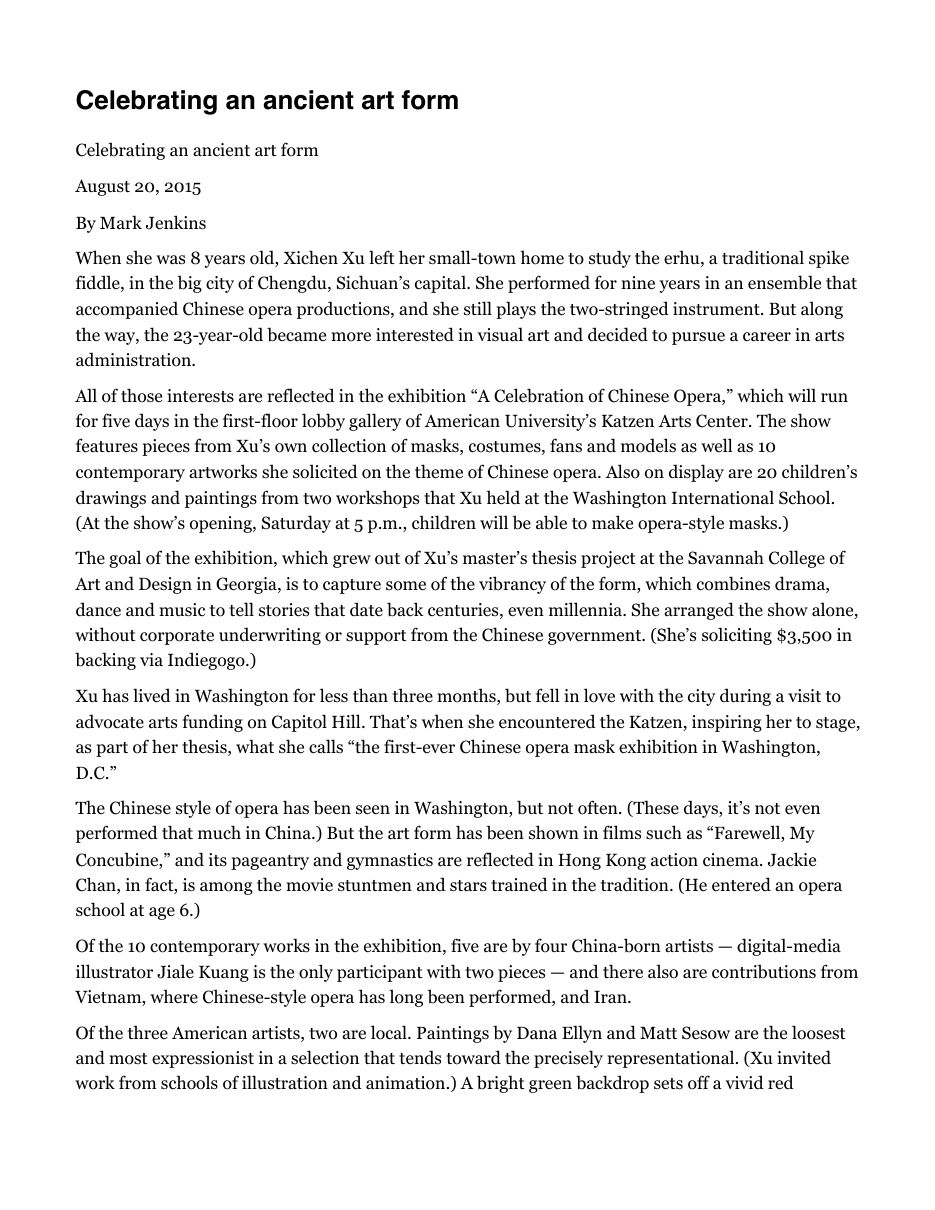
Celebrating an ancient art form Celebrating an ancient art form August 20, 2015 By Mark Jenkins When she was 8 years old, Xichen Xu left her small-town home to study the erhu, a traditional spike fiddle, in the big city of Chengdu, Sichuan’s capital. She performed for nine years in an ensemble that accompanied Chinese opera productions, and she still plays the two-stringed instrument. But along the way, the 23-year-old became more interested in visual art and decided to pursue a career in arts administration.
All of those interests are reflected in the exhibition “A Celebration of Chinese Opera,” which will run for five days in the first-floor lobby gallery of American University’s Katzen Arts Center. The show features pieces from Xu’s own collection of masks, costumes, fans and models as well as 10 contemporary artworks she solicited on the theme of Chinese opera. Also on display are 20 children’s drawings and paintings from two workshops that Xu held at the Washington International School. (At the show’s opening, Saturday at 5 p.m., children will be able to make opera-style masks.) The goal of the exhibition, which grew out of Xu’s master’s thesis project at the Savannah College of Art and Design in Georgia, is to capture some of the vibrancy of the form, which combines drama, dance and music to tell stories that date back centuries, even millennia. She arranged the show alone, without corporate underwriting or support from the Chinese government. (She’s soliciting $3,500 in backing via Indiegogo.)
Xu has lived in Washington for less than three months, but fell in love with the city during a visit to advocate arts funding on Capitol Hill. That’s when she encountered the Katzen, inspiring her to stage, as part of her thesis, what she calls “the first-ever Chinese opera mask exhibition in Washington, D.C.”
The Chinese style of opera has been seen in Washington, but not often. (These days, it’s not even performed that much in China.) But the art form has been shown in films such as “Farewell, My Concubine,” and its pageantry and gymnastics are reflected in Hong Kong action cinema. Jackie Chan, in fact, is among the movie stuntmen and stars trained in the tradition. (He entered an opera school at age 6.)
Of the 10 contemporary works in the exhibition, five are by four China-born artists — digital-media illustrator Jiale Kuang is the only participant with two pieces — and there also are contributions from Vietnam, where Chinese-style opera has long been performed, and Iran.
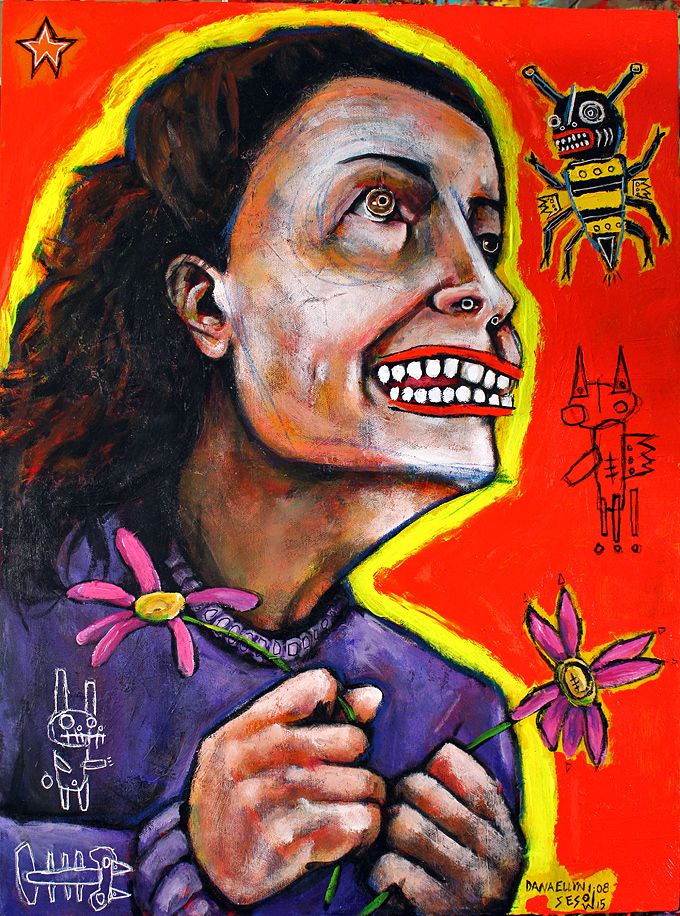
Of the three American artists, two are local. Paintings by Dana Ellyn and Matt Sesow are the loosest and most expressionist in a selection that tends toward the precisely representational. (Xu invited work from schools of illustration and animation.) A bright green backdrop sets off a vivid red
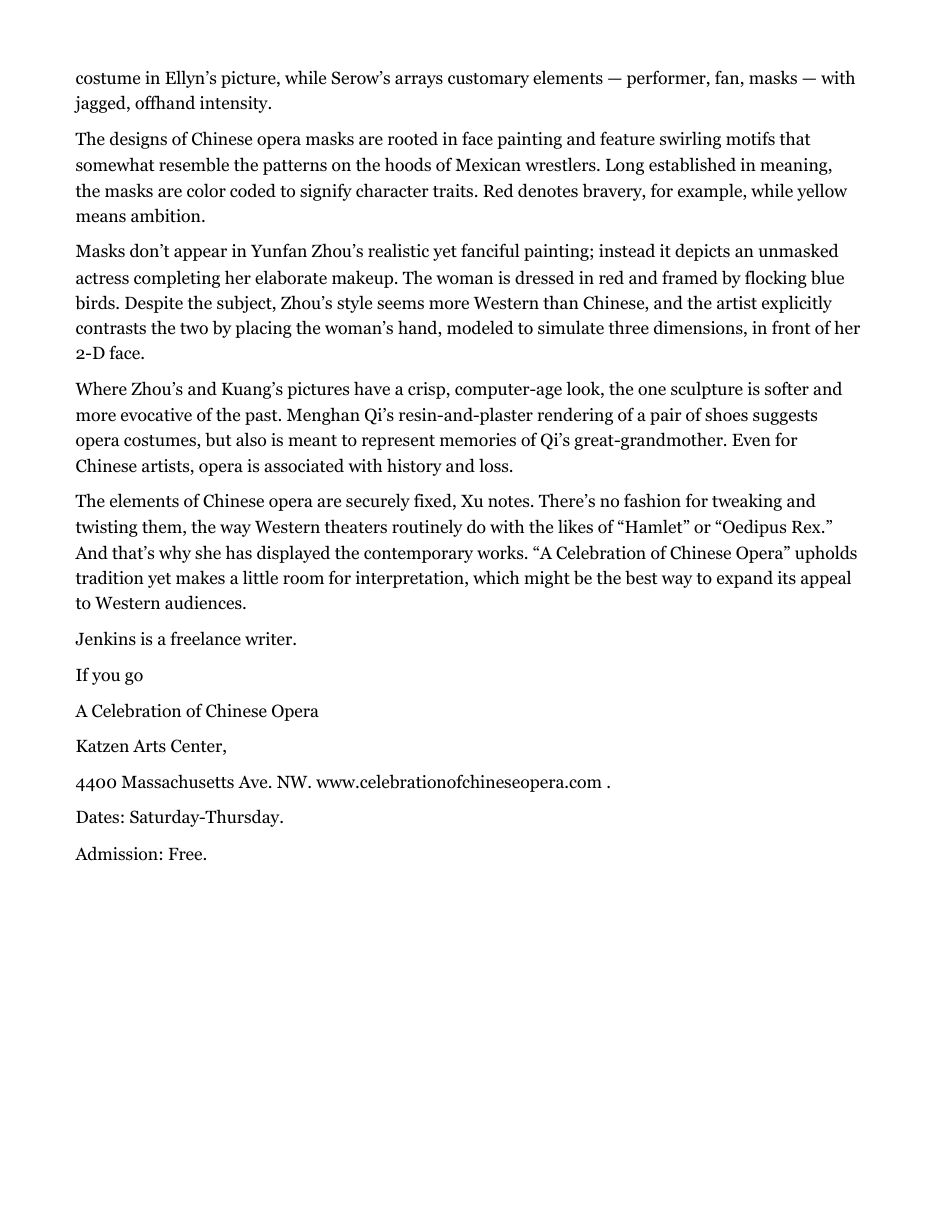
costume in Ellyn’s picture, while Serow’s arrays customary elements — performer, fan, masks — with jagged, offhand intensity.
The designs of Chinese opera masks are rooted in face painting and feature swirling motifs that somewhat resemble the patterns on the hoods of Mexican wrestlers. Long established in meaning, the masks are color coded to signify character traits. Red denotes bravery, for example, while yellow means ambition.
Masks don’t appear in Yunfan Zhou’s realistic yet fanciful painting; instead it depicts an unmasked actress completing her elaborate makeup. The woman is dressed in red and framed by flocking blue birds. Despite the subject, Zhou’s style seems more Western than Chinese, and the artist explicitly contrasts the two by placing the woman’s hand, modeled to simulate three dimensions, in front of her 2-D face.
Where Zhou’s and Kuang’s pictures have a crisp, computer-age look, the one sculpture is softer and more evocative of the past. Menghan Qi’s resin-and-plaster rendering of a pair of shoes suggests opera costumes, but also is meant to represent memories of Qi’s great-grandmother. Even for Chinese artists, opera is associated with history and loss.
The elements of Chinese opera are securely fixed, Xu notes. There’s no fashion for tweaking and twisting them, the way Western theaters routinely do with the likes of “Hamlet” or “Oedipus Rex.” And that’s why she has displayed the contemporary works. “A Celebration of Chinese Opera” upholds tradition yet makes a little room for interpretation, which might be the best way to expand its appeal to Western audiences.
Jenkins is a freelance writer.
If you go A Celebration of Chinese Opera Katzen Arts Center, 4400 Massachusetts Ave. NW. www.celebrationofchineseopera.com .
Dates: Saturday-Thursday.
Admission: Free.