Saved copy · 15 pages
Radio NABA 95.8 FM interview in Rīga (Art for Meat Tax festival)
Radio NABA 95.8 FM (Latvijas Universitāte) (Radio NABA morning show) · 2026-09-04 · original address
His live radio interview in Rīga on the opening day of the Art for Meat Tax festival.
Click a page to open it — scroll or pinch to zoom, drag to move, arrow keys for the next page.
Full text
Full text as published. Copyright remains with the original publisher; reproduced here for the historical record (machine-read pages may contain small errors — check the page images).
Radio NABA 95.8 FM interview in Rīga (Art for Meat Tax festival)
RADIO — Radio NABA 95.8 FM (University of Latvia's non-commercial station), Rīga, morning show, 4 September 2026. Guests: festival curator Katrīna Āboltiņa, Matt Sesow and Dana Ellyn. TRANSCRIPT — English captions from latvia.sesow.com (transcripts/radio_raw.txt), word for word. Lines marked [LV→EN] are translated from Latvian.
RADIO NABA — 4 September 2026 — English captions (translated where Latvian) Yellow in the video = translated from Latvian. White = spoken in English. [00:06] — translated from Latvian — [LV→EN] Well — let's call today's song the free version too. [LV→EN] Ministry, after thirty-odd years… [LV→EN] a little burned out, maybe.
[LV→EN] But we'll leave their problems to them.
[LV→EN] We have guests in the studio. Labrīt — good morning! [LV→EN] Good morning!
[LV→EN] So — who has come to see us?
[LV→EN] Hi, I'm Katrīna.
[LV→EN] I represent the festival Art for Meat Tax.
[LV→EN] There are three of us organizing it: Sandris Mūriņš, Roberta, [LV→EN] and me.
[LV→EN] This year we're holding the second Art for Meat Tax festival — [LV→EN] from this evening through Sunday, [LV→EN] at the creative factory Veldze.
[LV→EN] We have a huge, wonderful, beautiful exhibition in the Veldze [LV→EN] cellars, which are a very historic, [LV→EN] interesting place in themselves — [LV→EN] and a little spooky.
[LV→EN] If you come, wear good shoes — [LV→EN] it's pretty damp down there this time of year.
[LV→EN] The exhibition shows work by 27 artists from seven countries, [LV→EN] including Poland, Canada and New Zealand. [LV→EN] I won't name them all or I'll take up the whole broadcast. [LV→EN] There'll also be performances and lectures. [LV→EN] We're part of the White Night programme too, [LV→EN] so you can find us in the White Night listings, [LV→EN] or on Instagram: Gaļas nodoklis.
[LV→EN] And this year's special guest artists, [LV→EN] who came all the way from Washington just for our festival, [LV→EN] are Dana Ellyn and Matt Sesow — [LV→EN] here in the studio with me today.
[LV→EN] Sorry for doing your job — [LV→EN] I just wanted to introduce them.
[LV→EN] Thanks — less work for me!
[LV→EN] Let's talk with our guests.
[LV→EN] As it happens, in Washington most people don't speak Latvian, [LV→EN] so the interview will be in English, [LV→EN] and afterwards we'll try a short summary in Latvian. [02:05] — in English — So, the introductions have been made. Good morning. Good morning.
My name is Matt Sesow, from Washington, D.C., and with me is… Dana Ellyn, also from Washington, D.C. Amazing. Washington State is like the furthest away from Latvia as it can get, right? Yes.
No — actually, Washington, D.C. Oh, no. Yeah, Washington. No, but that is a common confusion people have. Yeah, so we're where the White House is. Yeah. You're from where the White House is. Yeah, yeah. Also D.C. It's like Latvia, Lithuania type of thing. Which one is which?
Yeah.
The other Washington has Seattle. I know. Yeah. Washington State.
Yeah. So we live and paint downtown in Washington, D.C., about four blocks from the White House.
Wow. — Yeah.
So when we paint, we sell our work online to people all over the world, when we're lucky.
And, you know, people buy our work.
And one of the cool things we do when we ship paintings out to the people who buy our work: we walk in front of the White House to get to the post office.
So it is actually on the way to send our work out. Most of the people on this planet can't say that they just stroll past the White House Because they have to get to the post office. Yeah, and one thing — well, I'm speaking for Dana here — But one of the things she really enjoys about going to the post office in the morning Is because there's always a lot of bomb-sniffing dogs out in front of the White House And they always like to come up and see what's in our packages. Yeah, you're not supposed to engage with them, but I can't help it. So I always give them that googly eyes. I look at them like, hello, it's a good doggy. Why do they look so friendly?
I think they're looking at me like I'm a nice snack. Would you consider using something in the paint to attract the dog?
I've thought about putting like hot dogs in my pockets. Okay. Yeah.
Do you have questions for them, maybe? Yes. Like, what kind of works can we see at this event? And yeah, what's the— —inspiration? Surely not just the hot dogs and dogs. — Although, you know, I don't think in this show I have a painting that does exactly that. But I'm sure I've painted those two things in one painting in the past. So my work — I've done a lot of paintings about animals and food culture for a lot of years.
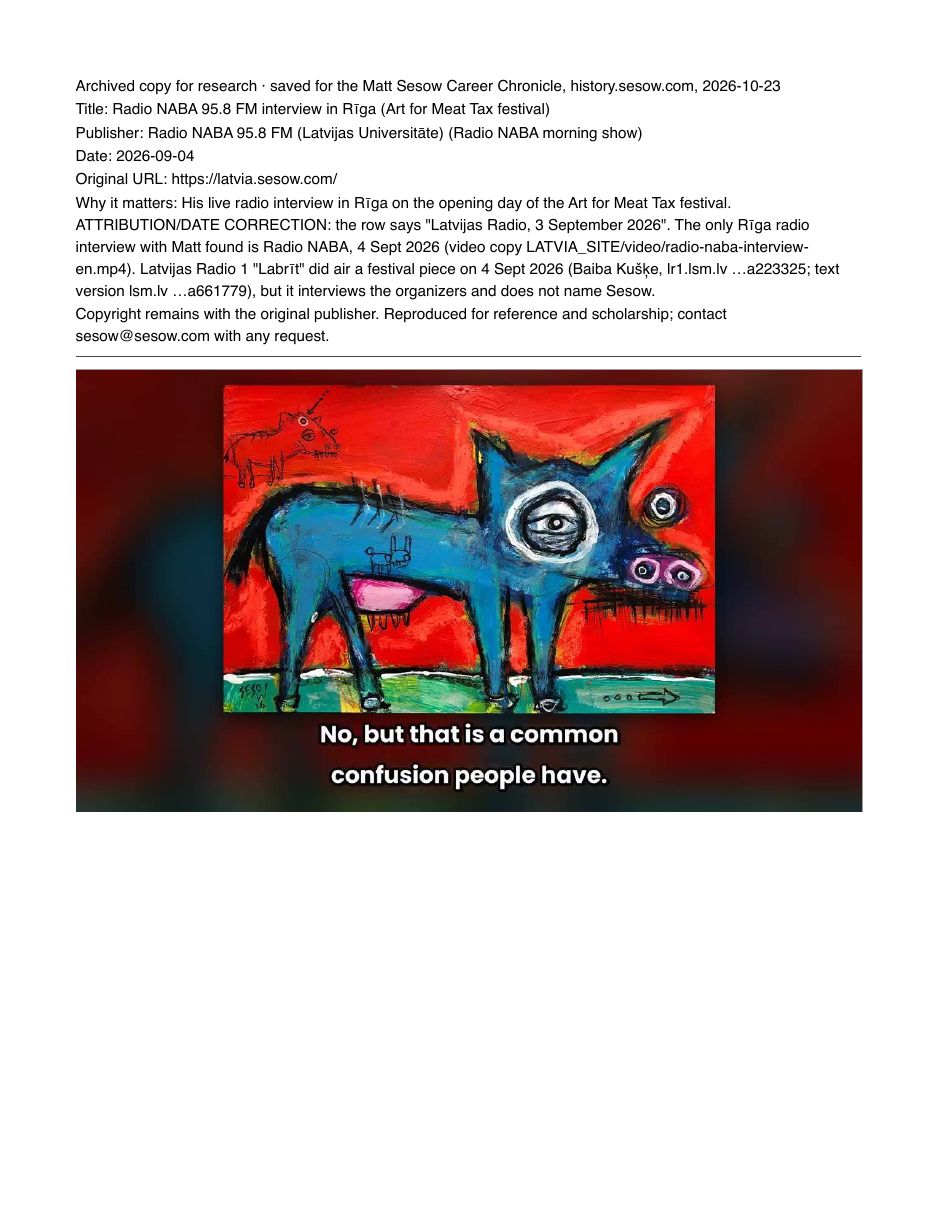
So I made a specific body of work for this show, focusing on— not specifically the meat tax, because that's not a subject for me to weigh in on as an American coming to Latvia.
But I had plenty of background painting animals, and how we see them, and how we treat animals differently depending on which animal it is. So, the whole idea of speciesism.
Say, putting a girl hugging a dog next to a girl hugging a pig and asking: what's the difference here? Why do we love one and eat the other?
That's kind of an underlying theme in a lot of my work. And for me — my work's fairly primitive. Sometimes people say, “Oh, my kid could do that.” So I do things like — I paint dogs.
You'll see some of my dogs in this exhibit.
And what I also did was look at some of the Latvian animal culture, and try to find some imagery here before I even got here, that I could paint in anticipation of what I was going to see. So I did the Bremen Town Musicians, from the statue — the rooster, the cat, the dog and the donkey. And then I also did one of grey peas — we bought the bag, but we haven't made them yet— —because we don't have grey peas in Washington, so we'll be doing those. So it's just a guy eating a bunch of grey peas.
And then I did some more Americantype things, about our culture of capitalism in America, and factory farming. So there's a Mr.
Monopoly guy with a whole bunch of animals around him. I tried to keep it pretty fun and pretty lighthearted. A lot of really bright colours.
I also included a few quotes, like from Kafka. So there's this picture of Kafka I painted, with his quote about being able to look fish in the eye, now that he won't be eating them. So nothing too hardcore with my stuff — even though I like to listen to hardcore.
So I really liked your music coming into the intro there. — Thank you. Along those lines — Matt talking about the grey peas.
In the research before we came — we've travelled together and shown in other countries, And I always like to look at their food culture.
So yeah, the grey peas were the first thing that came about, and then sprats on rye — and hearing that dill is in everything.
So these are things I'll carry forward. So when we did a show in Barcelona, for example I did a series of paintings similar to what I did here, but it was a little pig — a jamón — standing on tapas, so using the animal instead of the pieces of meat, and putting it into the food, depending on which country we're in.
I had something to say about food culture in China when we went there, too. There's always something to say. Definitely. The artwork, you make it at home, right?
And then you, how do you get it to the country that you're then visiting?
Do you carry it in your suitcase or do you ship it? You cross the White House and you go to the post office and ship it? Pretty much.
So, yeah, we paint and live in the same spot. So — I'm going to turn 60 in a couple of days, and I'll be, I think, up in the sky. Well, thank you.
I was saying it's because of the 30-plus years of vegetarianism.
But anyway — so we paint and live in the same spot. It's, I don't know what it would be in metres, but 800 square feet of living space.
I sleep in a bunk bed.
So we both live, you know, we live and paint together. Anyway, we make the work there,
and we bring it on the plane.
In the past, when we've done a show, we'd paint in the country before we hung the show. But this time we brought everything finished that we were hanging, put it in bags, and we just walked them in.
But one thing we're going to do while we're here: we brought a lot of art supplies — paper, paint. We even went and bought paint a couple of days ago here in the city — and we'll be painting while we're here. So we're going to take in a lot of what we see, the culture, and paint our experience while we're here, because we're here for about another week. — Oh yeah, that's quite some time.
Enough to get over the jet lag. — Yes.
And the things you plan to paint — maybe later this afternoon — will you exhibit them too, or will they travel on with you? — So, what we've done — because we have websites, and like I said, we sell most of our work online — we've set up a way to post work to our websites from here. So people back home are watching — and not just back home, but other states and other countries.
So we'll make them available immediately. I think I'm going to post some stuff later tonight.
We'll walk around, take
pictures — I might even paint something from this interview. Maybe a version of you guys, with your logo in the back. — Yeah! — If you see my work, you'll see it's not always the most realistic. — The joke when we compare our work: Matt captures the person, but then writes their name, with an arrow pointing — “this is John.” And then I can capture them exactly.
We have some work we do together — we call it DEFILED.
Typically Matt will start it and capture the essence of the person, and then I come in on top and firm up the details. And it always amazes me that even though at a glance one of Matt's paintings looks full-on loose and reckless — well, slightly reckless — when I work on top of it, he's got everything in exactly the right place for me to firm it up and make it look exactly like that person. Oh, thank you. Yeah.
I can make it easy for you guys.
So — Mārtiņš. For his name day — because Mārtiņš is a traditional Latvian name — in Latvian culture you would, I do apologise, kill a black rooster as an offering, right? And my name is Irbe, which is a bird name — partridge.
So you've got a rooster and a partridge, and we expect… So I'll tell you what: I'll do that, probably today or tomorrow.
And if you give me your email, I'll email you.
Let me know if you like it or not.
And if not, I'll just give it to you. Fantastic. Yeah. Sold. Did I hear it right?
If we don't like it, you'll give it to us? If you don't like it, I will give it to you as well. It's a threat! It'll still be okay — you can use it as a joke or something.
Don't threaten us with a good time.
Okay. But then, yeah, I might turn to you now in Latvian, to wrap it up a little.
[11:42] — translated from Latvian — [LV→EN] How do you find these artists — [LV→EN] how do you choose them and build the programme? [LV→EN] Do you go to biennials and look around, [LV→EN] or is there a public open call?
[LV→EN] Because you have seven artists in all this— [LV→EN] How do you put them together? Twenty-seven. [LV→EN] Twenty-seven, yes.
[LV→EN] How do you put them together?
[LV→EN] Well, we run with no budget at all — [LV→EN] it's pure activism, that's what drives us. [LV→EN] People often hear “Art for Meat Tax” [LV→EN] and it sounds scary straight away: they're going to take our [LV→EN] meat away? But really, the art here is more a metaphor for [LV→EN] overconsumption — [LV→EN] for the horror of it.
[LV→EN] This year's special theme is gluttony — [LV→EN] overconsumption.
[LV→EN] People buy, use, throw away so much food… [LV→EN] everything, everything.
[LV→EN] So, to answer: we put out open calls for artists, [LV→EN] both Latvian and foreign— [LV→EN] —in groups. The response this year was huge. [LV→EN] We couldn't even accept everyone, [LV→EN] because some didn't quite fit the concept— [LV→EN] —since the festival's core themes are health, [LV→EN] empathy and the environment.
[LV→EN] So there were artists who just didn't fit. [LV→EN] As for this year's special theme, gluttony — [LV→EN] honestly, we ended up with a bit too little art about it, [LV→EN] because most of the artists— [LV→EN] —the activist artists — [LV→EN] are like Dana: most often the empathetic ones, [LV→EN] who lean toward the animal side.
[LV→EN] So when people ask why the show is so full of animals — [LV→EN] well, what is meat, after all?
[LV→EN] That's how it turns out.
[LV→EN] There were very many applications, [LV→EN] and some artists we approached ourselves — [LV→EN] Dana among them.
[LV→EN] We knew of them.
[LV→EN] They're very modest — [LV→EN] they tell their story very modestly — but in truth— [LV→EN] —they are very well-known artists. [LV→EN] It's a huge honour for us.
[LV→EN] Matt says he paints “primitively” — [LV→EN] but he paints in an expressionist way, [LV→EN] a bit in the style of Basquiat— [LV→EN] —so no need to be so modest.
[LV→EN] And Dana paints realistically and expressively.
[LV→EN] So it's all very vivid.
[LV→EN] And yes, they're very well known.
[LV→EN] We reached out hoping they might at least send us something [LV→EN] we could print.
[LV→EN] And she said: “This subject feels so important to me — [LV→EN] we're coming.”
[LV→EN] I sat there for a while gripping the table, [LV→EN] then wrote back: “Do you understand we're a no-budget event?” — [LV→EN] “Yes, we understand. We're coming.”
[LV→EN] It was simply fantastic.
[LV→EN] We also reached out to Angela Singer, who is very, very famous — [LV→EN] I think one of the most controversial and famous [LV→EN] animal-rights artists in the world, if I can put it that way, [LV→EN] because she works with taxidermy.
[LV→EN] She sent us extremely high-quality prints of her taxidermy [LV→EN] works all the way from New Zealand.
[LV→EN] There were a few more artists we approached. [LV→EN] And of course I really want to mention our wonderful, [LV→EN] most famous Latvian activist artist, Katrīna Tračuma— [LV→EN] —who curated the exhibition for the first festival last year. [LV→EN] This year I took it over, because she had her biggest [LV→EN] retrospective ever — [LV→EN] the largest exhibition devoted to animal rights ever held in [LV→EN] the Baltics.
[LV→EN] I tried to help her with it too, but then we left her in [LV→EN] peace, and I took over running the whole process, [LV→EN] with a lot of help from Roberta, and together we searched for [LV→EN] artists. I'm probably talking too fast! [LV→EN] But I really feel the team we've gathered is wonderful — [LV→EN] both the people who applied and the ones we invited.
[LV→EN] The response this year was truly unexpected — [LV→EN] so thank you to Veldze, whose cellars have endless room. [LV→EN] Superb. So, to recap the main facts: you open today. [LV→EN] Today at six the festival opens with a lecture by Jānis [LV→EN] Brizga on the ecological footprint of our diets. [LV→EN] If you're interested, come and listen. [LV→EN] At seven there's a small opening gathering and the first [LV→EN] guided tour.
[LV→EN] Because I should add: since it's in the cellars, [LV→EN] we can't let people wander around as they please, [LV→EN] like in a gallery.
[LV→EN] So every 15–20 minutes, once enough people gather, [LV→EN] someone guides them and explains what's going on — [LV→EN] which matters, because it's a conceptual show. [LV→EN] Then tonight at eight there's the first performance, [LV→EN] and at nine a grunge-hardcore band, Dzemdes Skaudība, [LV→EN] who played Depo two nights ago.
[LV→EN] They formed the band especially for the festival — [LV→EN] and they were really, really good.
[LV→EN] Tomorrow the exhibition opens at 12, [LV→EN] and since it's White Night— [LV→EN] —we're open until half past midnight. [LV→EN] At two in the afternoon Matt and Dana give an artist talk, [LV→EN] then there are more lectures, and from six there are [LV→EN] performances in the cellar all evening. [LV→EN] Really interesting ones — [LV→EN] dance performances and experiential performances. [LV→EN] The programme is very, very full, because it's White Night. [LV→EN] On Sunday we're open from 11 to 7. [LV→EN] The exhibition is on view the whole time,
[LV→EN] with only a couple of events during the day — [LV→EN] but the closing one, a very interesting one, is Dana, [LV→EN] Matt and Katrīna Tračuma in a panel on how activist art [LV→EN] changes the world, moderated by Sandris Ādminis— [LV→EN] —which we're really happy about, because he's a huge [LV→EN] supporter of ours. Hi, Sandris!
[LV→EN] And — performances aside — [LV→EN] can someone buy the artworks?
[LV→EN] Does the money go on to NGOs or somewhere? [LV→EN] Or can I, as an ordinary person, walk in and think “I want [LV→EN] this one”? Is there any way to support you? [LV→EN] So — Matt has brought 21 paintings and Dana— [LV→EN] sorry, I'm mixing them up — [LV→EN] Matt has 14 paintings and Dana has 21.
[LV→EN] People can buy all of them, and the money goes entirely to [LV→EN] the artists, since they flew in from America. [LV→EN] That goes without saying.
[LV→EN] To support us, you'll be able to buy the prints we made [LV→EN] ourselves, since many artists sent their work that way. [LV→EN] As for the other artists' paintings — [LV→EN] well, we're not, how to put it, capitalists by nature. [LV→EN] We take no commission from the artists.
[LV→EN] You can deal with them directly, or always contact me if [LV→EN] something catches your eye.
[LV→EN] And I think we'll put out a donation box for anyone who [LV→EN] really wants to support us.
[LV→EN] A couple of friends donated money for the basics, [LV→EN] like printing.
[LV→EN] So once more: the guest artists' work is for sale. [LV→EN] Thank you, thank you, thank you!
[19:52] — in English — Let's wrap this up.
She had to do her specific job, which she did great, so we say a big thank you.
We have to move on with the next part. — Mārtiņš, yeah.
Thank you for coming. — Yes. — While we say our goodbyes — can I make a request? Can I request a song? — That'll be really complicated… only if you have— I've thought of the exact same thing! Oh — because we pre-program all of this. Okay. Maybe we'll call in later. Yeah, we'll call in later. That you can try, definitely.
I hope you'll like my choice.
It's going to be The Smiths. Oh, very good. I was going to request Fugazi — “Waiting Room.” They're from Washington, D.C.
Well, since it's on theme, I chose “Meat Is Murder.” Very good, very good.
I love it.
Really quick, too — from “Every Day Is Like Sunday.”
If you've ever seen the video for that, the girl is wearing a shirt that says “I don't eat my friends.”
And in the show, one of the paintings I did is of that T-shirt. So you picked the perfect song. Perfect — The Smiths. Thank you. Thank you.