A new interview with me from last week, check it out! https://systemagazine.wordpress.com/2026/06/04/in-conversation-with-matt-sesow/
Saved copy · 4 pages
In Conversation with Matt Sesow
the-System* magazine (systemagazine.wordpress.com) (the-System*) · 2026-06-04 · original address
Q&A on his painting process, the 1975 accident, and selling directly to collectors. Full text from the
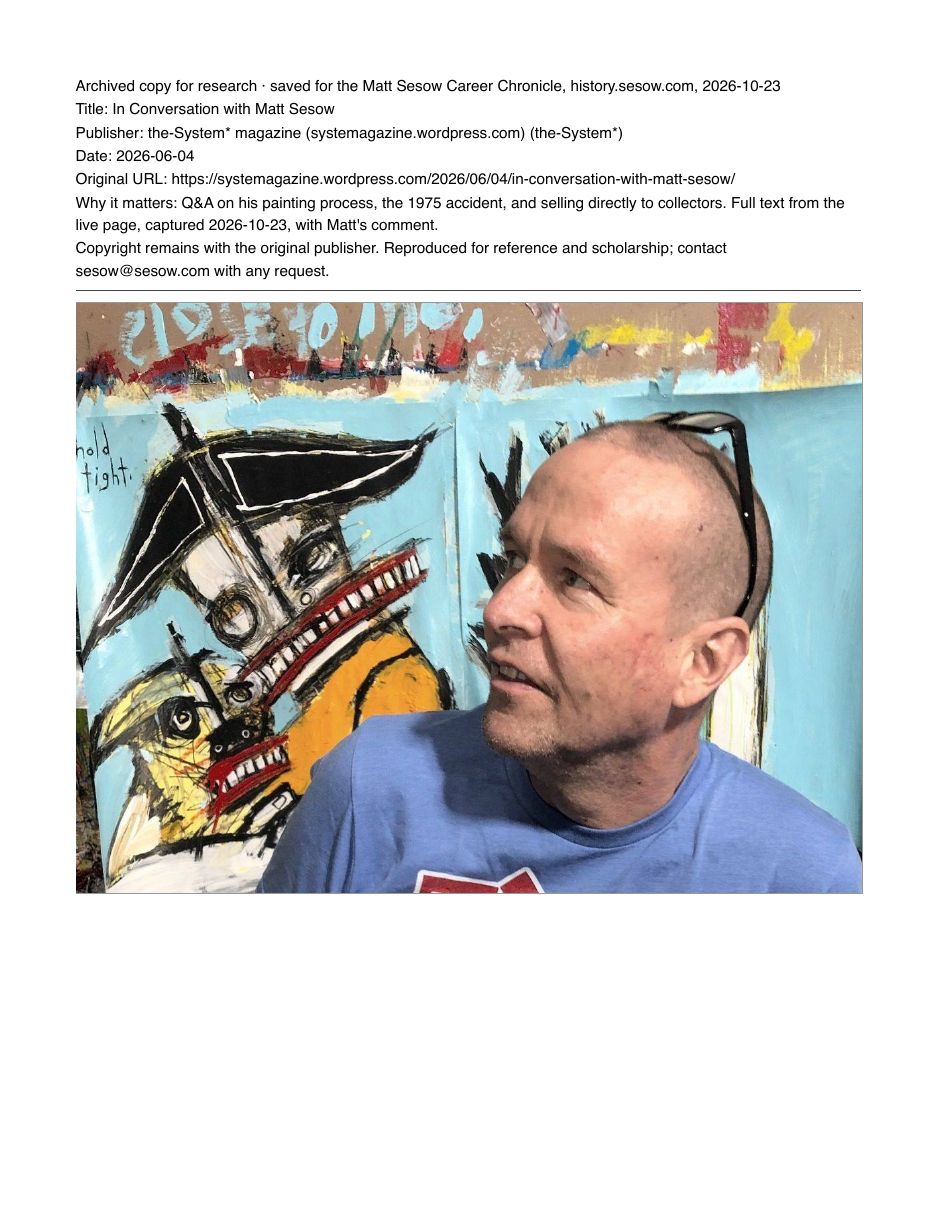
Click a page to open it — scroll or pinch to zoom, drag to move, arrow keys for the next page.
Full text
Full text as published. Copyright remains with the original publisher; reproduced here for the historical record (machine-read pages may contain small errors — check the page images).
In Conversation with Matt Sesow IN CONVERSATION WITH MATT SESOW Date: June 4, 2026 Author: the-System* 1 Comment Matt Sesow: “Most of my paintings happen in a single sitting/standing.. Overworking shows up as smoothness, as taste, as decisions that look like good ideas after the fact. I’d rather leave a painting a little raw than sand it into a decoration. “ MATT SESOW ON HIS UNIQUE PAINTING PROCESS AND SUBJECT MATTER, AND TURNING PERSONAL TRAGEDY INTO A LIFELONG, UNFILTERED ACT OF CREATION AND DIRECT CONNECTION WITH COLLECTORS Published Thursday , June 4 2026 | Matt Sesow the-System * Can you state your name and describe what you do?
Matt Sesow. I’m a self-taught painter based in Washington, DC. I’ve been making work since 1994, full-time since 2001, and I’ve sold over 17,000 original paintings directly to collectors in more than 40 countries. No gallery exclusives, no waiting list, no middlemen — new work goes up at new.sesow.com almost every week and ships straight from my studio. I share that studio with my wife, the painter Dana Ellyn (danaellyn.com). We’ve also been making collaborative paintings together since 2013 — nearly four hundred of them now — and that work lives at defiled.sesow.com.
That airplane accident at age eight changed everything. How directly does that single moment still show up in the energy, speed, or emotional tone of your paintings today?
I paint right-handed because my left arm ends at the elbow — a landing airplane took the rest of it in a Nebraska field in 1975 when I was eight. When I started painting in 1994, the accident was all over my canvases. For the first five years or so I painted about my feelings about having a disability. After that, I gained the confidence to take on meatier subjects like politics. In a real sense, the painting healed me a bit.
That single moment still sets the tempo, the speed, and the emotional tone of everything I do today. The figures show up fast and slightly off, like they don’t have time to compose themselves. The jagged teeth, the trauma cup, the small humans caught inside something much bigger — that iconography came out of me without permission and stayed. There’s an urgency and raw disruption in the energy that traces straight back to that day. We have all been hit by an airplane at some time in our lives — a moment that splits everything into before and after. Mine happens to
be literal. The painting is the after.
You’ve sold over 17,000 original paintings directly to collectors since the mid-90s. What’s the strangest or most meaningful thing someone has ever told you about how one of your works affected their life?
Sometimes I have the children of parents that have been collecting my work start collecting it themselves. They mention how they grew up looking at one or more for my paintings every day and now they want one in their home. That kind of story makes me very happy.
When you finish a piece in a short time, what tells you it’s done versus when you know you’ve overworked it?
Most of my paintings happen in a single sitting/standing.. Overworking shows up as smoothness, as taste, as decisions that look like good ideas after the fact. I’d rather leave a painting a little raw than sand it into a decoration. I try to leave a bit of myself in each piece. I can get bored with a painting if I work too long on it…. But to be honest, I love doing the larger pieces, and they take a long time and are challenging.
After all these years of painting almost every day, has the act of making art changed for you — does it still feel like survival, or has it become something else?
I had nightmares about the accident for nearly twenty years. They stopped in the late-90s, a handful of years after I started painting, and they have never come back. What’s left now is something steadier — a daily practice that doesn’t really negotiate with mood or weather or the news cycle. I get up, I paint, I post the new work, I ship the sold ones. Dana paints fifteen feet from me with tall bookcases between our working spaces. Some days I’ll try to paint what I call ‘my hits’ in order to make a sale or make available a popular painting that doesn’t currently exist in my inventory. Dana and I keep a spreadsheet that tracks our monthly sales/income so that we know if we are ahead or behind on our financial goals. When we are ‘ahead’ for the month, the painting is completely without stress… thankfully, that happens before the end of every month. Painting for a show or future exhibition keeps me focused on a theme or size of paintings. The survival part of my career was when I was able to paint non-stop for the first 25 years. Living a very simple life with few expenses and minimal social life… I painted in a 540 square foot apartment and slept in a bunk bed. I tore out the stove to make more room for painting storage, ate out of the same bowl every day and ‘cooked’ on a hotplate. Now I’ve graduated to living with my wife full-time in an 850 sq foot place. Although I am still sleeping in a bunk bed at the age of 60. Now I really only have time for painting and Dana,, I paint a little bit less because I have now realized that I need to get all the shows and paintings documented on the internet so that people new to my work can see my accomplishments from the past 33+ years.
If someone asked you why you never stopped — , even after decades of painting — what would your honest answer be right now?
Nothing else has ever held my attention this long. I tried a normal life — computer degree, IBM, Netscape, AOL, the suit and the badge, the whole nineties-tech version of a future. I enjoyed programming growing up and the creating of new programs on my own. I suppose it was a form of painting when I taught myself to code as a kid, but doing it for money wasn’t fun. I didn’t discover painting until I was 28. I love the challenge of trying to create something off the top of my head and being dependent on it to pay the bills. A huge risk, but it has made me work 10x harder than I ever did in the corporate world… and I am very happy now. And finally , When someone looks at one of your drawings and feels something strong — maybe unease, recognition, or relief — what do you secretly hope is happening inside them? I hope they recognize something in themselves that they haven’t been able to name. I don’t really know how or why I paint most of the time. It has become a natural thing and something that I have to do. I guess the paintings are like poetry in that I hope something subtle in what I create is understood and may have different meanings to different people.
COMMENTS:
ONE THOUGHT ON “IN CONVERSATION WITH MATT SESOW”
Matt Sesow June 4, 2026 at 6:25 pm Thank you very much for sharing! Everybody/Anybody that is interested in seeing my latest work. please check out NEW.SESOW.COM