Press 2003
Las Vegas Mercury review compares work to Grosz, Bacon and Munch
Newspaper article · 2003-09-11
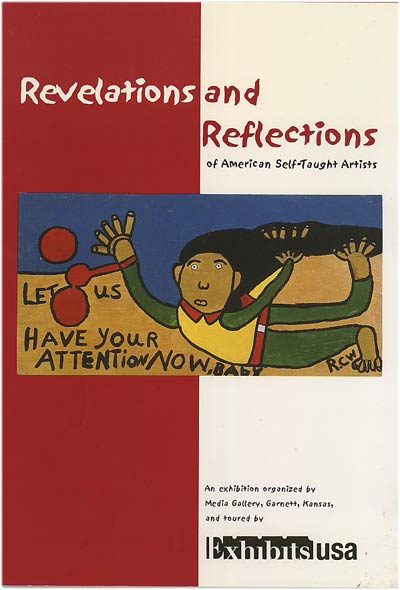
Art: Revelations and reflections
Las Vegas Mercury
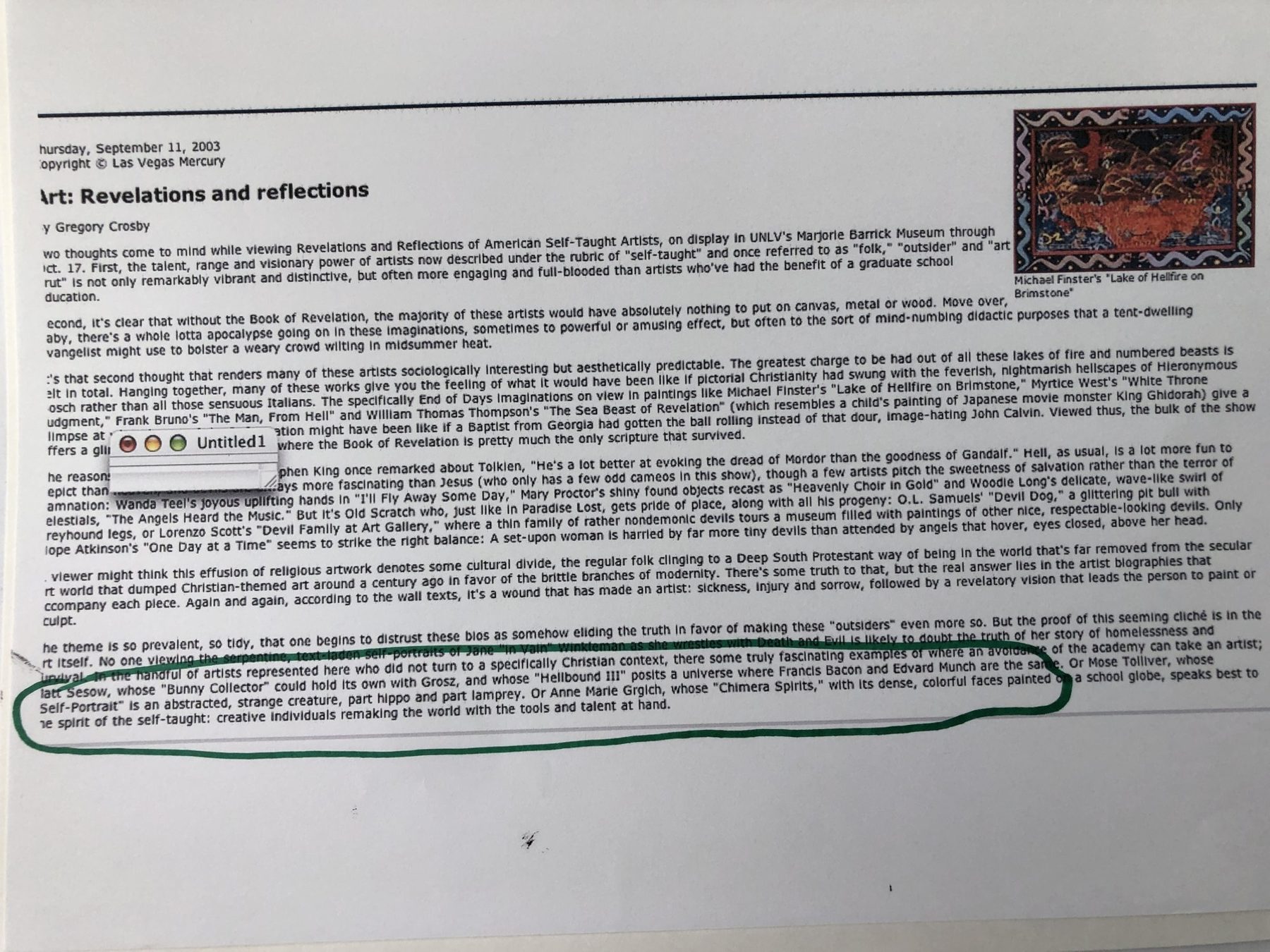
Click a page to open it — scroll or pinch to zoom, drag to move.
Full text
Photographed by Matt Sesow from his press packets, October 18, 2026; text transcribed from the photos by Claude.
Thursday, September 11, 2003
Copyright © Las Vegas Mercury
Art: Revelations and reflections
By Gregory Crosby
Two thoughts come to mind while viewing Revelations and Reflections of American Self-Taught Artists, on display in UNLV's Marjorie Barrick Museum through Oct. 17. First, the talent, range and visionary power of artists now described under the rubric of "self-taught" and once referred to as "folk," "outsider" and "art brut" is not only remarkably vibrant and distinctive, but often more engaging and full-blooded than artists who've had the benefit of a graduate school education.
Second, it's clear that without the Book of Revelation, the majority of these artists would have absolutely nothing to put on canvas, metal or wood. Move over, baby, there's a whole lotta apocalypse going on in these imaginations, sometimes to powerful or amusing effect, but often to the sort of mind-numbing didactic purposes that a tent-dwelling evangelist might use to bolster a weary crowd wilting in midsummer heat.
It's that second thought that renders many of these artists sociologically interesting but aesthetically predictable. The greatest charge to be had out of all these lakes of fire and numbered beasts is felt in total. Hanging together, many of these works give you the feeling of what it would have been like if pictorial Christianity had swung with the feverish, nightmarish hellscapes of Hieronymous Bosch rather than all those sensuous Italians. The specifically End of Days imaginations on view in paintings like Michael Finster's "Lake of Hellfire on Brimstone," Myrtice West's "White Throne Judgment," Frank Bruno's "The Man, From Hell" and William Thomas Thompson's "The Sea Beast of Revelation" (which resembles a child's painting of Japanese movie monster King Ghidorah) give a glimpse at [obscured by a computer window] ation might have been like if a Baptist from Georgia had gotten the ball rolling instead of that dour, image-hating John Calvin. Viewed thus, the bulk of the show offers a gli[obscured] where the Book of Revelation is pretty much the only scripture that survived.
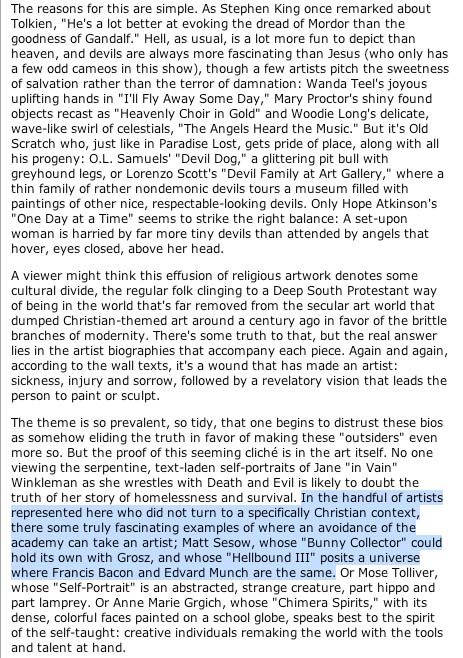
The reason[obscured] Stephen King once remarked about Tolkien, "He's a lot better at evoking the dread of Mordor than the goodness of Gandalf." Hell, as usual, is a lot more fun to depict than [obscured] ays more fascinating than Jesus (who only has a few odd cameos in this show), though a few artists pitch the sweetness of salvation rather than the terror of damnation: Wanda Teel's joyous uplifting hands in "I'll Fly Away Some Day," Mary Proctor's shiny found objects recast as "Heavenly Choir in Gold" and Woodie Long's delicate, wave-like swirl of celestials, "The Angels Heard the Music." But it's Old Scratch who, just like in Paradise Lost, gets pride of place, along with all his progeny: O.L. Samuels' "Devil Dog," a glittering pit bull with greyhound legs, or Lorenzo Scott's "Devil Family at Art Gallery," where a thin family of rather nondemonic devils tours a museum filled with paintings of other nice, respectable-looking devils. Only Penelope Atkinson's "One Day at a Time" seems to strike the right balance: A set-upon woman is harried by far more tiny devils than attended by angels that hover, eyes closed, above her head.
A viewer might think this effusion of religious artwork denotes some cultural divide, the regular folk clinging to a Deep South Protestant way of being in the world that's far removed from the secular art world that dumped Christian-themed art around a century ago in favor of the brittle branches of modernity. There's some truth to that, but the real answer lies in the artist biographies that accompany each piece. Again and again, according to the wall texts, it's a wound that has made an artist: sickness, injury and sorrow, followed by a revelatory vision that leads the person to paint or sculpt.
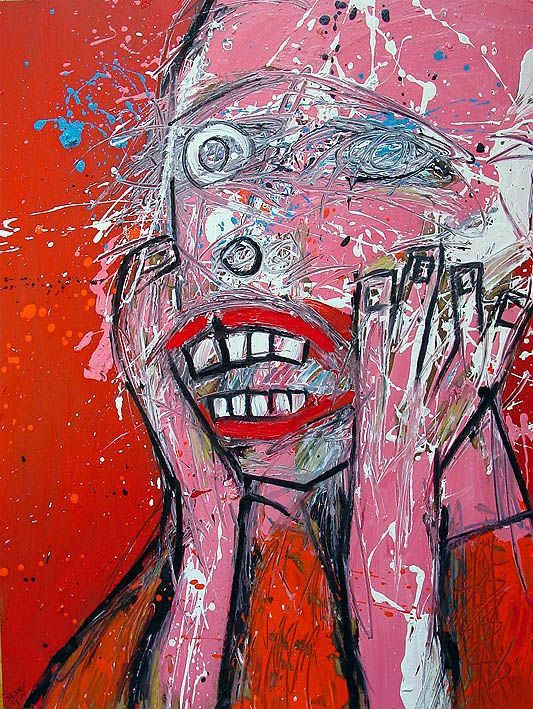
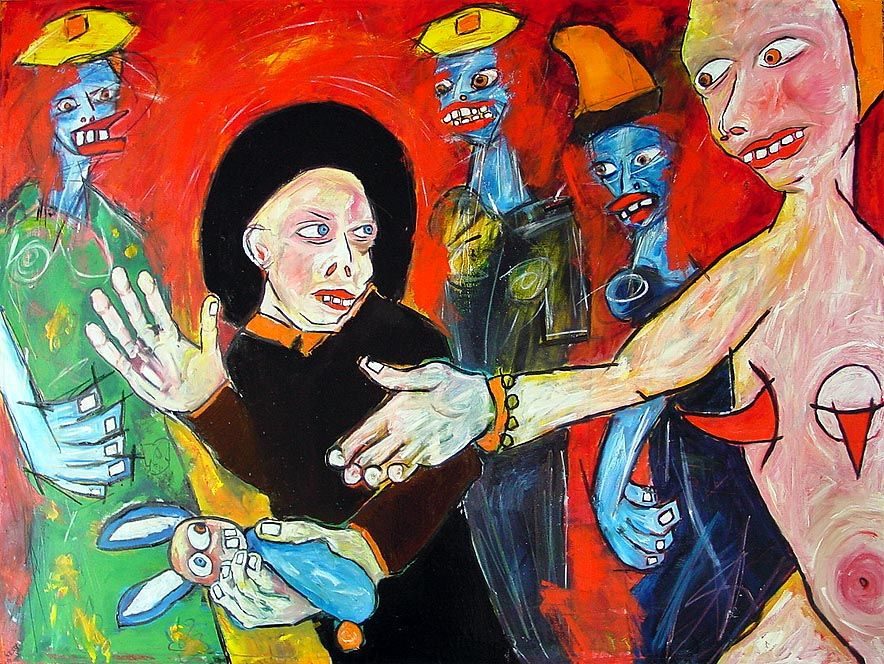
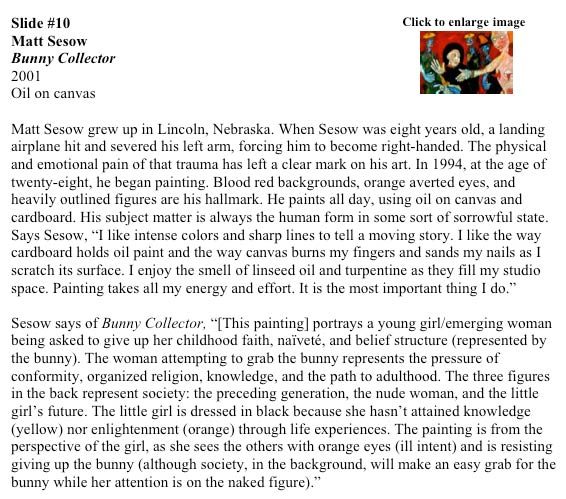
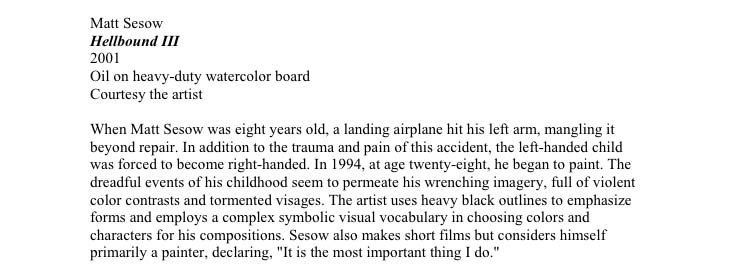
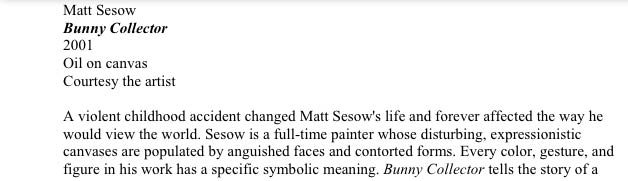
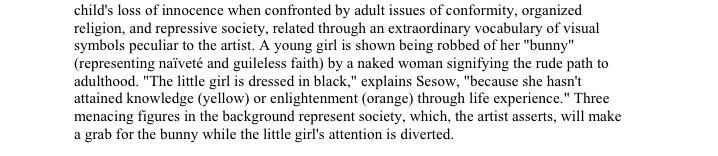
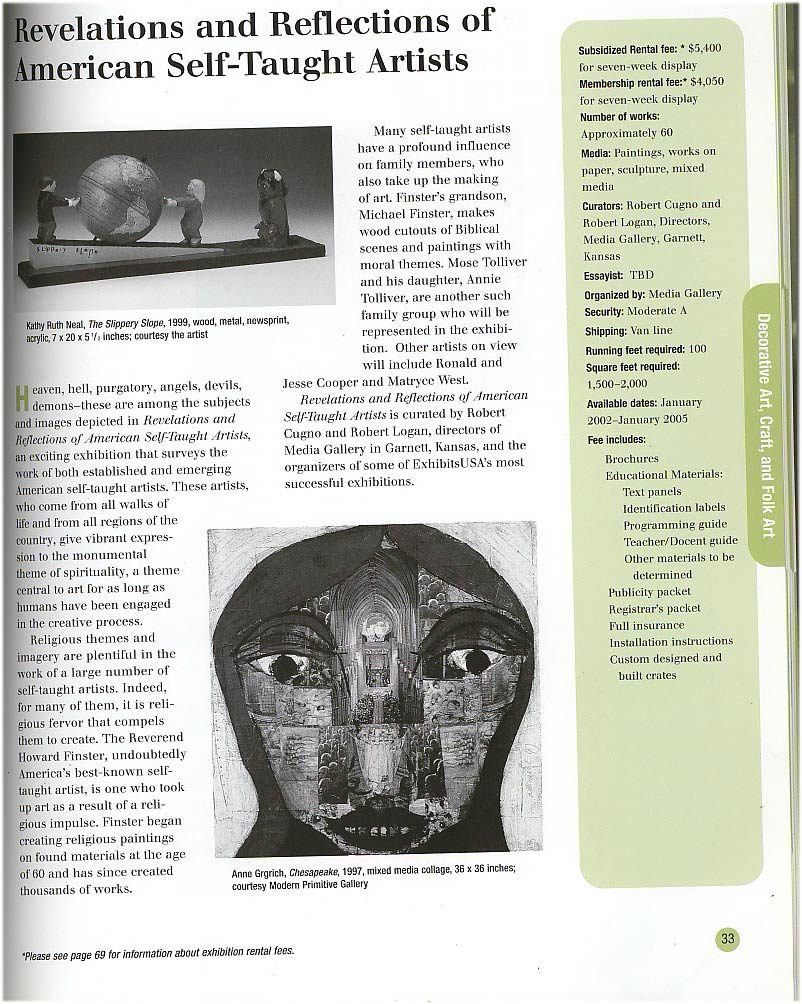
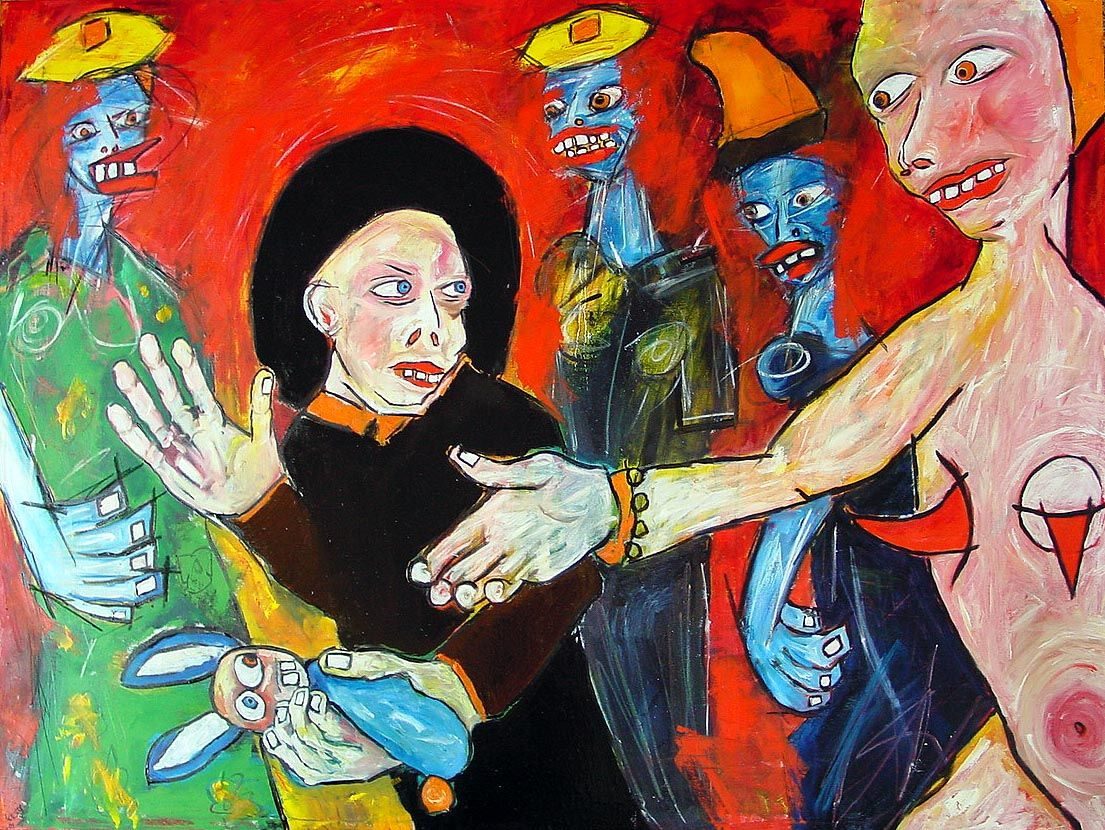
The theme is so prevalent, so tidy, that one begins to distrust these bios as somehow eliding the truth in favor of making these "outsiders" even more so. But the proof of this seeming cliché is in the art itself. No one viewing the serpentine, text-laden self-portraits of Jane "In Vain" Winkleman as she wrestles with Death and Evil is likely to doubt the truth of her story of homelessness and survival. In the handful of artists represented here who did not turn to a specifically Christian context, there some truly fascinating examples of where an avoidance of the academy can take an artist; Matt Sesow, whose "Bunny Collector" could hold its own with Grosz, and whose "Hellbound III" posits a universe where Francis Bacon and Edvard Munch are the same. Or Mose Tolliver, whose "Self-Portrait" is an abstracted, strange creature, part hippo and part lamprey. Or Anne Marie Grgich, whose "Chimera Spirits," with its dense, colorful faces painted on a school globe, speaks best to the spirit of the self-taught: creative individuals remaking the world with the tools and talent at hand.
[Caption:] Michael Finster's "Lake of Hellfire on Brimstone"
Pictures · click to enlarge


From the press archive
Research notes
- Artists listed on this newspaper article (Art: Revelations and reflections): Anne Marie Grgich, Frank Bruno, Jane "In Vain" Winkleman, Lorenzo Scott, Mary Proctor, Michael Finster, Mose Tolliver, Myrtice West, O.L. Samuels, Penelope Atkinson, Wanda Teel, William Thomas Thompson, Woodie Long.
Where this record comes from
- history.sesow.com (live, 2026-10-03)
- history.sesow.com (live, 2026-10-11)
- sesow.com/revelation.htm and press/2k2 scans (Las Vegas Mercury 9/11/2003; Brickman review; labels; slide #10; ExhibitsUSA catalog p.33)
- Matt Sesow press packet (photographed by Matt, 2026-10-18)
Cite as: Sesow, Matt. “Las Vegas Mercury review compares work to Grosz, Bacon and Munch.” Matt Sesow Career Chronicle, 2003. history.sesow.com/e/2003-las-vegas-mercury-review-compares.html. Accessed [date].
Were you there? Do you have a photo, a clipping or a memory of this? Please write to sesow@sesow.com or use Ask Matt a question, and it will be added here.
Also in 2003
Exhibition (23)
- Southern Ohio Museum, Portsmouth, OH
- Mandeville Gallery, Nott Memorial, Union College, Schenectady, NY
- UNLV Marjorie Barrick Museum, Las Vegas, NV
- “Art Against War,” Grand Atrium, Majlis Cultural Center, Mumbai
- “Political Bodies,” Seattle, WA
- Residency as visiting artist, Ciudad Colon, Costa Rica
- Stage set — five large painted canvases for the play “F**king Wasps”
- B-Side group show — Adams Morgan, Washington, DC
- Sesow showing in Lincoln — University Place Art Gallery
- Nisk-Art Gallery, Schenectady, NY
- Guest Artist — Kentuck Festival, Tuscaloosa, AL
- The Ottobar, Baltimore, MD, over 20 works
- Aroma, Cleveland Park, Washington, DC, 30+ works
- “A Really Big Show,” Results Gallery with WPA/Corcoran, Washington, DC
- “The Art of Conflict,” national juried exhibition, 57 N Fine Art
- “POV,” ARTOCONECTO national juried exhibition, 1701 Kalorama Road NW
- OCCOA at CDW Gallery, 30th and M Street, Georgetown, Washington, DC
- Kalorama Emerging Artists Fair, 1711 Kalorama Road NW, Washington, DC
- “Love and Eroticism,” juried exhibition, Khoja Gallery, Arlington, VA
- Capital Region Art Center, Albany, NY
- Guest Artist — 10th annual Folk Fest 2003, North Atlanta Trade Center
- “March Madness” shown in “Art Against War”
- SoWeBo Festival 2003, Hollins Market, Baltimore
Press (9)
- Washington City Paper on “31 Days in July” (2003)
- “…31 days in july…” — Get Underground feature (2003)
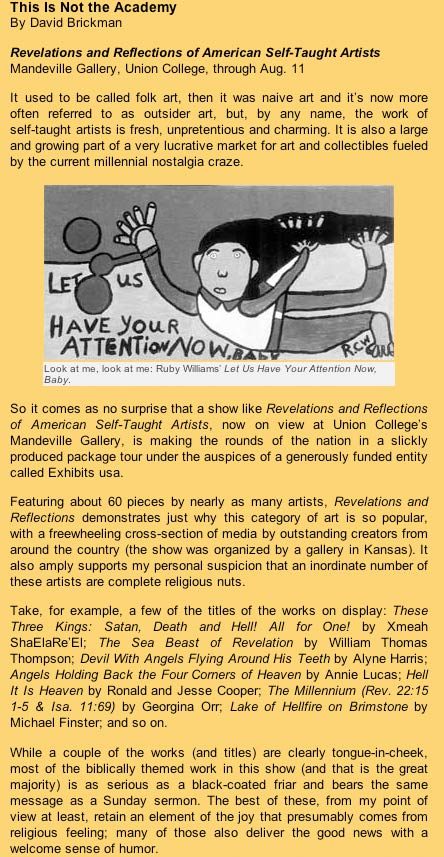
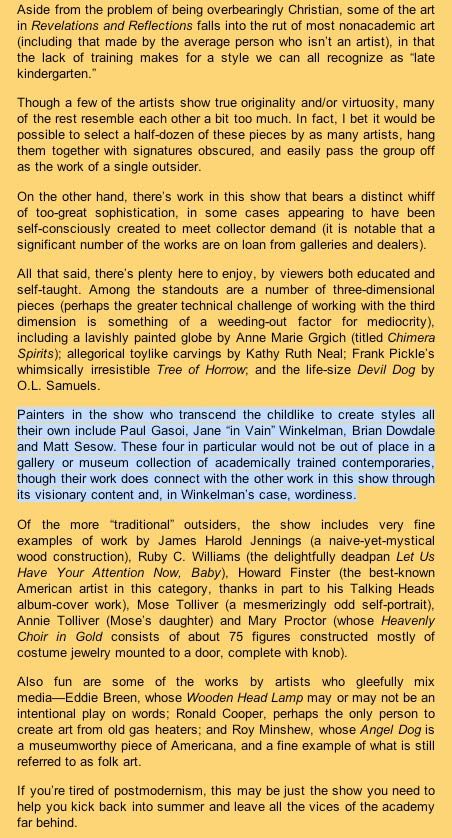
- David Brickman, “This Is Not the Academy”
- Interview with “The Palette”
- Article in “Artesian” Magazine
- Compass Magazine — cover and feature article
- Coagula Magazine — review of Theatre of NOTE production
- The Warrior — “Nisk-Art Gallery holds unique exhibit” by Alex
- OutsiderArt.info — online exhibition “Matt Sesow...WAR,” about two